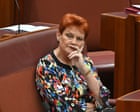
The censure of Senator Pauline Hanson serves as a high-fidelity diagnostic tool for mapping the internal pressures of the Australian Senate and the brittle nature of party-line cohesion. While media narratives often focus on the emotional or social friction of the event, a structural analysis reveals that the 2022 censure motion was less an act of moral arbitration and more an exercise in institutional signaling. The motion, passed 39 to 7, functioned as a stress test for the Coalition’s unified opposition strategy, exposing a calculated divergence between the Liberal and National parties regarding the threshold for formal parliamentary reprimand.
The Anatomy of the Censure Mechanism
In the Australian Westminster system, a censure motion is the strongest symbolic tool available to the chambers of Parliament. It possesses no legal force and does not trigger the loss of a seat or salary; instead, it operates as a reputational tax. The utility of this tax is measured by its ability to isolate the subject from the legislative mainstream. When the Senate voted to censure Hanson for her comments directed at Senator Mehreen Faruqi, the objective was to re-establish the boundaries of "parliamentary conduct" without the cumbersome process of a Section 44 challenge or a suspension of service. Don't forget to check out our recent article on this related article.
The effectiveness of this signaling depends entirely on the breadth of the consensus. A near-unanimous vote suggests a unified moral front; a split vote, however, identifies a Strategic Fault Line.
The Tripartite Logic of the Coalition Holdout
The refusal of the vast majority of Coalition senators to back the motion—despite the public nature of the comments—was not an endorsement of the rhetoric, but a defense of three specific procedural and political precedents. To read more about the background here, Reuters offers an informative breakdown.
- The Threshold of Content vs. Conduct: The Coalition argued that the Senate should not act as a "speech police" for interpersonal disputes, even those involving racial or religious sensitivities. By setting the bar for censure at "conduct that disrupts the business of the chamber" rather than "speech that offends a subset of the chamber," the Coalition attempted to preserve a high-friction environment for debate.
- The Precedent of Proportionality: Conservative strategists viewed the censure as a disproportionate escalation. In their framework, if every offensive remark triggered a formal motion, the legislative calendar would be subsumed by performative grievances. This creates a Slippery Slope Externality where the value of a censure is diluted through over-application.
- Constituency Alignment: For many Liberal and National senators, particularly those in Queensland and Western Australia, the risk of alienating One Nation’s preference flow outweighs the benefit of a symbolic vote with the Labor-Green bloc. The decision to abstain or vote against was a move to protect the Preference Ecosystem that sustains conservative seat counts in the lower house.
The Divergence of Smith and Bragg: Internal Fracture Analysis
The most significant data point in this event was the breaking of ranks by Liberal Senators Dean Smith and Andrew Bragg. Their decision to vote with the government indicates a breakdown in the Unified Opposition Model.
This divergence can be quantified through a Values-based Risk Assessment:
- The Urban Liberal Constraint: Senators Bragg and Smith represent cohorts within the Liberal Party that are increasingly vulnerable to "Teal" or progressive-leaning independents. In these electorates, the cost of appearing to defend or ignore exclusionary rhetoric is higher than the cost of breaking party discipline.
- The Governance Paradox: By voting for the censure, these senators signaled that the Liberal Party’s brand must be decoupled from One Nation to survive in high-education, high-income metropolitan areas. This creates an internal friction point with the "Inland National" faction, which views such concessions as a surrender to identity politics.
The Labor-Green Coalition: Consolidating the Moral High Ground
For the Albanese government and the Greens, the motion was a low-cost, high-reward tactical play. By bringing the motion to the floor, they forced every member of the Coalition to go on the record. This creates a permanent Voter Memory Asset that can be deployed in future election cycles.
The strategy followed a clear Information Asymmetry path:
- Selection: Isolate a comment that is objectively indefensible to the median voter.
- Force: Present a binary choice (Censure or No Censure).
- Extraction: Extract a "No" vote from the opposition, which can then be framed as "Tacit Approval" in campaign materials.
The Labor party’s management of the motion successfully moved the goalposts of the debate from the specific words used by Hanson to the character of those who refused to condemn her. This is a classic Framing Pivot, where the subject of the analysis shifts from the perpetrator to the observers.
Measuring the Efficacy of Parliamentary Reprimand
Does a censure actually change behavior? Historically, the data suggests a Diminishing Return on Censure. For a politician like Pauline Hanson, whose entire political identity is built on the concept of being an "outsider" or a "victim of the elite," a censure motion is not a deterrent—it is a Validation Mechanism.
From a branding perspective, Hanson’s "us vs. them" narrative is reinforced by the sight of the Labor, Green, and moderate Liberal senators voting against her. The censure provides her with:
- Earned Media: Millions of dollars in equivalent advertising value through news coverage.
- Base Consolidation: A tangible example of "cancellation" to present to her donor base.
- Defiance Capital: The ability to claim she is the only one "telling it like it is" while the rest of the Senate attempts to silence her.
The Systemic Failure of Self-Regulation
The Senate’s inability to reach a unanimous consensus on a matter of basic conduct reveals a systemic failure in the chamber's self-regulatory framework. When the rules of engagement are no longer agreed upon, the chamber ceases to function as a deliberative body and begins to function as a Bifurcated Echo Chamber.
This lack of consensus leads to a Regulatory Vacuum. If the Senate cannot agree on what constitutes unacceptable speech, the power to "police" the chamber shifts away from the President of the Senate and toward the court of public opinion. This transition from internal rules to external pressure increases the volatility of the political environment, as senators become more responsive to social media trends than to the Standing Orders.
Strategic Optimization for Future Motions
To restore the utility of the censure motion, the Senate must move toward an Objective Harm Metric. Currently, censures are viewed as partisan tools. To de-politicize the process, the chamber would need to establish clear, pre-defined triggers for censure that are independent of the specific political context of the day.
- Quantitative Triggers: Repeated violations of specific standing orders within a single session.
- The Independent Arbiter Model: Referring potential censures to a non-partisan ethics committee before they reach the floor for a vote, thereby stripping the motion of its "ambush" quality.
The 2022 censure was a missed opportunity for a structural reset. Instead of reinforcing the standards of the Senate, it reinforced the existing tribal boundaries. The Coalition’s refusal to participate in the "moral theater" of the government was a tactical success in the short term, but it further eroded the institutional weight of the Senate as a collective body.
The path forward for the Coalition requires a decisive choice: either formalize a distance from One Nation that allows for consistent voting on conduct issues, or accept the reputational drag that comes with the "Preference Ecosystem." The current middle ground—allowing two senators to cross the floor while the rest abstain—is an unstable equilibrium that satisfies neither the base nor the broader electorate. The only viable strategic play is the development of a Code of Parliamentary Standards that is co-authored by the opposition, removing the government’s ability to use the censure as a partisan weapon while maintaining a clear line of demarcation against fringe rhetoric.