France maintains the only independent nuclear deterrent in the European Union, a posture defined by the doctrine of "strict sufficiency." Unlike the massive overkill capacities maintained during the height of the Cold War by the United States and Russia, the French model operates on a logic of proportional deterrence. The objective is not to win a nuclear exchange but to make the cost of aggression against France’s "vital interests" unacceptably high relative to any potential gain. This strategy relies on two distinct technical layers: the Oceanic Force (FOST) and the Strategic Air Forces (FAS).
The Dual-Component Architecture
The effectiveness of the French deterrent is measured by its survivability and its flexibility. The architecture is intentionally redundant to ensure that a first strike cannot decapitate the nation's ability to respond.
Oceanic Force (FOST): The Guarantee of Second-Strike Capability
The FOST consists of four Triomphant-class ballistic missile submarines (SSBNs). At any given moment, at least one submarine is on a continuous at-sea patrol, hidden in the depths of the Atlantic. This component provides the ultimate insurance policy. If the French mainland were destroyed, the SSBN remains a silent, mobile launch platform capable of delivering a devastating counter-strike.
- Platform Specification: Each Triomphant-class vessel carries 16 M51 ballistic missiles.
- Vector Performance: The M51 missile is a three-stage rocket with a range exceeding 6,000 kilometers, capable of carrying multiple independently targetable reentry vehicles (MIRVs).
- Operational Cycle: With four hulls, the Navy ensures one is at sea, one is preparing for patrol, one is in training/return, and one is undergoing long-term maintenance.
Strategic Air Forces (FAS): The Logic of Graduated Escalation
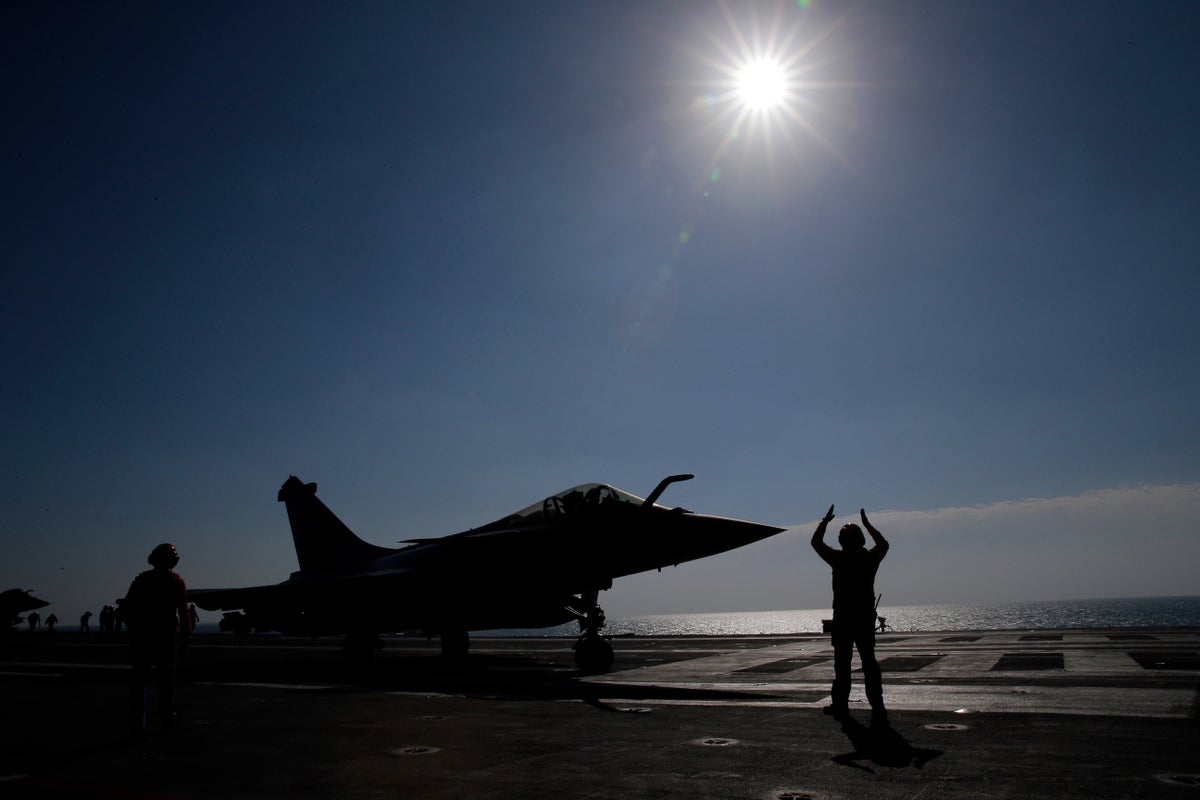
While the submarines offer stealth and mass, the airborne component—utilizing Rafale B fighters equipped with the ASMPA (Air-Sol Moyenne Portée Amélioré) supersonic missile—offers visibility and political signaling. Unlike a submarine launch, which is binary and final, the deployment of nuclear-capable aircraft can be tracked by an adversary. This allows the French Presidency to demonstrate resolve during a crisis without crossing the nuclear threshold immediately.
The ASMPA missile travels at speeds exceeding Mach 3, using a ramjet engine to penetrate sophisticated integrated air defense systems (IADS). Its primary role is the "final warning" (l'ultime avertissement)—a single, limited strike intended to restore deterrence by signaling that the next step will be total strategic engagement.
The Calculus of Strict Sufficiency
The French budget for nuclear modernization is not a discretionary expense but a structural requirement of their "Strategic Autonomy" policy. The Loi de Programmation Militaire (LPM) 2024-2030 allocates approximately 13% of the total defense budget to the nuclear mission. This investment is categorized into three functional streams:
- Warhead Evolution: Transitioning from the TNA (Tête Nucléaire Aéroportée) for missiles on planes to the TNO (Tête Nucléaire Océanique) for submarine-launched missiles. These warheads are designed using simulation technology rather than live testing, following the 1996 Comprehensive Nuclear-Test-Ban Treaty.
- Platform Modernization: The development of the third-generation SSBN (SNLE 3G) to replace the Triomphant class starting in the 2030s.
- Vector Upgrades: The development of the M51.3 missile and the future ASN4G (Air-Sol Nucléaire de 4ème Génération), a hypersonic missile designed to outpace evolving mid-century missile defense technologies.
Defining Vital Interests in a Multi-Polar Context
The most significant ambiguity in French doctrine is the definition of "vital interests." President Emmanuel Macron has updated this discourse to suggest that the "European dimension" of these interests is becoming more pronounced. While the decision to use nuclear weapons remains a strictly national prerogative of the French President, the security of France is inextricably linked to the stability of the European Union.
This creates a deliberate "strategic ambiguity." By refusing to draw a hard line on what constitutes a vital interest, France forces an aggressor to weigh the risk that a conventional attack on a NATO or EU ally might trigger a French nuclear response.
The Technical Constraints of Nuclear Sovereignty
France’s ability to maintain this posture depends on a closed-loop industrial base. Unlike the United Kingdom, which utilizes American-made Trident missiles on British hulls, France designs, builds, and maintains the entire kill chain—from the nuclear reactors powering the submarines to the guidance systems of the missiles.
- Propulsion: TechnicAtome manages the naval nuclear reactors.
- Aerospace: Dassault Aviation (Rafale) and ArianeGroup (M51) provide the delivery vectors.
- Warheads: The CEA (Commissariat à l'énergie atomique) manages the physics and materials.
This independence removes any "dual-key" or "veto" power from foreign entities, ensuring that the French deterrent is credible even if international alliances shift.
The Vulnerability Matrix
No defense system is absolute. The French deterrent faces three primary technical and geopolitical bottlenecks:
- Submarine Detection Breakthroughs: Advances in quantum sensing and satellite-based wake detection could theoretically make the oceans "transparent." If the FOST loses its stealth, the entire logic of second-strike capability collapses.
- Hypersonic Proliferation: While France is developing the ASN4G, the arrival of hypersonic glide vehicles (HGVs) in the arsenals of adversaries reduces decision-making time for the French executive, potentially forcing a "use it or lose it" scenario that increases the risk of accidental escalation.
- The Economic Burden: As the cost of maintaining high-tech conventional forces rises, the fixed cost of the nuclear deterrent creates "crowding out" effects within the French military, potentially weakening the conventional threshold and making the nation more reliant on nuclear threats for minor provocations.
Strategic Pivot: The Extended Deterrence Proposal
The current geopolitical trajectory suggests France will transition from a purely national deterrent to a de facto European security umbrella. To execute this without diluting the credibility of the force, the French administration must establish a formalized "strategic dialogue" with European partners. This does not involve sharing the launch codes, but rather coordinating conventional maneuvers with nuclear signaling.
The move toward the SNLE 3G and the ASN4G ensures that France remains technically capable of bypassing future missile shields. However, the true value of the French deterrent in the next decade will be measured by its ability to provide a "sovereign alternative" to the US nuclear umbrella, particularly if American isolationism increases. The strategic play is to integrate French nuclear logic into a broader European "Defense of the Continent" framework, positioning France as the indispensable guarantor of regional security.
Operational readiness must prioritize the hardening of communication nodes (C3I) against cyber and electronic warfare, as the "brain" of the deterrent is now more vulnerable than the "muscles" of the missiles themselves.