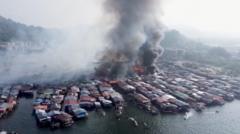
The pre-dawn sky over Sandakan, Sabah, was not lit by the sun this morning, but by a catastrophic inferno that has effectively erased a community. At approximately 1:30 AM on April 19, 2026, a fire ignited within the dense, wooden labyrinth of Kampung Bahagia, a "water village" comprised of homes built on stilts over the Celebes Sea. Within hours, 1,000 homes were reduced to charred pylons, displacing over 9,000 residents and leaving a gaping hole in the region's social fabric.
While drone footage circulating on social media provides a haunting bird’s-eye view of the orange glow reflecting off the tide, it fails to capture the systemic failure that made this tragedy inevitable. This was not a random act of nature. It was the predictable result of urban neglect, architectural vulnerability, and a geography that actively fights against emergency response.
The Architecture of Disaster
To understand why 1,000 homes can vanish in a single night, one must look at the structural reality of Sabah’s coastal settlements. These villages are a feat of informal engineering, but they are also a perfect fuel source. Thousands of wooden dwellings are connected by narrow, winding planks that serve as the only arteries for movement. When a single kitchen fire or electrical short occurs, these bridges act as fuses, carrying the flames from one home to the next with terrifying efficiency.
The Sandakan Fire and Rescue Department arrived within minutes, but they were met with a physical impossibility. Fire engines, designed for paved roads and hydrants, are useless in a community where the "roads" are three-foot-wide wooden walkways.
The logistical nightmare deepened with the tide.
Firefighters often rely on the very water the houses sit above, using portable pumps to draw from the sea. However, the blaze coincided with a low tide. The water had retreated, leaving nothing but mud flats beneath the burning stilts. Without an accessible water source and with strong coastal winds whipping the flames, the 37 personnel on-site were forced to watch as the fire followed its own path.
The Stateless and the Invisible
The headline figures—1,000 homes, 9,000 people—obscure a much darker humanitarian reality. Many residents of these water villages are part of Sabah’s "invisible" population: indigenous groups and stateless individuals who lack formal documentation. For these families, the loss of a home is not just a loss of property; it is a total erasure of their existence.
When a documented citizen loses a home, there are insurance claims, government grants, and digital records to fall back on. For a stateless resident of Kampung Bahagia, the fire likely consumed their only proof of life and history. This complicates the recovery efforts spearheaded by Prime Minister Anwar Ibrahim’s administration. Providing aid to a population that technically does not exist on a census requires a level of bureaucratic flexibility that the Malaysian government has historically struggled to maintain.
The relief centers currently set up in Sandakan schools are at capacity. The immediate focus is on food and medical care for smoke inhalation, but the secondary crisis is already brewing. Where do you rebuild 1,000 homes for a community that the state has spent decades trying to formalize or relocate?
The Drone Dilemma
We are seeing a new phenomenon in disaster journalism: the "spectacle of the drone." High-resolution aerial footage has turned the Kampung Bahagia fire into a viral moment, yet this technology remains curiously absent from the actual firefighting process.
While hobbyists use drones to capture "cinematic" views of the destruction, the Fire and Rescue Department lacks the integrated thermal-imaging drone fleets necessary to navigate these fires in real-time. In a dense water village, smoke makes ground-level visibility zero. Thermal drones could identify the leading edge of a fire and the hottest structural clusters, allowing commanders to deploy their limited portable pumps with surgical precision.
Instead, the technology is used for post-mortem analysis rather than life-saving intervention. We are watching the tragedy in 4K, but we are still fighting it with 20th-century tools.
Beyond the Embers
This is the third major water village fire in Sabah in the last six months, following a late-night blaze in Tawau’s Kampung Sri Aman last December. Each time, the narrative is the same: narrow access, low tide, wooden structures, and "investigations ongoing."
The investigation into Kampung Bahagia will likely point to an electrical fault or an unattended stove. But the true cause is the continued existence of high-density, flammable settlements in areas that cannot be reached by modern emergency services. Urban planners have long advocated for fire-breaks—physical gaps between clusters of stilt houses—and the installation of specialized dry riser systems that don't rely on sea levels.
These solutions require significant investment in infrastructure for communities that are often viewed as temporary or illegal. Until the government decides that the lives in Kampung Bahagia are worth the cost of permanent, fire-resistant infrastructure, the drone footage of the next fire is already being pre-rendered by the conditions on the ground.
The smoke over Sandakan will eventually clear, but for the 9,000 people standing in the mud today, the fire hasn't ended. It has just moved into its next phase: the slow, silent struggle of the displaced.