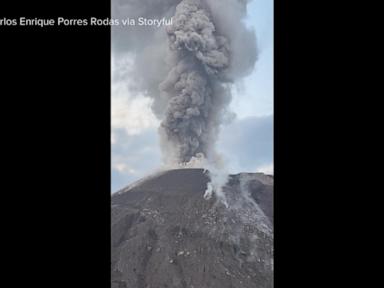
The viral footage of hikers scrambling down the ash-choked slopes of Guatemala’s Volcán de Fuego is more than just a brush with death captured on a smartphone. It is a symptom of a broken global tourism model. When Fuego erupts, sending pyroclastic flows screaming down its ravines, the people in the restricted zone aren't just unlucky victims. They are participants in a high-stakes, unregulated industry that prioritizes social media clout over human life. The reality is that these hikers were never supposed to be there, yet local economic pressures and a lack of government enforcement ensure that the "restricted" status of the crater remains a suggestion rather than a rule.
The Illusion of Safety in the Red Zone
Fuego is one of the most active volcanoes on the planet. It doesn't just rumble; it breathes fire with a frequency that makes it a goldmine for tour operators in nearby Antigua. For years, the standard excursion has been a trek up the neighboring Acatenango, which provides a stunning, relatively safe view of Fuego’s tantrums from across a saddle. But as the market for "extreme" content has saturated, the demand for closer proximity has bypassed logic.
Travelers are now paying "freelance" guides to lead them directly onto the shoulders of Fuego itself. This isn't mountaineering. It is a gamble against geophysics. A pyroclastic flow—a searing cloud of gas and volcanic matter—can move at speeds exceeding 100 miles per hour. There is no running away from it. The hikers seen in recent videos survived by the grace of wind direction and sheer statistical luck, not through any tactical retreat.
The problem starts with the maps. Official boundaries drawn by INSIVUMEH, Guatemala's seismic and volcanic institute, are clear. There is a permanent danger zone where entry is strictly forbidden. However, on the ground, these boundaries are invisible. There are no fences in the highlands. There are few rangers. For a local guide who hasn't seen a steady paycheck since the last tourism dip, the extra fifty dollars promised by a thrill-seeking foreigner to "get closer" is a powerful incentive to ignore the warnings.
Economic Desperation Meets Influencer Hubris
To understand why people risk being incinerated for a 15-second clip, you have to look at the economic machinery of the region. Antigua is a postcard-perfect colonial city, but the villages clinging to the base of the volcanoes tell a different story. In places like San Juan Alotenango, the volcano is both a god and a grocery store. When the coffee harvests fail or prices drop, the volcano is the only reliable source of income left.
Local guides are often caught in a pincer movement. On one side, they face the threat of legal action from the government if they are caught in restricted areas. On the other, they face the very real threat of starvation if they don't cater to the increasingly dangerous whims of international tourists. This has created a "gray market" of volcano trekking.
The Rise of the Rogue Guide
Legitimate tour companies generally stick to the Acatenango base camps. They have reputations to protect and insurance to maintain. But the rise of independent platforms has allowed uncertified guides to market directly to tourists. These operators often lack radio equipment, first aid training, or any understanding of volcanology beyond knowing which way the wind usually blows.
They sell the "authentic" experience, which is often code for "unregulated and dangerous." When a tourist asks to go to the "knife-edge" ridge of Fuego, these guides say yes because if they don't, the next guy will. This creates a race to the bottom where safety is the first casualty.
The Psychology of the Shot
We have to address the elephant in the room: the camera. Modern travel has been reduced to a series of trophies. The more "forbidden" the location, the higher the social currency. This creates a feedback loop where viewers see someone standing near an erupting vent and think it’s a standard, accessible activity. They don't see the dozens of times that same ridge was hit by lethal debris just hours before the camera started rolling.
The Failure of Institutional Oversight
Guatemala's government is in a difficult position. The country lacks the resources to station a permanent police force on the side of a mountain that is actively trying to kill anyone who stands on it. Beyond that, there is a fear that "cracking down" too hard will stifle the tourism revenue that the country desperately needs.
The result is a policy of reactive warnings. After a close call or a minor tragedy, the government issues a stern press release. They might block a trail for a week. Then, the heat dies down, the ash settles, and the guides return to the restricted zones.
This cycle is a blueprint for a larger disaster. In 2018, Fuego’s massive eruption killed hundreds of people in the lower villages. The tragedy was fueled by a breakdown in communication and an underestimation of the volcano’s power. If the authorities cannot protect the permanent residents living at the base, the idea that they can monitor transient hikers on the upper slopes is a fantasy.
Technical Limitations of Monitoring
Monitoring a volcano isn't like checking the weather. Even with the best sensors, Fuego is erratic. It can go from rhythmic, small puffs to a catastrophic collapse of the lava dome in minutes.
- Seismic Sensors: These detect the movement of magma, but they can't predict the exact moment a flank will fail.
- Infrasound: This helps track the intensity of explosions, but by the time the sound reaches the sensors, the debris is already airborne.
- Satellite Imagery: Useful for long-term trends, but useless for a hiker in the path of a sudden flow.
The technology exists to warn people, but it doesn't matter if those people have intentionally walked into the line of fire.
The Hidden Cost to First Responders
Every time a group of hikers gets stranded or caught in an eruption, it isn't just their lives on the line. Local rescue teams—often volunteers like the Bomberos Voluntarios—are forced to head into the danger zone to pull them out. These rescuers are frequently under-equipped, working with boots that melt on the hot ground and masks that don't properly filter volcanic gases.
There is a profound arrogance in requiring a local father of four to risk his life because a visitor wanted a better angle for their vlog. When we talk about "adventure travel," we rarely discuss the labor of the people who have to clean up when the adventure goes wrong. The moral weight of these rescues is shifted entirely onto the locals, while the tourists return home with a "crazy story" and a few thousand new followers.
Redefining the Volcano Experience
If we want to stop the body bags from coming off the mountain, the industry needs a hard reset. It starts with the platforms. Travel sites and social media companies need to stop surfacing content that clearly shows illegal and life-threatening behavior in restricted volcanic zones.
Next, the local government needs to transition from "restricted" zones to "enforced" zones. This doesn't mean arresting every hiker, but it does mean holding the tour organizers and the foreign agencies that book them financially and legally responsible. If a company is found to be leading groups into the red zone, their license shouldn't just be suspended; it should be revoked permanently.
Education Over Ego
We need to move away from the "conquering the volcano" narrative. Volcán de Fuego is a geological process, not a backdrop. Respecting the mountain means staying at a distance that allows for survival when—not if—it decides to change its mood.
True expertise in the mountains isn't about how close you can get to the edge; it's about knowing when the edge is no longer a safe place to be. The hikers who ran for their lives weren't brave. They were lucky. And in the world of volcanology, luck is a finite resource that eventually runs out.
The next time you see a video of someone standing on the rim of an active volcano, don't hit the like button. You are looking at a future casualty and the exploitation of a local community that will be left to mourn when the ash finally catches up.