The sea has a way of reclaiming what is hers. Walk down to any yacht club or marina where the luxury hulls bob in their expensive slips, and you will see the frontline of an endless, silent war. It is fought with gray slabs. Huge, monolithic walls of concrete and stone stand guard, intended to keep the waves from chewing away at the dry land we’ve claimed for our parking lots and clubhouses.
For decades, we viewed these seawalls as a triumph of engineering. They are sturdy. They are efficient. They are also dead.
To a human eye, a flat concrete seawall looks clean. To a fish, a crab, or a cluster of seaweed, it is a vertical desert. There are no crannies to hide from a predator. There are no shaded pockets to escape the blistering midday sun. There is nothing to hold onto when the tide rushes in with the force of a freight train. We built these barriers to protect our interests, but in doing so, we created a biological "no-fly zone" that stretches for thousands of miles across our global coastlines.
But at a quiet bend in the shoreline, the gray is beginning to turn green.
The Architect of the Intertidal Slum
Consider a hypothetical resident of this concrete coastline named Elara. She isn’t a person; she’s a mottle-brown crab the size of a coin. In a natural environment—a rocky shoreline sculpted by millennia of erosion—Elara would have a palace. She’d spend her days tucked into a deep, damp crevice, waiting for the tide to bring a buffet of microscopic nutrients.
When we replace that jagged rock with a smooth seawall, Elara’s world vanishes. She is exposed. The sun bakes the flat surface until it reaches temperatures that would kill her in minutes. The waves hit the flat wall and bounce back with doubled energy, a phenomenon called "wave reflection" that scours the seabed and makes it impossible for anything to take root.
We essentially built a high-rise with no stairs, no rooms, and no shade, then wondered why the neighborhood went quiet.
The Royal Prince Alfred Yacht Club didn't want to just patch a hole in a fence. They looked at their aging seawall and saw an opportunity to apologize to the water. The project wasn't about aesthetics; it was about "Living Seawalls." This isn't a brand name or a catchy slogan. It is a fundamental shift in how we inhabit the edge of the world.
Engineering the Nooks and Crannies
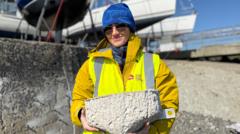
The transformation started with 3D printers.
It sounds like science fiction—printing a reef—but the logic is deeply grounded in the ancient patterns of the ocean. Instead of flat blocks, engineers and marine biologists designed hexagonal panels that mimic the complex geometry of nature. Some look like the tangled roots of a mangrove forest. Others resemble the honeycomb structures of a beehive or the deep ridges of a brain coral.
These aren't decorations. They are life support.
When you bolt these panels onto a dead seawall, the physics of the shoreline changes instantly. The ridges break up the force of the incoming waves, scattering the energy instead of reflecting it. This protects the structure itself, but more importantly, it creates "micro-habitats."
Think of it as the difference between a glass window and a bookshelf. If you throw a handful of seeds at a window, they slide off and die on the floor. If you throw them at a bookshelf, they find a home between the volumes.
Within weeks of installation, the "bookshelf" of the new seawall starts to fill up. First come the pioneers: the biofilms and algae. They coat the concrete in a slippery, living skin. Then come the filter feeders—the oysters and mussels. These are the unsung heroes of the harbor. A single adult oyster can filter up to 50 gallons of water a day. By giving them a place to stand, we aren't just "beautifying" a yacht club; we are installing a massive, solar-powered water filtration plant.
The Invisible Stakes of a Silent Coast
Why should a person living five miles inland care about a few crabs at a yacht club?
Because the ocean doesn't end at the high-tide mark. The health of our harbors is the literal foundation of our coastal economies and our mental well-being. When a harbor becomes a biological desert, the water turns murky. The fish disappear. The smell of decay replaces the scent of salt spray.
There is a psychological weight to a dead coast. We go to the water to feel connected to something vast and pulsing with life. When we stand on a pier and look down into a gray, empty void, we feel that loss, even if we can't name it.
The "Marine Makeover" is a proof of concept for a future where our infrastructure doesn't just "do no harm," but actually heals. For years, the conversation around environmentalism was focused on conservation—saving what was left. That’s no longer enough. We have built over so much of the natural world that we must now learn the art of "reconciliation ecology." We have to invite nature back into the spaces we’ve already taken.
A New Kind of Luxury
The yacht club is a place of prestige, but the most valuable thing it now offers isn't the dockage or the dining room. It’s the return of the tide.
Imagine a child leaning over the railing of the new seawall. Instead of seeing a boring, barnacle-crusted slab of grey, they see a vertical garden. They see the tiny, translucent shrimp darting in and out of the "mangrove" panels. They see the vibrant greens and deep purples of seaweed swaying in the current. They see the life that was always trying to be there, finally given a chance to hold on.
This isn't a localized miracle. It’s a blueprint.
From the massive harbors of Sydney to the crumbling piers of New York and the sprawling docks of Singapore, we are surrounded by millions of miles of "dead" infrastructure. Every single foot of it is a missed opportunity. If we can turn a yacht club wall into a flourishing rock pool, we can do it for the bridge pylons, the storm drains, and the coastal highways.
The cost of these panels is a rounding error in the budget of a major construction project. The "invisible cost" we’ve been paying is the silence of our shorelines.
We spent a century trying to beat the ocean into submission with flat walls and brute force. We tried to draw a hard line between "us" and "them," between the dry world and the wet one. But the sea is patient. She will always find the cracks.
The brilliance of the "living seawall" is that it stops fighting the water and starts dancing with it. It accepts the salt, the surge, and the spray. It understands that a wall doesn't have to be a tombstone. It can be a cradle.
As the sun sets over the Royal Prince Alfred Yacht Club, the tide begins its slow, rhythmic climb. The hexagonal panels disappear beneath the surface, one by one. And in the dark, cool pockets of the printed stone, thousands of tiny hearts begin to beat, hidden in the safety of the world we finally remembered to build for them.
The gray scar is gone. The wall is breathing.