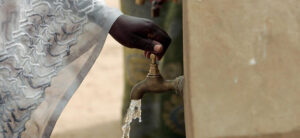
Consider a woman named Amina. She does not exist in a vacuum, but she represents millions. Every morning, long before the sun begins to bake the red dust of her village in the Sahel, she wakes to a silence that is heavy with a specific kind of anxiety. It is the anxiety of the empty jerrycan.
For Amina, the grand resolutions made in mirrored high-rise buildings in Addis Ababa or New York are not documents. They are not "pivotal" moments in diplomacy. They are ghosts. To her, the "Africa We Want" is not a political manifesto; it is simply a day where her daughter doesn't have to miss school to help carry thirty pounds of water on her head. It is a day where the water doesn't carry the invisible predators of cholera or dysentery.
We talk about infrastructure as if it were a matter of concrete and steel. We are wrong. Infrastructure is the difference between a life of possibility and a life of survival.
The Geography of Thirst
Africa sits on a paradox. The continent possesses vast groundwater reserves, enough to shrug off the droughts that are becoming increasingly frequent and cruel. Yet, nearly 400 million people in sub-Saharan Africa lack access to basic drinking water. Even more—roughly 700 million—live without decent sanitation.
Statistics are easy to ignore because they are numbing. Let us look closer at the mile.
When a community lacks a local well, the burden falls almost exclusively on women and girls. This is the "hidden tax" of water scarcity. Every hour spent walking to a distant, often contaminated stream is an hour stolen from an education, a business, or rest. When we fail to provide sanitation, we aren't just failing an engineering goal. We are trapping a generation in a cycle of physical exhaustion.
The water is heavy. A standard jerrycan holds about 20 liters. That weighs 20 kilograms, or roughly 44 pounds. Imagine walking three miles with a large microwave oven balanced on your head, every single day, twice a day. Now imagine doing that while you are pregnant, or while you are recovering from a fever.
This is the physical reality behind the dry reports on "service delivery."
The Silent Cost of a Missing Latrine
If water is the lifeblood, sanitation is the shield. Yet, it remains the awkward sibling of the development world. People like talking about sparkling taps; they rarely want to talk about toilets.
But consider the dignity of a young girl reaching puberty in a school that has no private bathroom. She faces a choice: risk her safety and health by using an open field, or simply stay home. Many choose to stay home. Eventually, they drop out.
The lack of sanitation is a silent thief of potential. It is estimated that Africa loses about 5% of its GDP annually to the consequences of poor water and sanitation—lost productivity, healthcare costs, and premature deaths. This isn't just a humanitarian issue. It is a massive, continent-wide economic hemorrhage.
We see the headlines about tech hubs in Nairobi or the booming film industry in Lagos. Those are real. They are exciting. But they are built on a foundation that is dangerously thin if the workers in those cities are still battling water-borne illnesses that were eradicated in other parts of the world a century ago.
The Myth of the Silver Bullet
There is a common misconception that this problem can be solved by a single, massive wave of foreign aid. A "celebrity well," as some locals call it—a high-tech pump installed with fanfare that breaks down six months later because no one in the village was trained to fix it or has the parts to do so.
Real progress is slower, grittier, and far less photogenic.
It looks like "circular economy" water management. It looks like local entrepreneurs being empowered to treat and sell water at prices that are fair but sustainable. It looks like governments moving past the "announcement" phase and into the "maintenance" phase.
The resolution for "The Africa We Want" (Agenda 2063) is a beautiful vision. It imagines a continent where every citizen has the right to clean water and a toilet. But to get there, we have to stop treating water as a charity project and start treating it as the primary engine of development.
In many African nations, the budget for water and sanitation is a fraction of what is spent on the military. This is a choice. It is a choice to prioritize the defense of borders over the survival of the people within them.
The Sound of the Tap
When water finally arrives in a village—not as a temporary gift, but as a permanent utility—everything changes. The atmosphere shifts.
The children are cleaner, yes. The clinics see fewer cases of "the stomach." But the most profound change is in the eyes of the women. There is a sudden, dizzying gift of time.
With that time, Amina might start a small garden. She might sell tomatoes at the market. She might sit with her daughter and help her learn to read, rather than teaching her how to balance a heavy plastic container without straining her neck.
This is the "human-centric" narrative that the policy papers miss. They see liters per day. We should see hours of freedom gained.
The stakes are invisible because they happen inside the body and in the quiet moments of a day. They are the parasites that don't kill you but make you too tired to work. They are the shame of having nowhere private to go. They are the grief of a parent who knows that the water they gave their child is the reason that child is now burning with fever.
Building the Shield
Climate change is no longer a "future" threat for Africa; it is a present-tense disaster. Cyclones in Mozambique and droughts in the Horn of Africa are making the quest for water even more desperate.
The water table is dropping. The rains are becoming unpredictable.
If we do not build resilient systems now—systems that can harvest rainwater, recycle greywater, and protect the underground aquifers—the progress of the last twenty years will evaporate.
This requires more than just money. It requires a shift in how we value the "common good." It requires political courage to demand that rural villages receive the same quality of service as the wealthy suburbs of the capitals. It requires us to listen to the people who are actually carrying the weight.
The Final Mile
Night falls. Amina is tired, but for the first time in weeks, she isn't worried about the morning. A new project, managed by the local community and supported by a transparent government grant, has brought a standpipe within fifty yards of her home.
The mile has been shortened.
She watches her daughter sleeping. The girl’s school uniform is laid out, clean and pressed. Tomorrow, she will be in a classroom, not on a dusty path.
The resolutions written in those high-rise buildings are only as good as the water flowing through that pipe. Until the weight is lifted from the heads of every Amina on the continent, the "Africa We Want" remains a sketch on a napkin.
The water is there. It is beneath our feet, flowing in our rivers, and falling from the sky. The only thing missing is the collective will to bridge the gap between the resolution and the reality of the pump.
We are not waiting for a miracle. We are waiting for a pipe.
Small. Metal. Cold to the touch.
When it opens, and the water flows, it doesn't just fill a bucket. It fills a future.