In the corridors of Bankova Street, the air doesn’t move. It is heavy, thick with the smell of stale coffee and the metallic tang of electronics that have been running for eight hundred days straight. Andriy Yermak, the man often described as the shadow behind the President, knows this stillness. It is the silence that follows a storm, or perhaps the one that precedes a ceasefire.
When he speaks of "progress toward an agreement," the words sound clinical in a news ticker. But on the ground, those words have the weight of lead. They represent the agonizing friction between the idealism of total victory and the brutal math of attrition.
The math is simple. The human cost is not.
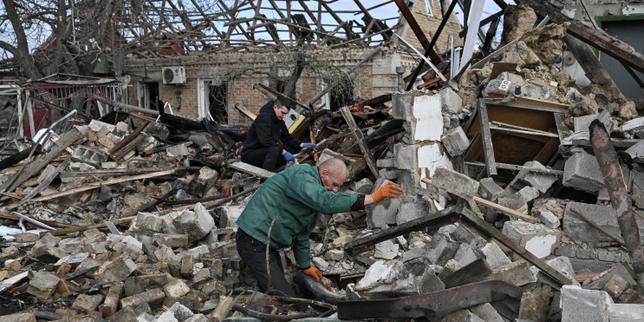
Consider a woman named Olena. She is not a diplomat. She is a schoolteacher from Kharkiv who now lives in a basement because her third-floor apartment has a hole where the kitchen used to be. For her, "progress toward an agreement" isn't a diplomatic victory or a geopolitical pivot. It is the possibility of boiling water without hearing the whistle of an incoming Shahed drone. It is the dream of a Tuesday where nothing explodes.
Negotiations are often portrayed as two sides sitting across a mahogany table, sliding folders back and forth. The reality is far messier. It is a grueling exercise in deciding which scars a nation is willing to live with. To move toward an accord is to admit that the map may never look the way it did in 1991, or even 2021, without a price that neither side can truly afford to pay.
The ink in a diplomat’s pen is essentially the blood of a generation, diluted until it is thin enough to sign a page.
Every time Yermak or any official mentions a "roadmap" or a "formula for peace," they are navigating a minefield of public sentiment. In the squares of Lviv and the trenches of Donbas, "peace" is a word that tastes like ash if it isn't accompanied by "justice." How do you tell a soldier who has lost his legs for a specific ridge that the ridge might now be part of a "demilitarized zone"? How do you tell a mother that the men who took her son will never stand in a Hague courtroom because a compromise was reached to save the city next door?
These are the invisible stakes.
The conflict has reached a stage where the geography of the war is shifting from the mud of the front lines to the psychological endurance of the high offices. For months, the narrative was one of stalemate. Now, the tone is shifting. There is a sense of urgency. The world's attention is a fickle resource, a spotlight that is slowly swinging toward other tragedies and other elections.
Ukraine knows this. Russia knows this.
To reach an agreement, both sides have to find a way to frame a retreat as a strategic pivot. They have to find words that satisfy the hawks while giving the doves room to breathe. It is a linguistic gymnastics that requires a level of precision usually reserved for neurosurgery. One wrong syllable can collapse a month of backroom deals.
The progress Yermak refers to is built on the ruins of absolute certainty. Early in the conflict, the goals were clear. Survival. Total reclamation. No compromise. But as the seasons bleed into one another, the definition of "victory" begins to warp. Is victory the restoration of a border, or is it the survival of a culture? If you save the land but lose the people, what is left to govern?
The energy in Kyiv right now is a mixture of exhaustion and a strange, steely resolve. People are tired of being brave. Bravery is a sprint; endurance is a marathon run through broken glass. When an official speaks of an agreement, they are testing the waters of a weary public. They are looking for the breaking point.
But the real problem lies elsewhere.
An agreement isn't just about Ukraine and Russia. It’s about a global architecture that has been cracked at the foundation. Any peace deal signed today is a blueprint for the wars of tomorrow. If the agreement is seen as a reward for aggression, the map of the world becomes a buffet. If it is seen as an impossible demand, the fire continues until there is nothing left to burn.
We often look at these headlines and see chess pieces. We see "territorial concessions" and "security guarantees." We should see the faces. We should see the hands of the negotiators, shaking not from fear, but from the sheer exhaustion of holding up the sky.
Imagine the room where these talks happen. It is likely windowless. The lighting is fluorescent and unforgiving. There is no music. Just the sound of breathing and the scratching of pens. In that room, the future is a series of trade-offs. A village for a decade of stability. A port for a generation of European integration.
It is a terrible trade. It is the only trade.
The progress being signaled isn't a celebration. It’s a somber acknowledgment that the time for pure, unadulterated triumph has passed, and the time for the hard, ugly work of ending a massacre has begun. It’s the realization that a flawed peace is often the only thing standing between a nation and its own ghost.
The pen is hovering over the paper. The ink is wet. The world holds its breath, not because we expect a miracle, but because we are desperate for the screaming to stop.
Andriy Yermak walks back to his office. The sirens start again in the distance. He hasn't slept in three days. He knows that every "progress" reported in the press is a gamble. He is betting that the people can stomach a peace that feels like a wound. He is betting that the alternative is a wound that never stops bleeding.
The street outside is dark. The streetlights are off to save power. In the shadows, a city waits for a signature that might finally let it sleep.