The marble floors of the Apostolic Palace have a way of amplifying the slightest sound. A footfall becomes a statement. The rustle of silk or the click of a heel carries through corridors that have witnessed centuries of static tradition. When Sarah Mullally walks these halls to meet Pope Leo, the sound is different. It is the sound of a thousand years of theological scaffolding being quietly, firmly rearranged.
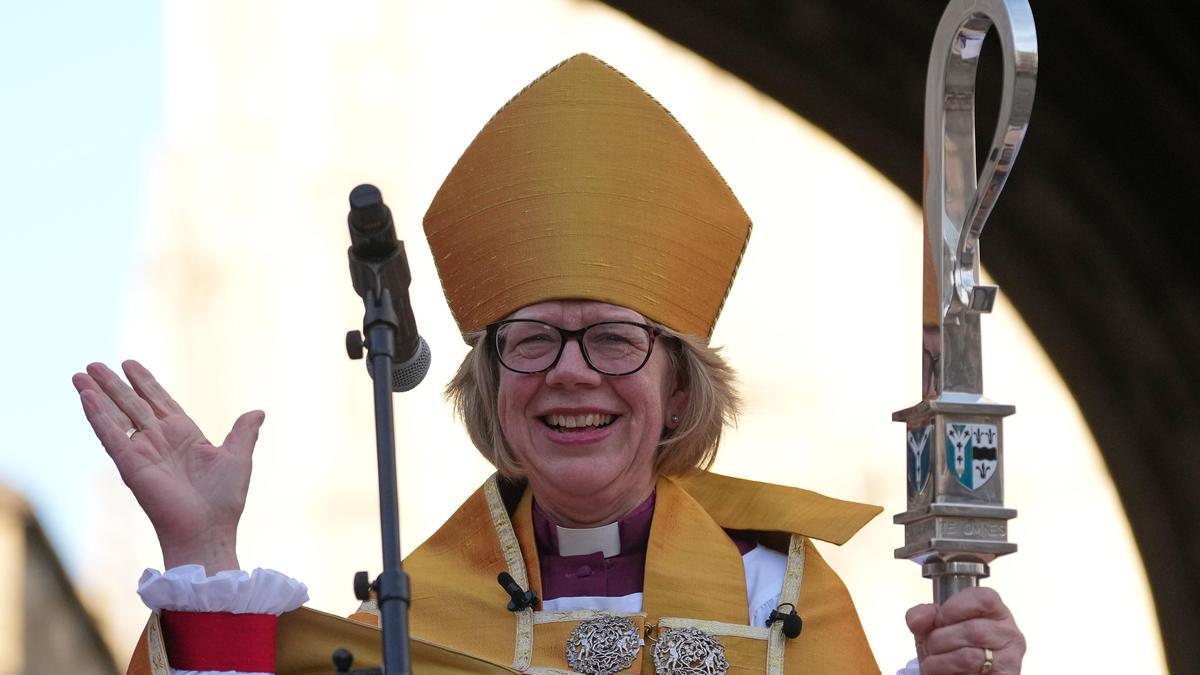
She is the first woman to hold the title of Archbishop of Canterbury. For some, she is a living herald of a new era; for others, a walking contradiction of ancient law. But as she approaches the doors of the Papal library, the debate ceases to be about abstract doctrine. It becomes about two human beings, both carrying the immense weight of their respective histories, sitting down to see if they can find a common language in a world that is rapidly losing its own.
The Silence Before the Greeting
Imagine the tension in that room. It isn't the hostile tension of enemies, but the heavy, expectant silence of two architects realizing they are looking at the same map from opposite sides. Pope Leo represents an unbroken line of male succession that stretches back to the dawn of the church. He sits in a chair defined by its permanence. Across from him, the Archbishop brings the lived experience of a woman who has navigated the corridors of the National Health Service and the pulpits of London.
Her presence is a disruption.
In the Anglican tradition, the path to this moment was paved with decades of heated synods and quiet prayers. It wasn't a sudden shift. It was a slow, sometimes painful evolution. Now, standing before the Bishop of Rome, the reality of that change is no longer a matter of policy papers. It is flesh and blood. It is a woman in a purple cassock.
The stakes are invisible but staggering. If this meeting is a mere formality, it is a wasted opportunity. But if there is a genuine spark—a moment of shared recognition between the shepherd of the Catholic world and the leader of the Anglican Communion—the ripples could move mountains. They aren't just discussing the intricacies of the Eucharist or the fine print of apostolic succession. They are navigating the survival of faith in a secular century.
A Tale of Two Cities and One Faith
To understand why this meeting feels like a tectonic shift, one has to look at the ground beneath their feet. For centuries, the relationship between Canterbury and Rome was a frozen conflict. It was a divorce that neither side quite knew how to settle. There were periods of warmth, followed by deep winters of disagreement, usually centered on who has the authority to stand at the altar.
The Archbishop knows this history intimately. She doesn't just study it; she wears it. Every time she speaks, she is aware of the voices that say she shouldn't be heard. Every time she leads a liturgy, she knows there are those in the Roman curia who view her orders as "absolutely null and utterly void," according to the 1896 papal bull.
Yet, there she is.
Leo, for his part, is a man known for a certain kind of radical pragmatism. He understands that the pews are emptying in the West. He sees a world where the moral authority of the church is being questioned at every turn. In this context, his decision to receive the first female Archbishop isn't just a polite gesture. It’s a signal. He is signaling that the common challenges of poverty, climate change, and human suffering are more urgent than the old wall of gendered hierarchy.
The Ghost of the NHS and the Altar
Before she was a priest, Sarah Mullally was a nurse. She rose to become the Chief Nursing Officer for England. This isn't a biographical footnote; it is the core of her identity. When she looks at a congregation, she sees a body that needs healing. When she looks at the Pope, she likely sees a fellow practitioner in the art of care.
There is a specific kind of exhaustion that comes from being the "first." You are never just yourself; you are a symbol. You are the test case. You are the one who has to be twice as good to be considered half as worthy. She carries that burden with a grace that can only come from years of dealing with life and death on a hospital ward.
In the Vatican, that practical, hands-on faith meets the high-minded, philosophical rigor of the Roman tradition. It’s a fascinating collision. Rome provides the deep roots, the ancient liturgy, and the uncompromising structure. Canterbury, through this new Archbishop, provides a vision of a church that can adapt, that can apologize, and that can find room for voices previously silenced.
Beyond the Handshake
What do they actually talk about?
The official press releases will mention "ecumenical dialogue" and "shared commitment to social justice." They will talk about the plight of refugees and the ethics of artificial intelligence. These are important, of course. But the real story is in the nuances. It’s in the way the Pope listens to a woman describe the spiritual needs of a modern city. It’s in the way she acknowledges the weight of his office while maintaining the integrity of her own.
Consider the hypothetical moment the cameras leave. The door closes. The advisors move to the background. In that space, two leaders are faced with a terrifying reality: the youth are leaving. The digital age is rewriting the human soul. The old arguments about who can wear a miter feel increasingly distant to a generation struggling to find meaning in a fractured world.
The real "game" here isn't about winning a theological debate. It’s about whether the church—in any form—can still offer a sanctuary for the broken. By meeting, Leo and the Archbishop are acknowledging that they are on the same side of that struggle.
The Iconoclast and the Keeper of the Keys
There is a specific kind of bravery required for this encounter. For Leo, inviting her is an act of defiance against his own hardliners. There are those in the Vatican who see this as a betrayal of tradition, a blurring of lines that should remain sharp. They fear that by recognizing her as a leader, he is implicitly conceding ground on the issue of women’s ordination.
For the Archbishop, there is the risk of being seen as seeking validation from a system that has long excluded her. She doesn't need Rome’s permission to exist, yet she knows that for the sake of Christian unity, the bridge must be crossed.
It is a walk across a high wire.
The conversation likely moves to the "ecumenism of blood"—the idea that those who persecute Christians don't ask if their victims are Catholic or Anglican. In the face of global suffering, the denominational labels start to fade. The Archbishop’s experience in the secular world of healthcare gives her a unique perspective on this. She knows that when someone is dying, they don't care about the gender of the person holding their hand; they care about the presence of the divine.
A New Kind of Power
We are used to seeing power through the lens of dominance. Who has the most followers? Who has the final word? But what we are witnessing in this meeting is a different kind of authority. It is the authority of vulnerability.
The Archbishop isn't trying to be a man in a dress. She is bringing a distinctly female, distinctly modern authority to an ancient role. She is proof that tradition can breathe. And Leo, by welcoming her, is showing that the oldest institution in the world is still capable of surprise.
The world outside the Vatican walls is loud and chaotic. It is a place of instant outrage and fleeting trends. Inside, time moves differently. A meeting like this is measured in decades and centuries. It is a seed planted in the soil of history. We might not see the full bloom of this encounter in our lifetime, but the soil has been disturbed. The ground has shifted.
The Echo in the Hallway
As the meeting concludes, there is the inevitable exchange of gifts. A pectoral cross, perhaps. A book of prayers. Small tokens of a massive shift.
The Archbishop walks back out through those same marble halls. The sound of her heels is still there, echoing against the statues of long-dead popes. But the air feels slightly different. The silence is no longer the silence of a closed door.
It is the silence of a question that has finally been asked.
There will be no sudden change in Catholic doctrine tomorrow. The clouds will not part, and the two churches will not merge into a single entity by next week. But the image of these two people sitting together stays. It lingers in the mind like a half-remembered dream that slowly becomes reality.
The significance isn't in the agreement reached, but in the fact that the conversation happened at all. In a world defined by its divisions, seeing two people from such different worlds find a way to sit at the same table is a quiet, radical act of hope. It reminds us that even the most stubborn walls are made of stone, and stone can eventually be worn away by the steady, persistent flow of human connection.
She leaves the palace, moving back out into the light of a Roman afternoon. The fisherman’s ring and the modern cross have met. The world is still the same, and yet, it is irrevocably changed. The history books will record the date and the titles, but the soul of the event lies in the quiet recognition between two people who realized that the future of faith doesn't look like the past. It looks like a conversation. It looks like a risk. It looks like the courage to stand in a room where you were once told you didn't belong.