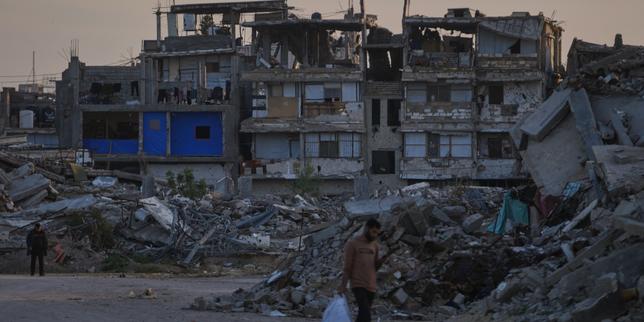
The air in Gaza does not just carry the scent of salt from the Mediterranean or the char of wood fires. It carries the weight of pulverized concrete. It is a fine, grey powder that settles into the creases of your skin, hitches a ride in your lungs, and turns the vibrant chaos of a neighborhood into a monochrome ghost of itself. When the strikes hit on Friday, that dust rose again, thick and suffocating, claiming a space where life had been trying, stubbornly, to take root.
Civil defense crews do not use the word "incidents." They use the word "recoveries." In the wake of the latest Israeli strikes targeting the north and center of the strip, seven people were pulled from the wreckage. Seven names. Seven histories. Seven chairs that will now sit empty around plastic tables in crowded tents. To the world watching through a screen, it is a digit. To those standing knee-deep in the rubble, it is the sound of a phone ringing in a pocket beneath a slab of stone, unanswered. Also making waves recently: The Price of Fire Why the Iran Conflict is Breaking the American Household.
The Calculus of the Rubble
Imagine a man named Mahmoud. He is not a combatant. He is a father who spent his morning trying to find clean water, a task that has become a marathon of endurance. He returns to a street that no longer has a name because the landmarks—the bakery with the blue door, the school on the corner—are gone.
The strike happens in a heartbeat. More information regarding the matter are explored by NPR.
There is no cinematic buildup. There is only a sudden, violent displacement of reality. One moment, the sun is hitting a balcony; the next, the balcony is a jagged tooth of rebar. When the civil defense teams arrive, they don't have heavy machinery. They have shovels. They have their bare hands. They have the desperate, rhythmic scratching of fingers against debris, hoping to hear a cough or a whimper from the dark spaces below.
This is the grim arithmetic of the current conflict. We track the tallies—seven here, ten there—but we rarely talk about the physical cost of the search. The rescuers are exhausted. Their boots are worn through. Every time they pull a body from the ruins, they are not just documenting a death; they are witnessing the erasure of a family line. The civil defense agency reported that among the seven killed were women and children, the demographics that continue to bear the brunt of a war that has no "off" switch.
The Invisible Stakes of Survival
Behind the headlines of "seven dead" lies the terrifying reality of the living. For every person lost, dozens more are pushed further into the margins of existence. The infrastructure of Gaza is a nervous system that has been severed. When a residential building is hit, it isn't just a loss of housing. It is the destruction of the only sanctuary left in a world where "safe zones" have become a bitter irony.
Consider the logistics of a strike. The blast radius doesn't just kill; it shatters the windows of every home for three blocks. It ruptures the few remaining water pipes. It sends tremors through the psyche of every child who had just managed to fall asleep. This is the "collateral" that never makes it into a briefing. It is the slow-motion collapse of a society’s ability to mend itself.
The strikes on Friday targeted areas that have been hit repeatedly. This creates a layering of trauma. People return to the ruins of their homes because they have nowhere else to go, only to be buried in the same spot where they once felt most secure. It is a cycle of return and ruin that defies logic but defines the daily life of two million people.
The Sound of the Unanswered
Statistics are a shield. They allow us to process tragedy without feeling the heat of the fire. But if you sit in the silence that follows a strike, the truth is louder. It is the sound of a mother’s voice cracking as she calls out a name into a hole in the ground. It is the sight of a rescuer sitting on a curb, head in hands, because he recognized the shoes on the person he just carried out.
These seven deaths occurred in a context of mounting pressure. Negotiations for a ceasefire flicker in and out of existence like a failing lightbulb. Meanwhile, the strikes continue. The military objectives are stated in broad, strategic terms, but the results are local and intimate. A kitchen floor covered in glass. A child’s notebook fluttering in the wind. A wedding photo torn in half.
We often look at the geopolitical chessboard to understand why this happens. We analyze the movements of battalions and the rhetoric of leaders. But the real story isn't on a map. It is in the grit under the fingernails of the men digging for survivors. It is in the eyes of the teenagers who have seen more death in a year than most people see in a lifetime. They are learning a lesson that no child should know: that the world can end on a Tuesday afternoon while you’re waiting for bread.
The Fragility of the Front Line
The civil defense workers are the unsung cartographers of this war. They map the destruction. They know which neighborhoods are crumbling and which are still holding on by a thread. Their reports are clinical—"seven dead, multiple injured"—because they have to be. To let the emotion in would be to drown in it.
But the fragility is everywhere. It’s in the lack of fuel for the ambulances. It’s in the shortage of medicine to treat the "multiple injured" who survived the blast but might not survive the infection. The strikes don't just take lives; they create a vacuum where hope used to be. Every explosion is a message that the walls are closing in.
When we read about seven more deaths, we are seeing the tip of an iceberg. Beneath the surface is a massive, frozen weight of grief and displacement. Families are being subdivided by tragedy, scattered across different camps, losing track of who is alive and who is gone. The social fabric is being pulled until it snaps.
The Echo in the Dust
The dust eventually settles, but it never goes away. It coats everything. It remains as a physical reminder of what was lost. In the coming days, there will be more strikes. There will be more numbers added to the ledger. But we must look past the digits.
Seven people were alive on Friday morning. They had plans. They had worries about the weather or the price of flour. They had people who loved them and people they were annoyed with. They were not "targets" or "stats." They were the beating heart of a community that refuses to stop beating, even when the air itself is trying to choke them.
As the sun sets over the ruins, the rescuers pack up their meager tools. They wash the grey powder from their faces, knowing they will be back tomorrow. The silence returns to the street, but it is a heavy, expectant silence. It is the silence of a place that is waiting for the next sound of the sky breaking open, while the rest of the world turns the page to the next headline.
The tragedy isn't just that they died. The tragedy is how quickly we have learned to count them.