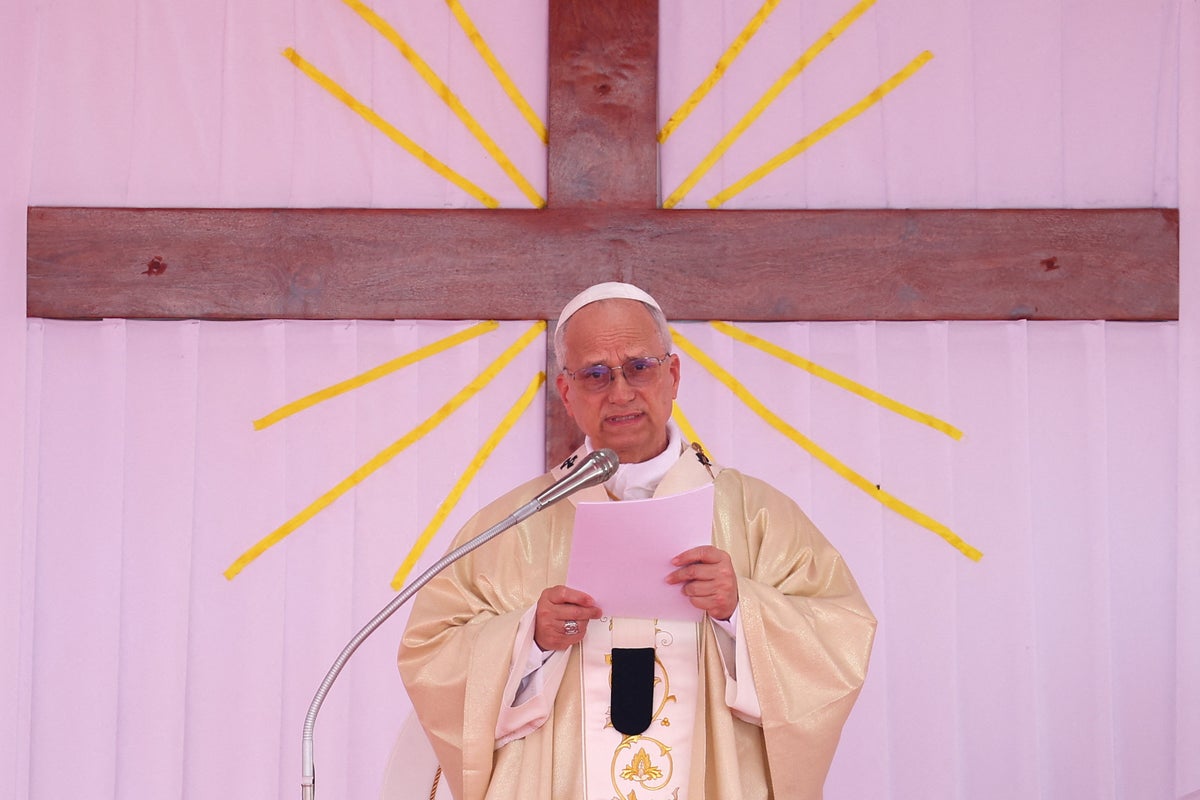
Pope Francis recently delivered one of the most blistering critiques of global finance in his decade-long papacy, explicitly accusing the ultra-wealthy of "defrauding" the poor through systemic economic exclusion. This was not a vague theological musing on charity. It was a targeted indictment of the mechanisms that allow capital to accumulate at the top while the purchasing power of the working class evaporates. The core of his message centers on the "idolatry of money," a state where profit margins are prioritized over human dignity, effectively creating a permanent underclass trapped by debt and stagnant wages.
While many observers dismiss these sermons as predictable religious rhetoric, they actually mirror a growing anxiety among secular economists. The "defrauding" the Pope speaks of refers to the widening gap between productivity and compensation, a trend that has defined the global economy since the late 1970s. When wealth is generated by the collective effort of a workforce but the gains are captured almost exclusively by shareholders and executives, a fundamental social contract is broken.
The Mechanics of Modern Dispossession
To understand the weight of the Vatican’s critique, one must look at how wealth is currently extracted rather than created. We are living through an era of "financialization," where the primary goal of a corporation is no longer to provide a superior product or service, but to manipulate its own stock price.
This is often achieved through aggressive stock buybacks. Instead of reinvesting profits into worker training, higher wages, or better equipment, companies use their cash reserves to buy their own shares. This reduces the supply of stock, inflates the price, and triggers massive bonuses for executives whose pay is tied to share performance. To the worker on the factory floor or the clerk behind the desk, this looks like a shell game. They see the company reporting record profits while being told there is no budget for a cost-of-living adjustment.
The Pope’s use of the word "defrauded" is precise. It implies a deceptive taking of what rightfully belongs to another. In economic terms, this manifests as the erosion of the "labor share" of GDP. For decades, as economies grew, the portion of that growth going to workers remained relatively stable. Now, that share is shrinking in almost every developed nation.
The Myth of the Level Playing Field
The defense of the current system usually rests on the idea of meritocracy. The wealthy are wealthy because they took risks, innovated, and worked harder than everyone else. While that narrative holds true for some, it ignores the structural advantages that keep the rich insulated from the very market forces they champion for others.
Consider the disparity in tax burdens. In many jurisdictions, income earned through physical or mental labor is taxed at a significantly higher rate than income earned through capital gains. A billionaire selling stock pays a lower percentage in tax than a specialized surgeon or a senior engineer. This is a structural subsidy for the wealthy. It allows capital to compound at a rate that labor can never hope to match.
Furthermore, the "too big to fail" era has introduced a moral hazard that the Pope finds particularly offensive. When massive financial institutions take reckless risks and lose, the public often bears the cost of the bailout. When they win, the profits are privatized. This creates a heads-I-win-tails-you-lose dynamic that effectively drains the public treasury to protect private fortunes.
The Global South and the New Colonialism
The Vatican’s perspective is unique because it views the economy through a truly global lens. Pope Francis, hailing from Argentina, has seen firsthand how international debt can be used as a tool of subjugation.
Many developing nations are caught in a cycle of perpetual debt. They take out loans for infrastructure or development, often under terms that are predatory. When the interest payments become unsustainable, international bodies frequently demand "austerity measures." These measures typically involve cutting spending on education, healthcare, and social safety nets—the very things that would allow the nation to eventually grow its way out of debt.
This is the macro-level version of the "defrauding" mentioned in the sermon. The wealth of the developed world is frequently built on the extraction of raw materials and cheap labor from regions that are then kept in a state of financial dependency. It is a feedback loop that ensures the "rich" nations and individuals continue to grow their margins while the "poor" are told to work harder and wait for the benefits to trickle down.
Technology as an Accelerator of Inequality
We cannot ignore the role of automation and algorithmic management in this conversation. In the past, industrial revolutions eventually led to the creation of new, often better, jobs. However, the current shift toward AI and robotics is different because it targets the cognitive tasks that once provided a path to the middle class.
Companies are now able to scale to billions of dollars in revenue with a fraction of the staff required twenty years ago. This "scalability without mass employment" means that the wealth generated by technological breakthroughs stays concentrated in the hands of a very small group of founders and venture capitalists.
When a platform replaces ten thousand taxi drivers with an autonomous fleet, or replaces a thousand customer service agents with a chatbot, where does the saved labor cost go? It does not go to the displaced workers in the form of a social dividend. It goes to the bottom line. This is a massive transfer of wealth from the labor pool to the capital pool, occurring at a speed that social safety nets are not equipped to handle.
The Cost of Social Cohesion
The Pope’s warning is not just a moral plea; it is a pragmatic one. History shows that when a society reaches a certain level of inequality, it becomes inherently unstable. We are seeing the symptoms of this instability in the rise of populist movements, the breakdown of civil discourse, and the general loss of faith in democratic institutions.
When people feel the system is rigged against them—when they work forty hours a week and still cannot afford a home or basic healthcare—they lose their stake in the status quo. They become susceptible to demagogues who promise to tear the system down. The "rich" who are currently benefiting from these lopsided economic structures are, in the long run, undermining the very stability that allows their wealth to exist.
A market cannot function without consumers who have money to spend. If the "defrauding" continues to the point where the majority of the population is living paycheck to paycheck, the entire engine of global capitalism will eventually seize up. You cannot have a consumer economy without consumers.
Rethinking the Value of Labor
The solution requires more than just increased philanthropy. The Pope is not asking for more "crumbs from the table." He is calling for a fundamental restructuring of how we value work.
This starts with the concept of a living wage—not a minimum wage that keeps a person in poverty, but a wage that allows for a dignified life, the ability to save, and the security to raise a family. It also involves rethinking corporate governance. What if employees had a seat on the board of directors, as is common in parts of Europe? What if profit-sharing was the default rather than the exception?
These are not radical ideas; they are restorative ones. They are designed to return us to a version of capitalism that actually rewards work and fosters a broad-based middle class.
The Illusion of Infinite Growth
The current economic model is predicated on the idea of infinite growth on a finite planet. This drive for "more" at any cost is what fuels the exploitative practices the Pope decries. To maintain 3% or 5% quarterly growth, companies are forced to find new ways to squeeze their suppliers, their workers, and their customers.
This pressure leads to planned obsolescence, the degradation of product quality, and the externalization of environmental costs. The rich get richer by "defrauding" the future, consuming resources and emitting carbon today while leaving the bill for the next generation.
True reform would mean moving toward a "circular economy" or a "steady-state economy" where the goal is stability and sustainability rather than raw, unchecked expansion. It requires admitting that a GDP figure does not tell you if a mother can afford medicine for her child or if a young couple can afford to start a home.
The Moral Responsibility of Wealth
The Vatican's stance is that wealth is not inherently evil, but the unrestricted pursuit of it is a form of spiritual and social sickness. Those who have benefited most from the current system have a disproportionate responsibility to fix it. This is not about guilt; it is about stewardship.
When a CEO makes 400 times what their average worker makes, it is a failure of leadership. It is a sign that the leadership no longer sees their employees as partners, but as expenses to be minimized. To reverse this, we need a shift in corporate culture that prizes long-term stability over short-term "optimization."
Governments also have a role to play in closing the loopholes that allow the ultra-wealthy to opt out of the social contract. This means international cooperation to end tax havens and a global minimum tax on corporations to prevent a "race to the bottom" where countries compete to see who can demand the least from the rich.
Beyond the Sermon
The Pope’s message is a call to look past the spreadsheets and see the human faces behind the data points. Behind every "efficiency gain" is a worker who might have lost their health insurance. Behind every "disrupted industry" is a community that has lost its economic anchor.
We are currently operating an economic system that functions like an extractive industry, mining human effort and natural resources to produce a concentrated surplus that stays at the top. The "fraud" is telling the rest of the world that this is the only way a modern economy can function.
It is a choice. We can choose an economy that serves humanity, or we can continue to serve an economy that views humanity as a disposable input. The current path leads to a world of gated communities and desolate streets, a division that is ultimately unsustainable for both the rich and the poor.
The time for incremental adjustments is passing. We need a systemic re-evaluation of what an economy is actually for. If its purpose is not to provide for the well-being of the many, then it is failing, regardless of what the stock market indices say. We must stop measuring the health of a society by the wealth of its most fortunate members and start measuring it by the security and dignity of its least.