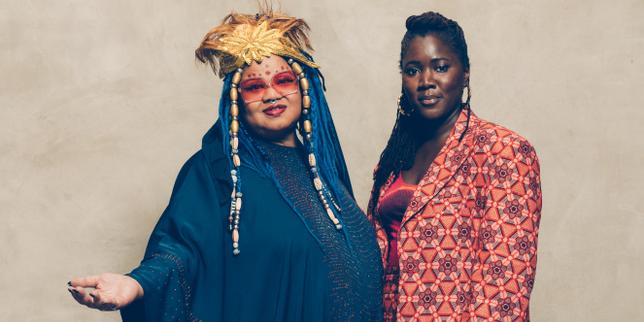
The performance of Vénus Noire at the Banlieues Bleues festival represents more than a mere musical collaboration. It is a calculated, jarring confrontation with the ghosts of European history. When filmmaker Alice Diop and avant-garde composer Angel Bat Dawid took the stage at the Pavillon Sous-Bois, they weren't just honoring Sarah Baartman, the Khoikhoi woman paraded through 19th-century Europe as a "freak show" attraction. They were dismantling the very gaze that created her. By blending Diop’s cinematic precision with Bat Dawid’s chaotic, free-jazz spirituality, the project transforms a historical tragedy into a live sonic interrogation. This isn't entertainment in the traditional sense; it is an exorcism of the colonial lens that persists in modern French culture.
The Weight of the Archival Image
Alice Diop has built a career on looking where others turn away. Her transition from documentary filmmaking to the acclaimed feature Saint Omer demonstrated a preoccupation with how the French legal and social systems perceive Black bodies. In Vénus Noire, she pushes this further by utilizing archival silence. The project began with a realization that while Sarah Baartman’s physical form was documented, measured, and eventually preserved in a jar at the Musée de l’Homme until 1974, her voice was entirely erased.
Diop uses film as a structural anchor. The visuals projected during the performance do not merely narrate Baartman’s life. They challenge the audience to recognize their own complicity in the act of watching. The imagery is sparse, often focusing on textures and the heavy atmosphere of the banlieues—the suburban fringes of Paris where the festival is rooted. This geographical choice is intentional. By staging this performance in the Seine-Saint-Denis department, Diop and Bat Dawid are speaking directly to the descendants of those marginalized by the same colonial machinery that once commodified Baartman.
The tension in the room is palpable. You can feel it in the way the audience holds its breath when the music stops and only the grainy flickers of the film remain. It is a reminder that history isn't behind us; it is the ground we are standing on.
Angel Bat Dawid and the Sound of Defiance
If Diop provides the frame, Angel Bat Dawid provides the fire. The Chicago-based multi-instrumentalist does not play jazz so much as she conducts a spiritual uprising. Her approach to the clarinet and the keyboard is visceral. It is loud, messy, and intentionally disruptive.
Bat Dawid’s involvement is the "how" behind the performance’s emotional impact. She rejects the idea of Baartman as a passive victim. Through "Afro-futurist" sonic structures, she reimagines Baartman as a cosmic entity, reclaiming the agency that was stripped from her in London and Paris circuses. The music shifts from mournful wails to aggressive, dissonant peaks. This dissonance is vital. It prevents the audience from falling into a state of comfortable pity. Pity is a passive emotion that requires no change from the person feeling it. Bat Dawid’s wall of sound demands an active, often uncomfortable engagement.
The collaboration succeeds because it avoids the traps of "prestige art." There is no polished veneer here. During the set, Bat Dawid often shouts, chants, and pushes her instruments to the point of mechanical failure. It reflects a reality where the Black experience cannot be contained within neat, melodic boxes. It is a rebellion against the "neatness" of French universalism, which often seeks to erase racial specificity in favor of a theoretical, color-blind equality that rarely exists in practice.
Breaking the Museum Glass
For decades, the story of the Hottentot Venus was a footnote in scientific history, a shameful secret hidden in the basements of French museums. The return of Baartman’s remains to South Africa in 2002 was supposed to be the end of the story. Diop and Bat Dawid argue that the return of the body did not return the dignity.
The performance acts as a symbolic retrieval. By placing Baartman’s narrative in the hands of two Black women artists, the project shifts the power dynamic. In the 1800s, Baartman was the object. In Vénus Noire, she is the catalyst for a modern creative explosion.
However, we must ask if these institutional spaces—even progressive festivals like Banlieues Bleues—are truly capable of hosting such a radical critique. There is a persistent irony in performing a critique of the "spectacle of the Black body" within a ticketed event attended largely by a demographic that still holds the majority of cultural power. Diop seems aware of this. Her direction doesn't provide easy answers or a cathartic "happy ending." Instead, it leaves the audience with the heavy realization that the structures which allowed Baartman’s exploitation have merely evolved, not vanished.
The Sonic Banlieue
The choice of venue at the Pavillon Sous-Bois is not a logistical coincidence. The Banlieues Bleues festival has spent forty years navigating the complex social geography of the Paris outskirts. These are areas often characterized in the media by civil unrest and economic struggle. By bringing Vénus Noire here, the artists are grounding a global historical trauma in a local, contemporary reality.
The soundscape incorporates elements of the environment. The hum of the city, the grit of the concrete, and the specific energy of the 93rd arrondissement bleed into Bat Dawid’s compositions. This connection makes the historical subject matter feel urgent. It bridges the gap between a woman who died in 1815 and the youth living in Clichy-sous-Bois today. They are linked by a thread of surveillance and the struggle for self-definition in a society that insists on defining them first.
Reclaiming the Narrative from the Academic
Critics often approach Diop’s work through a strictly intellectual lens, citing post-colonial theory and film semiotics. While those frameworks are valid, they often strip the work of its raw, emotional marrow. Vénus Noire is an assault on the senses before it is an academic exercise.
The "why" behind the project is rooted in survival. For Bat Dawid, music is a tool for psychic healing. For Diop, film is a tool for judicial truth. When these two meet, the result is a form of "radical witnessing." They are testifying to a life that was lived in the shadows of the Enlightenment. The Enlightenment, after all, was the same intellectual movement that used "reason" to justify the hierarchy of races.
The performance exposes the rot at the heart of that logic. It shows that the scientific curiosity which led to Baartman’s dissection was just a sanitized form of violence. By reacting to this violence with noise and light, the artists create a space where the "Venus" is no longer a specimen. She is a scream.
The Architecture of the Performance
The stage layout reflects the fragmented nature of memory. Diop’s screen is not always the focus; sometimes it goes dark, forcing the audience to sit in total blackness while Bat Dawid’s voice echoes through the hall. This use of negative space is a sophisticated move. It mimics the gaps in the historical record.
We do not know what Sarah Baartman thought while she was on display. We do not know her private dreams or her internal language. By refusing to "fill in" these gaps with fictionalized dialogue, Diop respects the privacy that Baartman was never allowed in life. The performance is respectful precisely because it is incomplete. It acknowledges that some parts of the soul are unreachable, even by art.
The musicians accompanying Bat Dawid—often members of her Tha Brothahood ensemble—provide a rhythmic foundation that feels ancient and modern simultaneously. The drums don't just keep time; they pulse like a heart under stress. It is an exhausting experience for the viewer, and that exhaustion is the point. You shouldn't be able to walk away from a piece about human commodification feeling refreshed.
Beyond the Festival Circuit
The danger for a project like Vénus Noire is that it becomes a "must-see" for the elite art crowd before being filed away as another successful commission. To avoid this, the work must maintain its jagged edges. It must remain "un-curatable."
Diop and Bat Dawid have achieved this by making the performance intensely personal. This isn't a history lesson delivered from a distance. It is a shared grief. The power of the piece lies in its refusal to be polite. In the context of French culture, which prides itself on decorum and "proper" discourse, the screaming clarinet of Angel Bat Dawid is a necessary profanity.
The collaboration proves that the most effective way to handle history is not to put it in a museum, but to let it burn in public. The flames don't just destroy; they provide the light necessary to see the truth of our current moment.
We are still looking. We are still being watched. The "Vénus Noire" is no longer in a jar, but the room is still full of mirrors. The only way out is to break them. Move toward the sound of the shattering glass.