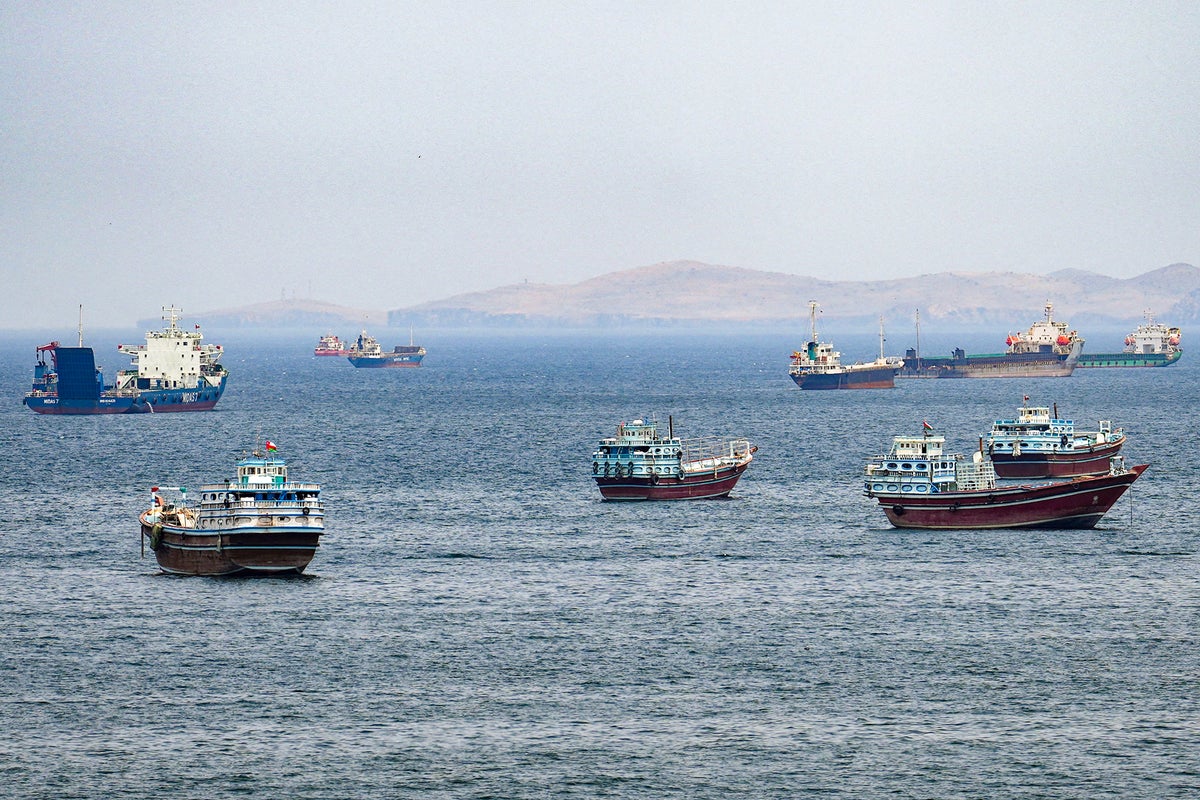
The steel under Captain Marek’s boots vibrates with a low, rhythmic thrum that usually signals safety. On a clear night in the Strait of Hormuz, that vibration is the heartbeat of a $150 million machine carrying two million barrels of crude oil. But lately, the heartbeat feels like a countdown.
Marek—a hypothetical composite of the masters currently navigating these waters—doesn't look at the horizon for stars anymore. He looks for the fast-moving silhouettes of patrol boats. He watches the radar for "dark" vessels that have cut their transponders. He knows that at its narrowest point, this waterway is only twenty-one miles wide. Shipping lanes, the invisible highways of the sea, shrink that usable space even further.
One mistake, one seizure, or one stray drone, and the engine of global civilization begins to sputter.
The Strait of Hormuz is the world’s most important choke point. It is a geographic fluke that dictates the price of a gallon of gas in Ohio, the stability of a pension fund in London, and the warmth of a home in Seoul. About a fifth of the world’s total oil consumption passes through this needle’s eye every single day. When shipping bosses demand "safe and sustainable" passage, they aren't just asking for lower insurance premiums. They are asking for the preservation of the modern world’s nervous system.
The Invisible Stakes of a Narrow Sea
We tend to think of global trade as a cloud-based abstraction. We click "buy" and things appear. We pull a lever at a pump and liquid flows. But the reality is heavy, wet, and incredibly vulnerable.
Inside the boardroom of a major shipping conglomerate, the tone has shifted from cautious optimism to quiet desperation. These executives are looking at data that suggests a "risk premium" is no longer a temporary fluctuation. It is a permanent tax on existence. When a tanker is diverted or delayed due to security threats, the ripples move faster than the ship ever could.
The math is brutal. If the Strait were to close, even for a few days, the global supply of oil would drop by roughly 20 million barrels per day. There is no pipeline network on Earth capable of bypassing that loss. The resulting price spike wouldn't just be a news headline; it would be a systemic shock. Food prices would soar because tractors run on diesel. Logistics networks would freeze because planes and trucks would become prohibitively expensive to operate.
The "safe" part of the shipping bosses' demand is about human life. The "sustainable" part is about the survival of the global economic order.
A Day in the Kill Zone
Consider the perspective of a deckhand. On a standard run, the biggest threats are boredom and the occasional storm. Now, the crew undergoes "hardening" drills. They practice retreating to the citadel—a reinforced room inside the ship designed to withstand an armed takeover. They watch the Iranian coastline, which looms just miles away, bristling with anti-ship missiles and speedboats.
This isn't a war zone, officially. But for the people on the water, the distinction is academic.
The tension isn't just about the threat of violence; it’s about the erosion of international law. For decades, the "freedom of navigation" was a pillar of the sea. You didn't touch a merchant vessel. It was the sacred neutral ground of commerce. That pillar is crumbling. When ships are seized as political bargaining chips, the sea becomes a forest of shadows.
Insurance companies have noticed. The cost to insure a single voyage through the Strait has jumped by hundreds of percent in recent years. For a large tanker, that can mean an extra $200,000 just for a few days of transit. These costs aren't swallowed by the shipping companies. They are passed down, cent by cent, until they reach your grocery bill.
The Fragility of the "Just-in-Time" Illusion
We have spent thirty years building a world that values efficiency over resilience. We stripped away "waste" and "excess inventory." We created a "just-in-time" delivery system that assumes the roads will always be open and the seas will always be calm.
The Strait of Hormuz is the ultimate stress test for that illusion.
It is a bottleneck of historic proportions. To the north lies Iran. To the south, Oman and the United Arab Emirates. The deep-water channel required for massive tankers is narrow enough that a few well-placed mines or a scuttled ship could create a logistical nightmare that would take weeks, if not months, to untangle.
The shipping bosses aren't just worried about the oil. They are worried about the precedent. If the world’s most vital waterway can be held hostage by regional volatility, then the very concept of a global market begins to dissolve. We move back toward a world of fragmented, localized economies, where "global" is a luxury few can afford.
Beyond the Barrel
While the headlines focus on oil, the Strait is also the primary exit for Liquefied Natural Gas (LNG) from Qatar. As Europe tries to move away from Russian energy, this thirty-mile stretch of water has become even more critical to the survival of Western industry.
Imagine a glass factory in Germany or a chemical plant in France. These facilities require a constant, unwavering stream of gas to keep their furnaces hot. If the flow stops, the molten material hardens inside the machinery, effectively destroying the plant. The "sustainable" passage shipping bosses are screaming for is the only thing keeping those furnaces burning.
The vulnerability is psychological as much as it is physical. Markets hate uncertainty. The moment a tanker is harassed, the "fear index" spikes. Traders begin to bet on the worst-case scenario. This speculative pressure can drive up prices even if a single drop of oil hasn't been delayed. We are paying for the possibility of a crisis.
The Ghost of the Tanker War
History has a cruel way of repeating its most stressful chapters. In the 1980s, the "Tanker War" saw hundreds of merchant ships attacked in these same waters. Back then, the world’s navies had to intervene, escorting tankers in massive convoys to ensure they reached the open ocean.
Today, the shipping industry is calling for a modern version of that protection, but the world is more complicated now. The weapons are cheaper—drones and "suicide" boats replace traditional destroyers. The actors are more varied. The geopolitical stakes are higher.
Captain Marek stands on the bridge and watches a small boat approach. Is it a fishing vessel? A smuggler? A scout for a regional navy? He has seconds to decide how to react. If he's too aggressive, he risks an international incident. If he's too passive, he risks his crew and his ship.
It is a heavy burden for a merchant sailor to carry. These are men and women who signed up to move cargo, not to serve as pawns in a high-stakes game of maritime chess.
The Cost of Silence
When we read about "shipping bosses demanding safety," it sounds like a corporate press release. It sounds like a plea for profit. But look closer.
It is a warning.
They are telling us that the floor we are standing on is much thinner than we realize. They are pointing to the map and showing us the exact spot where the global economy could fracture.
The silence of the sea is deceptive. Underneath the blue water of the Strait of Hormuz lies the reality of our interdependence. We are all on that ship with Marek. We are all vibrating with that low rhythmic thrum, hoping the heartbeat doesn't stop.
If the passage isn't secured, the cost won't just be measured in dollars or barrels. It will be measured in the sudden, cold realization that our interconnected world is only as strong as its narrowest point.
The sun sets over the Iranian mountains, casting long, jagged shadows across the water. Marek adjusts his binoculars. The shipping lanes are crowded tonight. A line of giants, miles long, carrying the lifeblood of nations, moves slowly toward the narrow gap. They move with a strange, haunting grace, vulnerable and massive, waiting for the world to decide if their safety is worth the effort.
Marek turns the radar gain up, filtering out the noise of the waves, searching for the one blip that shouldn't be there.