The Distance Between Us
Standing on a balcony in Business Bay, you can almost hear the city breathing. It is a rhythmic, mechanical sound—the hum of ten thousand air conditioners, the distant drone of the Sheikh Zayed Road, and the shimmering heat waves rising off the glass towers. But for the three million people who call Dubai home, the city isn't just a collection of skylines. It is a series of calculations.
How long will it take to get to Dubailand? Is Jumeirah Golf Estates too far for a Tuesday dinner? Can I afford the time it takes to cross the desert expanse that separates my desk from my front door? Meanwhile, you can read similar events here: The Hollow Crown and the Shadow of Peter Mandelson.
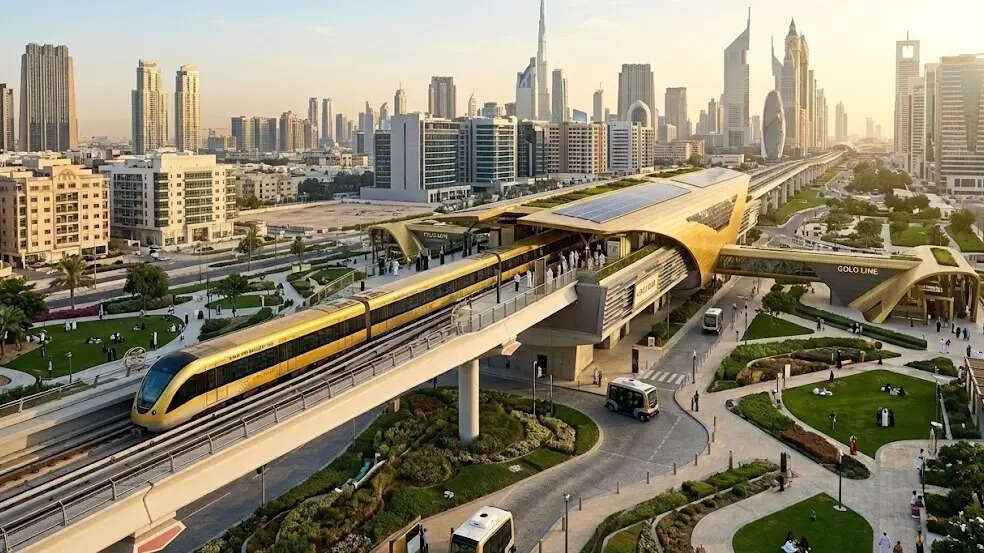
For years, the map of Dubai has been defined by these gaps. We measure our lives in minutes lost to the asphalt. When Sheikh Mohammed bin Rashid Al Maktoum recently signed off on the Dh34 billion Dubai Metro Gold Line, he wasn't just approving a transit project. He was rewriting the geography of our daily lives. This is a story about the death of distance.
Consider a person we will call Sarah. She represents thousands. Sarah works in a sleek, high-pressure marketing firm in Business Bay, surrounded by the vertical ambition of the Burj Khalifa district. Her life is a blur of deadlines and double espressos. She dreams of living in the quiet, green reaches of Dubailand, where the air feels a fraction cooler and the horizon isn't blocked by steel. But the commute? The commute is a wall. It’s a sixty-minute negotiation with traffic that drains the soul before the day has even truly begun. To see the complete picture, check out the detailed article by Al Jazeera.
The Gold Line changes Sarah's math.
The Golden Thread
The Dubai Metro Gold Line is not a mere extension. It is a tectonic shift in how the city functions. Spanning dozens of kilometers and costing roughly $9.2 billion in American terms, this is the most ambitious addition to the city’s nervous system since the Red Line first sliced through the desert in 2009.
This new vein will connect the glass-and-steel heart of Business Bay directly to the sprawling residential communities of Dubailand and the lush, manicured expanses of Jumeirah Golf Estates. These were once places you went "to." Soon, they will simply be places you "are."
The engineering required for this is staggering. We aren't just laying tracks; we are threading a needle through a fully realized urban environment. It involves tunneling beneath existing infrastructure, bridging gaps over major highways, and creating stations that aren't just stops, but destinations in themselves. These stations will be the cathedrals of the modern age—climate-controlled, architecturally daring, and designed to move tens of thousands of people per hour without a single hitch in the rhythm.
But why gold? In Dubai, names are rarely accidental. Gold signifies a standard. It represents the "Gold Phase" of the city's 2040 Urban Master Plan. It is a promise that the quality of life in the outskirts will mirror the prestige of the center.
The Invisible Stakes
It is easy to get lost in the Dh34 billion figure. It’s a number so large it feels abstract. To understand the stakes, we have to look at what happens when a city doesn't build.
Cities that stop moving, die. They become stagnant. They become "cities of islands," where people stay in their own small bubbles because the friction of moving between them is too high. You see it in London, in New York, in Los Angeles—the "commuter's tax" on happiness.
Dubai is attempting to bypass that fate. By 2026, when the first whispers of the Gold Line’s sleek, driverless trains begin to echo through the tunnels, the city will have effectively shrunk.
Think about the father living in Jumeirah Golf Estates who currently misses bedtime because the E44 is a parking lot at 6:00 PM. Think about the college student in Dubailand who wants to take an internship in the Dubai International Financial Centre (DIFC) but doesn't own a car. These aren't logistical "pain points." They are human limitations. The Gold Line is the sledgehammer breaking those walls down.
The Mathematics of Flow
There is a specific kind of magic in a driverless train. If you have ever stood at the very front window of the existing Red or Green lines, you’ve felt it. You are a pioneer in a glass capsule, hurtling toward the future. The Gold Line will take this technology and refine it.
The system relies on a complex web of sensors and centralized control.
$$C = \frac{P \cdot V}{H}$$
In the simplified physics of urban transit, the capacity of a line ($C$) is a function of the number of passengers per train ($P$), the velocity ($V$), and the headway—the time between trains ($H$). By automating the Gold Line, the RTA can reduce $H$ to a matter of seconds. No human error. No fatigue. Just a constant, unwavering flow of humanity.
This efficiency is the silent engine of the economy. When people can move, money moves. When the distance between a home in the suburbs and a job in the city center is reduced to a twenty-minute air-conditioned ride, the labor market expands. Property values in Dubailand aren't just rising because of the bricks and mortar; they are rising because those homes are suddenly "closer" to the world.
A Walk Through the Future
Let’s step forward. It is a Monday morning in late 2026.
The air in the Business Bay Gold Line station is crisp. You aren't sweating. You aren't stressed. You tap your phone or your watch at the gate, and the barrier vanishes. A train glides in—silent, punctual, inevitable.
You find a seat. You open your laptop or a book. Outside the window, the city begins to change. The dense clusters of Business Bay give way to the shifting sands and rising developments of the interior. You see the skyline of the city in the rearview mirror, but you aren't fighting it. You are rising above it.
Within minutes, the train pulls into a station in the heart of Dubailand. You step out into a neighborhood that has been revitalized. Where there were once isolated villas, there are now vibrant plazas, cafes, and parks, all built around the gravity of the Metro station. This is "Transit Oriented Development." It is the idea that we shouldn't build roads and hope for the best; we should build paths and let life grow around them.
The impact on Jumeirah Golf Estates is even more profound. What was once an exclusive enclave, somewhat detached from the urban core, is now stitched into the fabric of the metropolis. You can live in a sanctuary and work in a powerhouse. The trade-off—the choice between peace and progress—is gone.
The Cost of Silence
Some will argue about the price tag. Dh34 billion is a massive investment of public wealth. But we must ask: what is the cost of silence? What is the cost of a city that reaches a standstill?
The Gold Line is an insurance policy against the future. As Dubai’s population aims toward nearly six million people over the next two decades, the existing roads cannot hold the weight of our ambitions. Every person on a train is one less car on the road. Every minute saved on a commute is a minute gifted back to a family, a business, or a creative pursuit.
We often talk about "smart cities" as if they are made of silicon and code. They aren't. A smart city is one that respects its citizens' time. It is a city that understands that the most valuable commodity in the world isn't gold or oil—it’s the hour you spend with your children instead of staring at a brake light.
The Horizon
As the sun sets over the Arabian Gulf, casting a long, amber glow over the construction sites and the finished towers, the vision of the Gold Line feels less like a project and more like a destiny. It is the logical conclusion of a city that refused to be told "no" by the desert.
We are watching the construction of a bridge. Not a bridge over water, but a bridge over the gaps in our lives. When the doors of the first Gold Line train slide open in 2026, they won't just be letting passengers in. They will be opening a new chapter for Dubai—one where the city is no longer a collection of destinations, but a single, unified home.
The map is changing. The calculations are being rewritten. The pulse of the city is getting faster, steadier, and more inclusive.
The desert is still there, wide and unforgiving. But now, there is a golden thread running through it, and we are all connected.