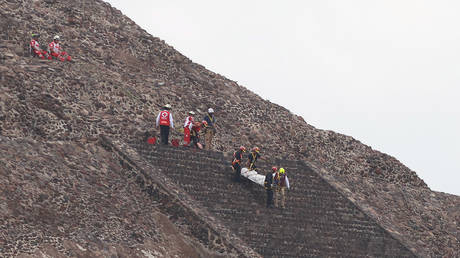
The headlines are bleeding with the same tired narrative. A Canadian tourist is gunned down at the Teotihuacan pyramids, and the media immediately defaults to the "senseless violence" script. They call it a tragedy of "planned" proportions, as if the intent changes the underlying mechanics of global travel risk.
Stop looking at this through the lens of a botched vacation.
If you think this shooting was a failure of the Mexican state or a sign that the "pyramids are no longer safe," you are fundamentally misreading the board. This wasn't a failure of security. It was a targeted execution that highlights the cold reality of the "Safe Zone" delusion. People travel to UNESCO World Heritage sites under the assumption that historical significance provides a magical shield against reality.
It doesn't.
The Fallacy of the Tourist Bubble
Mainstream travel reporting wants you to believe that the "planned" nature of this hit makes it more terrifying. I argue the opposite. Random violence is the nightmare; targeted violence is a business transaction. When officials say a hit was "planned," they are inadvertently telling you that the average traveler—the person not entangled in the shadow economies of North America—is statistically safer than they were yesterday.
The competitor rags are obsessing over the "shock" of it happening at a landmark. Why? A landmark is just a high-traffic logistics hub. If you need to find someone, you go where they are forced to be. Teotihuacan is a bottleneck.
The "lazy consensus" is that Mexico needs more boots on the ground at ruins. That is a decorative solution. Adding five hundred federales to the Avenue of the Dead won't stop a professional hit. It just increases the overhead for the next one.
Geography is Not Destiny, Logistics Is
I’ve spent a decade navigating high-risk corridors from CDMX to San Salvador. The mistake every "industry expert" makes is treating Mexico as a monolith of risk. It’s not. It’s a patchwork of sovereignty.
Teotihuacan sits in the State of Mexico (Edomex), a region that has long served as a pressure cooker for the capital’s spillover tension. When a tourist gets hit there, the media treats it as a breach of the "Sacred Site." In reality, the site is just a backdrop.
- Fact Check: The homicide rate for foreign tourists in Mexico remains lower per capita than the homicide rate in several major U.S. cities you’d happily visit for a weekend.
- The Nuance: The risk isn't "Mexico." The risk is the specific friction between your personal history and the local power structure.
If this was a planned hit, as the authorities claim, it means the victim was followed or tracked. That isn't a "travel safety" issue. That is an intelligence and personal security issue. To blame the site’s security for a targeted execution is like blaming a parking garage for a car bombing. The venue is irrelevant to the intent.
Stop Asking If It’s Safe
"Is Mexico safe?" is the dumbest question in travel. It’s the hallmark of a mind that doesn't understand probability.
The real question is: "Do I have a footprint that warrants attention?"
Most travelers are invisible. They are background noise. The moment you start asking for "fortified" tours or "safe" zones, you are signaling that you have something worth protecting. You are creating a profile.
The Canadian tourist caught in this crossfire—whether they were the target or a bystander to a specific dispute—is a data point in a much larger, uglier game of regional control. When officials label it "planned," they are trying to manage the optics. They want to reassure the "average" tourist that they aren't on the list.
But here is the truth nobody admits: The more "planned" these events become in tourist zones, the more they reveal the erosion of the unspoken agreement between the cartels and the state. That agreement used to be: "Don't kill the golden goose." The goose is now on the menu.
The Intelligence Gap in Modern Travel
We are living through the death of the "incidental" traveler.
In the 90s, you could disappear into a crowd. Today, with facial recognition, digital footprints, and the democratization of surveillance, there is no such thing as a random crowd. If someone wants to find you at the Pyramid of the Moon, they don't need a scout. They just need access to a data broker or a compromised cellular tower.
The "authorities" are still using 20th-century rhetoric to solve 21st-century hits. They talk about "increasing patrols."
- Patrols are theater.
- Metal detectors are theater.
- Official statements are theater.
Real security in 2026 is about signal management. It’s about knowing that the moment you land at AIFA or MEX, you are part of a digital ledger. If you are high-value, you are visible.
The Professional’s Take on "Planned" Violence
When a hit is planned, it means the perpetrator has calculated that the reward outweighs the heat of a federal investigation. That is a terrifying shift in the risk-reward calculus. It means the "International Tourist" status no longer carries the diplomatic immunity it once did.
The Canadian government will issue a travel advisory. The Mexican government will promise a "full investigation."
I have seen this cycle repeat in Guerrero, in Michoacán, and now in the heart of the country’s historical pride. The outcome is always the same: a temporary dip in hotel bookings followed by a return to the status quo once the news cycle finds a new carcass to pick.
How to Actually Navigate High-Tension Zones
If you’re waiting for a government website to tell you when it’s "safe" to go back to the pyramids, you’re a sheep waiting for a shepherd who is already at lunch.
- Ditch the "Safe Zone" Mentality. Nowhere is safe; some places are just better managed. Treat a historical site with the same situational awareness you’d use in a dark alley in Nezahualcóyotl.
- Anonymity is your only real armor. The moment you look like a "VIP," you are a target. This Canadian incident proves that being in a "protected" area is a myth.
- Recognize the "Planned" Signal. If the government says it was planned, believe them—but understand what it implies. It means the infrastructure for professional hits is now comfortably operating within the most visited sites in the Western Hemisphere.
The Brutal Reality of the Global South
We love to consume the culture of the Global South while demanding it be as sanitized as a Disney resort. This is the ultimate Western arrogance. Mexico is a country in the midst of a multi-decade internal conflict that involves the highest levels of global finance and consumption. To expect that conflict to pause because you want to see some 2,000-year-old rocks is delusional.
The Teotihuacan shooting isn't an "incident." It's a symptom.
It’s the sound of the world getting smaller and the "safe" places disappearing. You can either stay home and watch the world through a screen, or you can accept that travel in the 2020s involves a non-zero chance of being caught in someone else’s war.
The pyramids haven't changed. The danger hasn't even really increased. The only thing that’s changed is your realization that the fence around the "tourist zone" was always made of paper.
Stop looking for "safety" and start practicing survival. Or stay on the cruise ship. Those are your only two honest options. Everything else is just marketing.