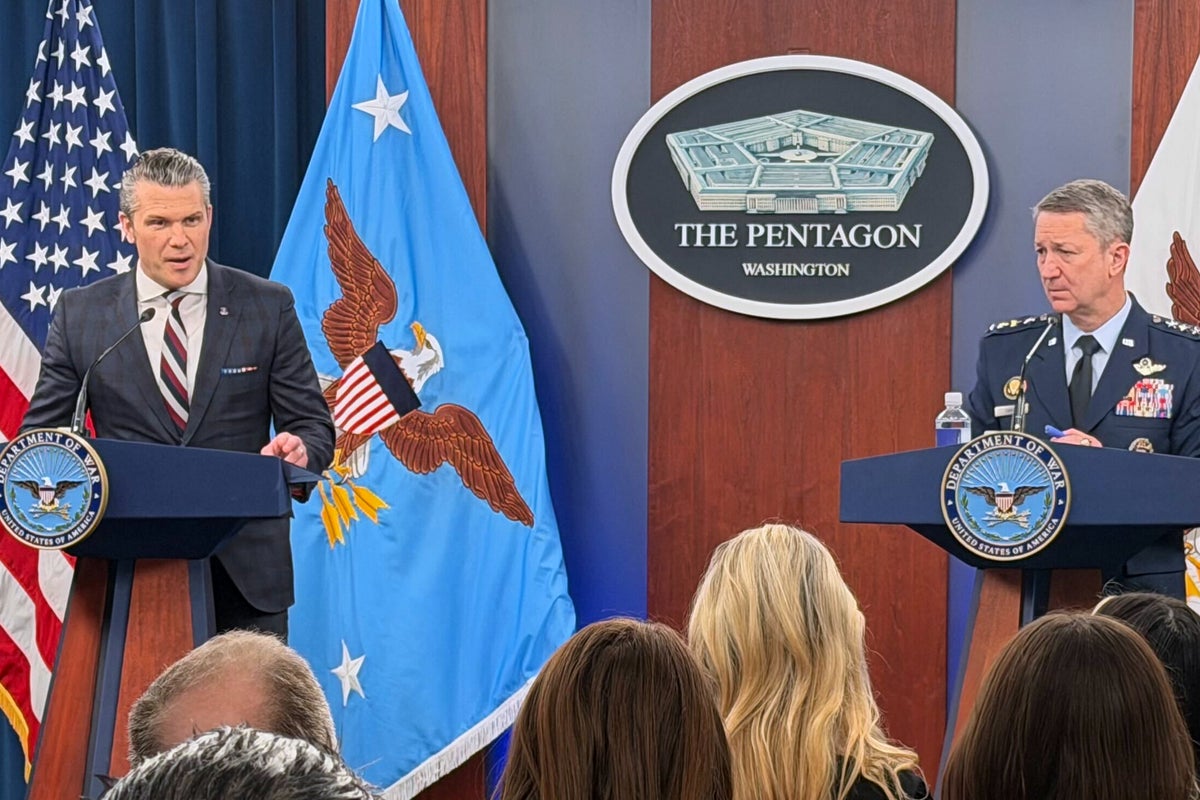
The cycle of retribution between Washington and Tehran just hit a fever pitch. In a surgical strike that effectively decapitated a significant portion of Iran’s unconventional warfare apparatus, U.S. forces eliminated the high-ranking Iranian official allegedly responsible for orchestrating a series of assassination plots against President Donald Trump. Pete Hegseth, speaking on behalf of the administration’s defense posture, framed the operation as a definitive closing of the circle. It wasn't just a tactical win. It was a message sent in the only language the Islamic Revolutionary Guard Corps (IRGC) truly respects.
Intelligence circles had been tracking the target for months. This wasn't a sudden discovery but the culmination of a high-stakes game of electronic signals and human intelligence. The operative in question wasn't just a bureaucrat; he was the architect of the "asymmetric reach" strategy that aimed to bring the battlefield to American soil. By removing him from the board, the U.S. has disrupted a specific, lethal pipeline of planning that had put the lives of high-ranking American officials in the crosshairs.
The Mechanics of a Precision Deletion
The strike didn't happen in a vacuum. To understand the "how," you have to look at the shifting nature of drone warfare and localized intelligence. We aren't talking about the carpet-bombing tactics of the previous century. This was a "R9X" style operation—or its successor—designed to minimize collateral damage while ensuring the target has zero chance of survival.
When the Hellfire missile left the rail, it wasn't just aiming for a vehicle. It was aiming for a specific seat in that vehicle. The U.S. military has reached a point where they can differentiate between a driver and a passenger from thousands of feet up, using thermal signatures and gait analysis. This level of precision is what allowed the strike to occur in a populated or contested area without leveling a city block. It is a terrifying display of competence that forces every other IRGC commander to look over their shoulder every time they hear a faint hum in the sky.
Dissecting the Iranian Shadow Doctrine
Iran has long relied on the "proxy and plot" method. They know they cannot win a conventional carrier-group-to-carrier-group war with the United States. Instead, they export their ideology and their explosives through the Quds Force. The official killed in this strike was the connective tissue between the high-level directives coming out of Tehran and the street-level operatives tasked with scouting locations in Florida or Washington D.C.
Why the Trump Plot Changed the Rules
For decades, there was an unwritten rule in global espionage: you don't go after the principals. You might swap spies, you might sabotage a nuclear centrifuge, or you might fund a local militia. But targeting a former head of state is a bridge too far. When the IRGC crossed that line, they effectively dismantled the "gentleman’s agreement" of international intelligence.
The U.S. response had to be disproportionate. If the Pentagon had simply issued a stern warning or leveled another round of economic sanctions, it would have signaled weakness. By choosing a kinetic solution—killing the man in charge of the operation—the administration reset the boundaries. They moved the red line back to where it belonged.
The Intelligence Failure That Led to Success
Every successful strike is preceded by a failure on the other side. In this case, the Iranian security apparatus suffered a catastrophic breach. Whether it was a compromised communication device or a high-ranking defector, the U.S. knew exactly where the target would be at a time when he felt most secure.
The IRGC often prides itself on its "dark" communications—using couriers and offline systems to avoid the NSA's reach. Yet, the strike proves that no system is truly air-gapped. If you are moving money, people, or weapons, you are leaving a footprint. The U.S. simply waited until that footprint was in a location where they could stomp on it.
The Global Power Shift
This isn't just about one man or one plot. This strike ripples through the Middle East. Our allies in Riyadh and Tel Aviv are watching closely. For years, the complaint from the Gulf states was that America had lost its appetite for direct confrontation. They saw the U.S. as a retreating power, more interested in pivot-to-Asia rhetoric than in maintaining the stability of the petroleum corridor.
This operation changes that perception. It demonstrates that even as the U.S. looks toward the Pacific, it maintains a "long-reach" capability that can be activated at a moment's notice. It reaffirms the U.S. role as the ultimate arbiter of security in the region.
The Risks of a Proportional Response
Of course, there is no such thing as a clean hit in the world of geopolitics. Every action has an equal and opposite reaction—or in the case of Iran, a sneaky and asymmetric one. The IRGC will likely feel compelled to respond to save face. They cannot allow their top planners to be picked off like ducks in a gallery without some form of retaliation.
The danger now moves to "soft targets." This includes embassies, private American citizens traveling abroad, or shipping lanes in the Strait of Hormuz. The U.S. has effectively traded the safety of a high-profile political figure for an increased risk profile for the rest of the nation's global assets. It is a cold, hard calculation.
A New Era of Executive Protection
The assassination attempt on Donald Trump, and the subsequent death of its planner, has forever altered how we protect our leaders. Secret Service protocols are no longer just about bulletproof glass and motorcade routes. They are now integrated with the broader military intelligence community.
We are seeing a fusion of domestic protection and foreign offensive operations. If you plot against an American leader, you aren't just a criminal to be arrested by the FBI; you are a combatant to be eliminated by the DOD. This shift in status is a massive deterrent, but it also blurs the lines between law enforcement and warfare.
The Domestic Political Impact
Inside the Beltway, the strike is being viewed through a partisan lens, but the underlying reality is bipartisan. National security doesn't care about your party affiliation when an adversary is trying to kill a former president. Hegseth’s comments reflect a "peace through strength" philosophy that resonated during the Cold War and is making a fierce comeback.
Critics will argue that this move escalates tensions needlessly. They will say it brings us closer to a full-scale war that the American public has no stomach for. But the counter-argument is simpler: how many plots do you let go before the next one succeeds? If the U.S. had waited, and a drone or a sniper had actually reached Trump, the ensuing war would have been far more devastating than a single targeted strike.
The Ghost in the Machine
We must also consider the role of AI and autonomous systems in this operation. While the decision to fire was made by a human, the data used to find the target was almost certainly processed by machine learning algorithms. These systems can sift through petabytes of surveillance footage and intercepted audio to find the needle in the haystack.
The target likely thought he was invisible. He wasn't. He was just another data point in a vast, global surveillance network that the U.S. has spent trillions to perfect. When his pattern of life matched the criteria for "high-value target involved in active threats," his fate was sealed.
The Long Memory of the Pentagon
The military has a very long memory. They don't forget threats, and they don't let dossiers gather dust. The official killed in this strike may have thought the heat had died down after the initial reports of the plot surfaced. He was wrong. The U.S. government moves slowly, but it moves with an inevitability that is hard to escape.
This operation proves that there is no statute of limitations on threatening American leadership. Whether it takes six weeks or six years, the capability to reach out and touch someone in a remote corner of the world remains the cornerstone of American power. It is a brutal reality, but it is the one we live in.
Moving Beyond the Revenge Narrative
While some frame this as "Trump getting the last laugh," the professionals in the intelligence community see it differently. For them, it’s not about laughter or revenge. It’s about utility. Does killing this man make Americans safer? Yes. Does it degrade the enemy's ability to conduct operations? Yes. Everything else is just optics for the evening news.
The real story is the quiet, relentless application of pressure. The U.S. didn't just kill a man; they invalidated a strategy. They showed the IRGC that their "asymmetric" advantages are an illusion when faced with superior technology and the will to use it.
The Iranian leadership now faces a choice. They can continue to escalate, risking more of their top-tier talent in lopsided exchanges, or they can pull back and rethink their approach to regional influence. History suggests they will choose a middle path—bluster in public while being much more careful in private. They know now that the sky isn't just empty space; it's a vantage point for their executioners.
Ask yourself what happens to the next mid-level officer who is told to plan a hit on an American official. He will look at the crater where his predecessor used to be and he will hesitate. That hesitation is the ultimate goal of the strike. It is the friction that slows down the machinery of terror. In the world of high-stakes intelligence, a few seconds of doubt can be the difference between a successful plot and a foiled one.
Would you like me to analyze the specific drone technologies used in recent "precision deletion" operations to see how they bypass modern jamming systems?


