Most conservation efforts in East Africa die a quiet death once the donor checks stop clearing. You've seen the cycle before: a massive NGO lands in a remote village, plants a few thousand trees for a photo op, and vanishes two years later, leaving the community with no way to maintain the land. The Tana Delta restoration project is doing things differently. It isn't just about "saving nature" in the abstract; it's a sophisticated exercise in blended finance and legal de-risking that actually puts money in the pockets of the people living on the ground.
The Tana Delta is a massive, 130,000-hectare wetland system. It’s also a place that has been scarred by decades of land disputes and failed, top-down biofuel schemes that promised jobs but delivered nothing. Today, the funding model behind its recovery is proving that you don't need a single billionaire donor to fix a landscape. You need a mix of multilateral grants, county government equity, and private sector skin in the game.
The Tricky Math of Multilateral Grants
The heavy lifting started with the Global Environment Facility (GEF). They provided a USD 3.3 million grant through the United Nations Environment Programme (UNEP). Now, in the world of international development, 3 million bucks isn't actually that much. It’s "catalytic" money.
The real magic is in the co-financing. For every dollar the GEF put in, the project mobilized about eleven dollars from other sources. This isn't just "matching funds" on paper; it's a structural alignment where the Tana River County government and various philanthropic partners committed roughly USD 36.8 million to the cause.
Why does this matter to you? Because it means the project isn't an island. When the county government puts their own budget—about KSh 60 million (USD 460,000) annually—into restoration, they aren't just doing a favor for an NGO. They're investing in their own infrastructure and climate resilience. It makes the restoration part of the local government's DNA.
De-risking the Delta for Real Business
Investors usually run away from wetlands. They see land tenure disputes, flooding, and zero infrastructure. The Tana Delta project used its initial grant money to fix the "boring" stuff that makes business possible. They funded the Tana Delta Land Use Plan (LUP), which literally mapped out where people can graze, where they can farm, and where the water needs to be protected.
This plan was turned into law. Once you have a law, you have "land-use certainty." That’s when the private sector finally showed up.
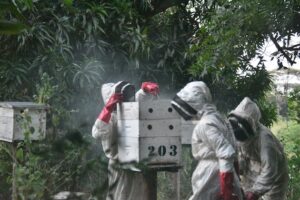
- African Beekeepers Limited (ABL): They aren't there for charity. They’re there because there is a stable environment to produce honey.
- Equator Kenya Limited: They signed contract farming agreements with the Tana Delta African Birds Eye Chilli Group.
- The Green Heart Initiative: This is a massive play to build an industrial estate in Minjila. The county donated 60 hectares of land to create a hub where these products—honey, chilli, milk, and rice—can be processed locally.
By using public money to build the governance and the roads, the project "de-risked" the area. It turned a "charity case" into a supply chain.
The Community Forest Association Factor
If you want to know who is actually doing the work, look at the Community Forest Associations (CFAs). In Kipini, the CFA members have planted nearly 100,000 mangrove seedlings.
The funding model here isn't just paying people a wage to plant trees. It’s about building cooperatives. Currently, 11 cooperatives with over 2,500 members are being trained in resource mobilization and marketing. When a member of the Golbanti women's group manages her 50 beehives, she isn't a "beneficiary"—she’s a business owner.
The financial flow looks like this:
- Grants pay for the nurseries, the training, and the legal frameworks.
- County Budgets pay for the roads and the industrial land.
- Private Partners provide the market and the off-take agreements.
- Community Cooperatives own the production and keep the profits.
Why One Percent Still Matters
If you look at the raw data, direct private sector investment is still less than 1% of the total project cost—roughly USD 341,000. Critics might say that's a failure. I’d argue it’s the most important 1% in the whole budget.
That money represents commercial viability. It’s the proof of concept that says, "You can make a profit while restoring this wetland." The goal of the GEF and UNEP isn't to fund this forever. It’s to move the needle so that in ten years, that 1% becomes 50%.
What You Can Learn from Tana
If you're looking at restoration projects—whether you're an investor, a policy-maker, or a conservationist—Tana proves that "integrated" isn't just a buzzword. It's a survival strategy.
- Stop looking for one big donor. Seek out "catalytic" funds that can be used to leverage local government budgets.
- Fix the law before you plant the tree. Without a Land Use Plan, your restoration project will eventually be grazed over or plowed under.
- Focus on value chains. If the community can't sell what they grow (or the honey they harvest), they won't protect the environment it comes from.
- Think like a developer. Treat the landscape like an "industrial estate" for nature. Build the infrastructure, secure the titles, and the private sector will eventually follow.
The Tana Delta is still a work in progress. It’s messy, and it’s hard. But by moving away from the "handout" model and toward a "blended finance" model, it’s actually giving the delta a fighting chance to stay green for the long haul.
Go look at your own local initiatives. Are they building a supply chain, or are they just burning through a grant? The answer to that question will tell you exactly how long they're going to last.