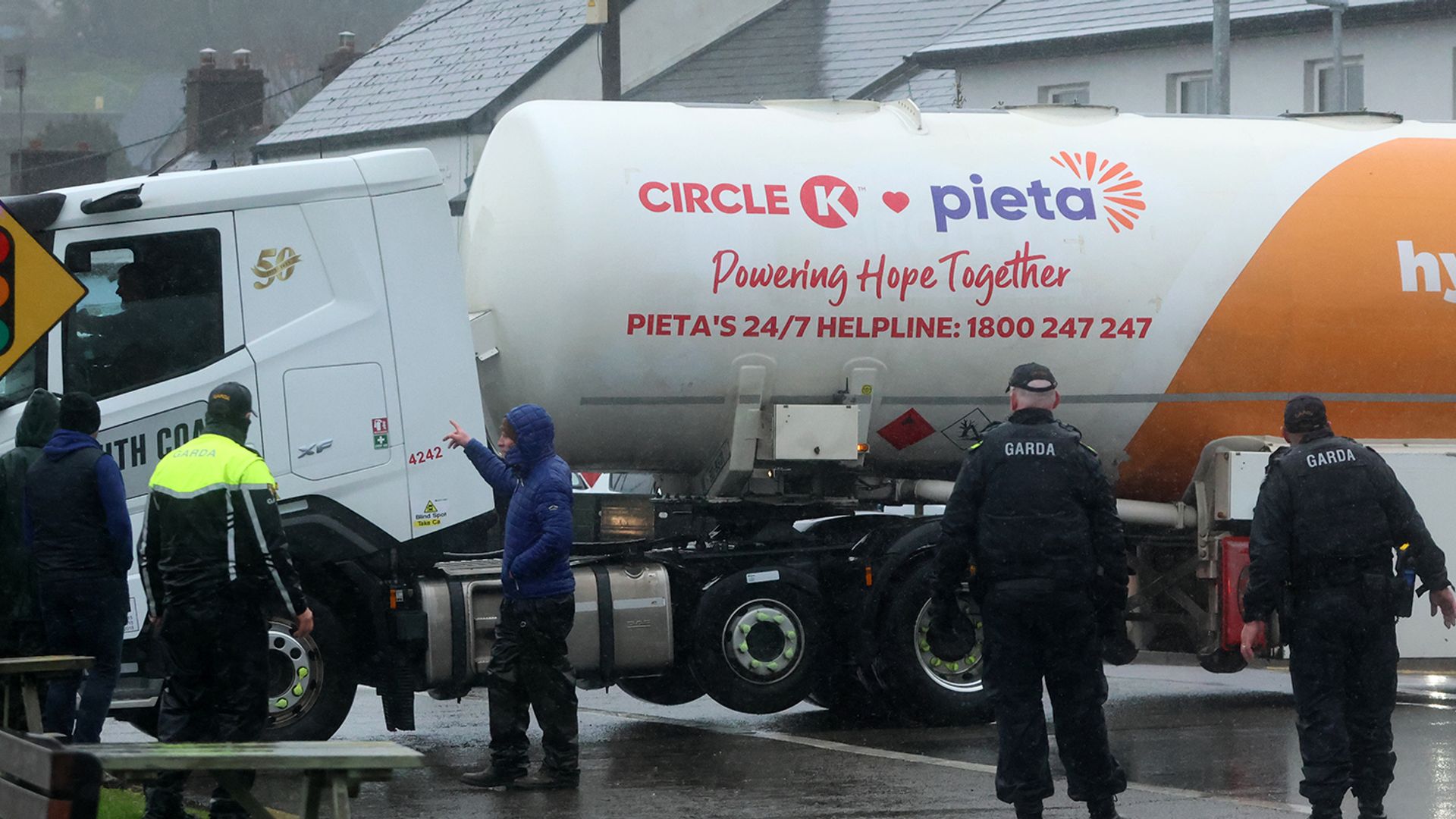
The resumption of fuel tanker operations at the Whitegate refinery in County Cork reveals a critical vulnerability in Ireland’s national energy security: the disproportionate impact of low-cost, high-leverage physical blockades on just-in-time fuel distribution. When protestors obstructed access to Ireland’s only crude oil refinery, they did not just stop trucks; they triggered a localized inventory drawdown that threatened to cascade into a regional logistics failure. Understanding the resolution of this standoff requires an analysis of the three structural pillars governing refinery output: physical throughput capacity, terminal access legality, and the psychology of supply chain anxiety.
The Triple Constraint of Refinery Logistics
Refinery operations are governed by a rigid flow-based architecture. Unlike modular manufacturing, a refinery cannot simply pause a single segment of its production line without affecting the entire chemical equilibrium. The Irving Oil facility at Whitegate processes roughly 75,000 barrels of crude oil per day, meeting approximately 40% of Ireland's fuel requirements. The disruption observed during the recent protests targeted the most sensitive node in this system: the "Last Mile" terminal gate.
- The Throughput Buffer: Refineries maintain storage tanks to absorb fluctuations in demand. However, these tanks have finite capacities. If tankers cannot exit the facility to deliver product to retail forecourts, the storage tanks fill to capacity. Once the "ullage" (available space) is exhausted, the refinery must throttle or shut down production units, a process that takes days to reverse and costs millions in thermal energy and lost yields.
- The Legal-Operational Friction: The delay in restoring access was not a failure of physical force but a complex negotiation of labor and civil law. Irving Oil’s reliance on injunctions highlights the gap between immediate operational needs and the slow machinery of the judiciary.
- Distribution Decay: Fuel has a shelf life in the context of economic movement. Every hour a tanker sits idle, the "deadweight" cost of the vehicle and the driver increases, while the retail stations downstream face a geometric increase in the risk of stockouts.
The Cost Function of Civil Disruption
The impact of the Whitegate protests can be quantified through a specific cost function. While the protesters focused on environmental or political grievances, the operational reality was an exercise in economic attrition.
The Total Disruption Cost ($C_{total}$) is defined by:
$$C_{total} = (L_{r} \times T_{d}) + (O_{c} \times V_{m}) + S_{p}$$
Where:
- $L_{r}$ is the Lost Revenue per hour of idle terminal time.
- $T_{d}$ is the total duration of the blockade.
- $O_{c}$ is the Opportunity Cost of diverted vessels or delayed crude shipments.
- $V_{m}$ is the Volatility Premium added to local fuel prices.
- $S_{p}$ is the Security and Legal Procurement cost required to break the impasse.
The competitor narrative suggests that the "resumption" of access is a return to normalcy. This is a flawed assumption. The resumption phase involves a "Logistics Bullwhip Effect." Because the supply chain was starved of movement for several days, the sudden release of tankers creates a bottleneck at the receiving end—the inland depots and retail stations. Drivers reach their maximum legal driving hours faster as they scramble to replenish dry stations, creating a secondary labor shortage immediately following the resolution of the physical blockade.
Structural Vulnerabilities in Irish Energy Infrastructure
The Whitegate incident exposes the danger of "Single Point of Failure" (SPOF) infrastructure. Because Whitegate is the sole refinery in the state, any disruption there forces an immediate shift to imported refined products from the UK or Continental Europe. This shift introduces two immediate risks:
1. The Basis Risk in Pricing
Importing refined petrol or diesel is more expensive than refining it domestically due to shipping costs, port fees, and the "spot market" premium. When Whitegate's output is throttled, the price at the Irish pump is no longer tied to crude oil prices but to the immediate availability of refined product in the ARA (Amsterdam-Rotterdam-Antwerp) hub.
2. Strategic Reserve Depletion
Ireland is mandated by the International Energy Agency (IEA) to maintain 90 days of oil reserves. However, these reserves are intended for global supply shocks, not localized terminal blockades. Frequent disruptions at the Whitegate gates force the National Oil Reserves Agency (NORA) to monitor stocks more aggressively, potentially triggering state intervention that signals market instability to international investors.
The Mechanism of Resolution: Injunctions and Enforcement
The restoration of access was not a result of the protesters' demands being met, but rather the exhaustion of their tactical leverage against a high-court injunction. In maritime and industrial law, the "Right to Pass" is often prioritized over the "Right to Protest" when the commodity in question is deemed critical infrastructure.
The legal framework used here—likely an interlocutory injunction—serves as a "Circuit Breaker." It shifts the risk from the corporation (Irving Oil) to the individuals. Once the injunction is served, the protest moves from a civil disagreement to a criminal contempt of court issue. The "recovery" of the refinery is therefore less about a change in sentiment and more about the re-establishment of the cost-of-consequence for the disruptors.
Operational Recovery Requirements
Moving forward, Irving Oil and the Irish state must address the "Restoration Lag." It is insufficient to simply open the gates. The following steps are required to stabilize the system:
- Prioritized Dispatch: High-volume retail hubs must be replenished first to prevent public panic, which causes "top-off" behavior—where consumers fill their tanks at 75% capacity, artificially spiking demand by 3-4x the normal daily rate.
- Buffer Recalibration: Increasing the "on-site" storage of refined products at secondary depots (like those in Dublin or Shannon) to decouple refinery gate access from retail availability.
- Hardened Access Points: Physical redesign of the Whitegate terminal entrance to allow for "sterile zones" where tankers can be staged behind secure perimeters before entering public roads, reducing the surface area for future blockades.
The Whitegate blockade was a successful stress test of Ireland’s energy resilience, conducted by an external party. The data shows that a relatively small group of individuals can desynchronize 40% of the nation’s fuel supply within 72 hours. This indicates that the current security posture is reactive rather than structural. To mitigate this, the strategic play is the diversification of the fuel mix and the expansion of strategic storage away from the primary refining node. Relying on a single gate for national mobility is an unacceptable operational risk.
Future resilience depends on the integration of automated terminal management systems that can reroute load-outs to alternative maritime jetties, bypassing land-based obstructions entirely. Until the physical "choke point" at the refinery gate is engineered out of the system, the Irish fuel supply remains a hostage to any sufficiently motivated group with the ability to park a vehicle in a narrow road.