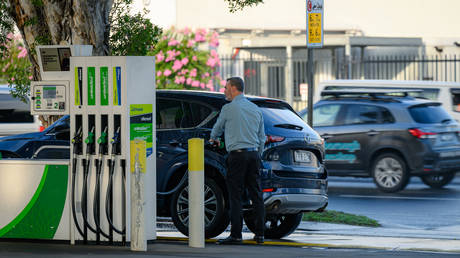
The Australian government’s recent public information campaign regarding fuel prices and consumer behavior represents a fundamental misunderstanding of price elasticity, infrastructure constraints, and the psychological architecture of the domestic energy market. While the stated objective was to provide transparency and mitigate cost-of-living pressures, the execution ignored the structural bottlenecks that dictate how and when Australians consume fuel. By examining the disconnect between the government's "shopping around" directive and the actual logistics of fuel retail, we can identify a significant misallocation of both public funds and political capital.
The Friction of Information Arbitrage
The central thesis of the government's campaign relies on the assumption that consumers possess perfect information and zero-cost mobility. This is a classic economic fallacy applied to a high-friction retail environment. In reality, the "savings" touted by the campaign are often offset by the operational costs of the search itself.
- The Search Cost Variable: Every kilometer driven to reach a cheaper service station incurs a literal cost in fuel and a figurative cost in time. If a consumer drives five kilometers out of their way to save $0.04 per liter on a 50-liter tank, the gross saving is $2.00. If the vehicle's fuel consumption is 10 liters per 100km, the 10km round trip consumes 1 liter of fuel—roughly $1.80 to $2.10 at current rates. The net economic gain is effectively zero or negative.
- The Information Gap: While apps like FuelCheck exist, they do not account for real-time traffic flow or the opportunity cost of the user's time. The government's push for "smarter" shopping ignores that fuel is a low-involvement, high-frequency purchase. Consumers generally optimize for convenience because the marginal utility of finding the absolute lowest price is dwarfed by the utility of time.
The Geometric Failure of Fuel Cycles
The Australian fuel market, particularly in East Coast capitals (Sydney, Melbourne, Brisbane), operates on a price cycle dictated by oligopolistic wholesale behaviors and inventory management. The campaign failed to address the systemic nature of these cycles, instead placing the burden of market correction on the end-user.
The Asymmetry of Price Transmission
Retailers exhibit a "rockets and feathers" pricing strategy: prices rise like rockets when wholesale costs increase or the cycle resets, but they drift down like feathers when costs decrease. By advising citizens to "wait for the drop," the government ignores the inelastic nature of demand. A commuter with a near-empty tank cannot wait three days for the cycle to hit its floor. This creates a regressive tax on those with the least flexible schedules—typically lower-income workers who lack the luxury of timing their purchases around market fluctuations.
Infrastructure Incompatibility
The campaign's focus on individual behavior distracts from the lack of sovereign fuel security and refining capacity. Australia’s reliance on imported refined product means domestic prices are almost entirely pegged to the Singapore Mogas 95 benchmark and the AUD/USD exchange rate. Public messaging that suggests local "shopping" can fix a global supply chain issue is intellectually dishonest. The primary drivers of the price at the pump are:
- International Benchmark Prices: Approximately 40-50% of the retail price.
- Taxes and Levies: The fuel excise is a fixed-rate tax (indexed to CPI) that does not fluctuate with the price, meaning the government’s revenue remains stable even as consumer pain increases.
- Wholesale and Retail Margins: Often the smallest portion of the total cost, yet the only one the government’s campaign targets.
The Cognitive Dissonance of Policy Objectives
There is a glaring contradiction between the government’s long-term decarbonization goals and a short-term campaign focused on subsidizing or facilitating fossil fuel consumption. This creates a "policy debt" where the government uses taxpayer money to tell taxpayers how to spend more money on a product the government intends to phase out via Electric Vehicle (EV) mandates and emissions standards.
The "ridiculous" nature of the campaign, as cited by critics, stems from this lack of alignment. If the objective is to reduce the cost of living, the more effective lever is the removal or reduction of the fuel excise. However, because the excise is a critical revenue stream for road infrastructure, the government is trapped in a circular logic: it needs the high fuel taxes to fund the roads, but it needs to appear sympathetic to the voters paying those taxes.
The Quantitative Reality of the Fuel Excise
The Australian fuel excise is currently 49.6 cents per liter. For a standard 60-liter tank, $29.76 goes directly to the federal treasury before the consumer even accounts for the cost of the fuel itself or the 10% GST applied on top of the excise.
- The Double-Taxation Mechanism: GST is calculated on the total price, including the excise. This means the government is taxing a tax.
- Revenue Neutrality: When the government spends millions on an advertising campaign urging people to save $2.00 at the pump, it is simultaneously collecting nearly $30.00 from that same transaction. This creates a credibility gap that no amount of creative marketing can bridge.
Strategic Realignment of Energy Communications
To move beyond the current backlash, the communication strategy must shift from behavioral nudges to structural transparency. A data-driven approach would involve:
Real-Time Margin Disclosure
Instead of telling consumers to "look for the best deal," the government could mandate that service stations display their current margin over the daily wholesale price (Terminal Gate Price). This shifts the onus of transparency from the consumer to the retailer, utilizing market pressure rather than individual labor to drive down prices.
Indexing Relief to Volatility
A more sophisticated policy would involve a sliding-scale excise. When international benchmarks exceed a certain threshold, the excise could automatically trigger a temporary reduction. This provides immediate, non-discretionary relief that does not require a marketing budget to explain. It acknowledges that fuel is an essential input for the majority of the Australian workforce, particularly in outer-suburban and regional areas where public transport is non-existent.
The Distributional Impact of Geographic Disparity
The government's advice is particularly disconnected from the reality of regional Australia. In metropolitan areas, a "cheaper station" might be three kilometers away. In regional hubs, the next station might be fifty kilometers away.
- Monopolistic Corridors: In many rural settings, a single distributor controls the majority of retail outlets. "Shopping around" is a physical impossibility.
- The Freight Multiplier: High fuel prices in regional areas don't just affect the family car; they increase the cost of every good delivered to those areas. A campaign focused on "personal savings" ignores the systemic inflation triggered by fuel costs in the logistics sector.
The Efficiency Paradox
This campaign exemplifies "The Efficiency Paradox" in public policy: the more the government tries to optimize individual micro-behaviors, the more it tends to ignore the macro-inefficiencies it actually controls. By focusing on the 2% of the price a consumer might save by driving across town, the government successfully avoids a public debate on the 25-30% of the price it controls through the excise and GST.
The path forward requires a cessation of "consumer education" campaigns that treat the public as if they lack basic arithmetic skills. Instead, the focus must move to the underlying components of the Australian energy mix. The backlash is not merely about the content of the ads; it is a reaction to the perceived condescension of a state that profits from a commodity while lecturing its citizens on the "correct" way to buy it.
The strategic play is to pivot resources away from retail behavior modification and toward the acceleration of alternative transport infrastructure. Every dollar spent on a "fuel-saving" ad is a dollar not spent on fast-charging networks or hydrogen freight corridors—the only long-term solutions to the volatility of the Singapore Mogas benchmark. The government must decide if it is a regulator of an essential service or a passive observer of a market it continues to heavily tax. Until that distinction is made clear, public skepticism will remain the default response to any "helpful" fuel intervention.