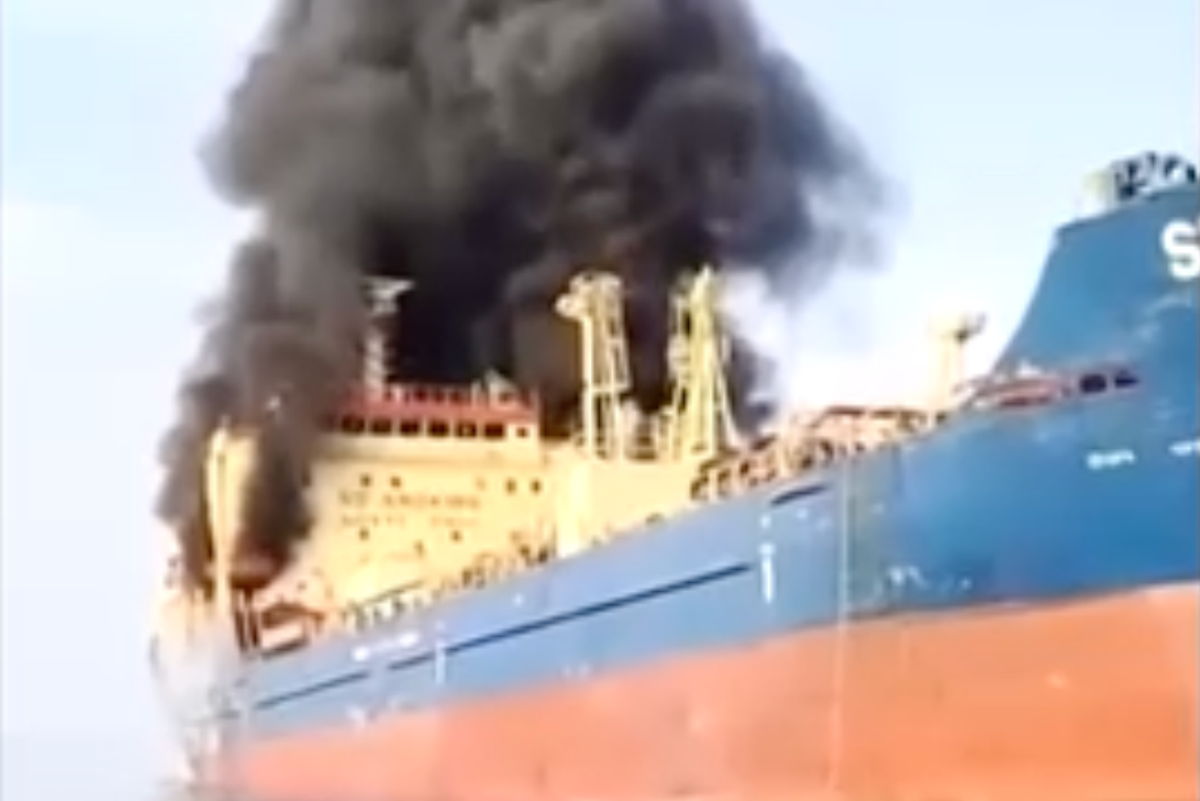
The global energy market functions on a thin margin of logistical reliability, a reality laid bare whenever kinetic friction occurs near the Strait of Hormuz. While general media reports focus on the "fear" of rising prices, a structural analysis reveals that the current price spike is not merely a reaction to headlines but a calculated repricing of the Maritime Risk Premium. This premium accounts for the potential disruption of approximately 21 million barrels of oil per day (bpd), representing roughly 21% of global petroleum liquids consumption. When Iran targets shipping vessels, it is not just attacking a hull; it is stress-testing the global supply chain’s elasticity.
The Mechanics of the Hormuz Chokepoint
The Strait of Hormuz is a geographic bottleneck where the shipping lane narrows to a width of only two miles in either direction. This physical constraint creates a binary risk environment. Unlike other transit points, there are no immediate, high-capacity alternatives for the crude oil and liquefied natural gas (LNG) flowing from Saudi Arabia, the UAE, Kuwait, Iraq, and Iran.
The primary logic of the current price surge can be broken down into three specific pillars:
- Insurance and Freight Escalation: As soon as a kinetic strike is confirmed, "War Risk" insurance premiums for tankers in the Persian Gulf move from a negligible overhead to a significant percentage of the cargo’s value. This cost is immediately passed through the spot market.
- Inventory De-stocking Logic: Refineries operating on "just-in-time" delivery models are forced to draw down inventories to hedge against potential transit halts. This increases immediate demand for non-Gulf crudes (such as Brent or WTI), driving a wedge between regional price benchmarks.
- The LNG Contingency: While oil dominates the conversation, the Strait facilitates nearly 20% of the world’s LNG trade. A prolonged disruption threatens the power grid stability of major Asian economies—specifically Japan and South Korea—which have limited domestic energy storage.
The Disruption Cost Function
To quantify the impact of these attacks, we must look at the Disruption Cost Function. This isn't a simple linear relationship where "Attack = $X Increase." Instead, the market calculates the probability of a total blockade versus "harassment-style" disruptions.
- Level 1: Harassment (Current State): Small-scale attacks or seizures. This adds a $5 to $10 "security tax" per barrel. The physical supply remains intact, but the certainty of delivery time is compromised.
- Level 2: Target Escalation: Attacks on critical infrastructure or multiple tankers. This triggers a decoupling of oil prices from standard supply-demand fundamentals, shifting the market into a state of "Preemptive Scarcity."
- Level 3: Total Blockade: A closure of the Strait. Modeling suggests this would remove 15-20 million bpd from the market. Given that global spare capacity (mostly held by Saudi Arabia) is currently estimated at only 4-5 million bpd, the math dictates a catastrophic supply deficit that cannot be bridged by the Strategic Petroleum Reserve (SPR) alone.
Assessing the Bypass Infrastructure Paradox
A common fallacy in energy reporting is the assumption that pipelines can easily mitigate a Hormuz closure. A clinical audit of existing bypass infrastructure reveals significant bottlenecks.
- The East-West Pipeline (Saudi Arabia): Has a nameplate capacity of approximately 5 million bpd. However, utilizing this at 100% efficiency requires complex logistical shifts and only covers a fraction of Saudi exports.
- The Abu Dhabi Crude Oil Pipeline (ADCOP): Can move roughly 1.5 million bpd to the port of Fujairah.
- The Total Shortfall: Combined, all functional bypass routes can handle perhaps 6.5 to 7 million bpd. This leaves a minimum of 14 million bpd stranded—a volume equivalent to the total daily production of the United States.
The Role of Shadow Fleets and Sanctions Evasion
The complexity of these ship attacks is deepened by the presence of the "shadow fleet"—tankers operating outside Western insurance and regulatory frameworks to transport sanctioned Iranian and Russian oil. These vessels often turn off their Automatic Identification Systems (AIS), making the maritime environment less transparent. When Iran targets "vessels," it often selects targets to signal specific geopolitical displeasure, but the collateral damage to the "dark fleet" logistics can ironically hurt Iran's own revenue streams. This creates a self-limiting loop on how far Tehran can push a blockade before it bankrupts its own export-dependent economy.
Macroeconomic Feed-through and the Inflationary Spiral
Central banks view oil prices as a "tax on the consumer." When prices soar due to Middle Eastern instability, the effect is twofold:
Direct Compression of Disposable Income
Higher fuel costs act as an immediate drain on household spending. Because energy demand is relatively inelastic in the short term, consumers cannot quickly switch to alternatives. This slows GDP growth in energy-importing nations.
The Logistics Multiplier
Oil is an input for almost every physical good. Higher bunker fuel prices for container ships and higher diesel costs for trucking fleets mean that a "temporary" oil spike translates into "permanent" price increases for retail goods. If the Strait of Hormuz risk remains elevated for more than one fiscal quarter, the probability of a "higher-for-longer" interest rate environment increases as central banks fight the resulting cost-push inflation.
Strategic Implications for Global Refiners
Refineries in the Atlantic Basin are currently re-evaluating their crude slates. The risk in the Persian Gulf makes West African (light sweet) and Brazilian (medium sour) grades more attractive despite higher baseline prices. This geographic shift in procurement creates a "bidding war" for non-Middle Eastern barrels, which explains why WTI and Brent often rise even if the specific ships attacked were bound for Asian markets.
Structural Vulnerability in Maritime Security
The reliance on the U.S. Fifth Fleet to guarantee freedom of navigation is a single point of failure. As global naval assets are stretched across the Red Sea (addressing Houthi threats) and the South China Sea, the density of protection in the Strait of Hormuz has decreased. This security vacuum allows for the "gray zone" tactics currently being employed—actions that fall below the threshold of war but high enough to disrupt global commerce.
Deterministic Outlook and Portfolio Positioning
The market is currently pricing in a 15% probability of a major regional conflict. If this probability moves to 30%, expect a "flight to quality" where capital exits emerging market equities and enters gold and US Treasuries, despite the inflationary nature of the oil shock.
The immediate strategic requirement for energy-intensive industries is the implementation of Volumetric Hedging. Rather than just hedging the price of oil, firms must secure physical supply contracts from diverse geographic origins. Reliance on "the market" to provide liquidity during a Hormuz crisis is a failure of risk management; in a total blockade scenario, liquidity vanishes, and only physical possession of inventory determines operational survival.
The most critical metric to watch over the next 48 hours is the Tanker Tracking Data (AIS gaps). An increase in ships "going dark" near the Strait is a leading indicator of an imminent escalation in kinetic activity. Organizations should move to a maximum-storage posture, prioritizing the filling of onsite tanks regardless of current spot price premiums, as the cost of a complete stock-out far outweighs the current $10/barrel risk premium.