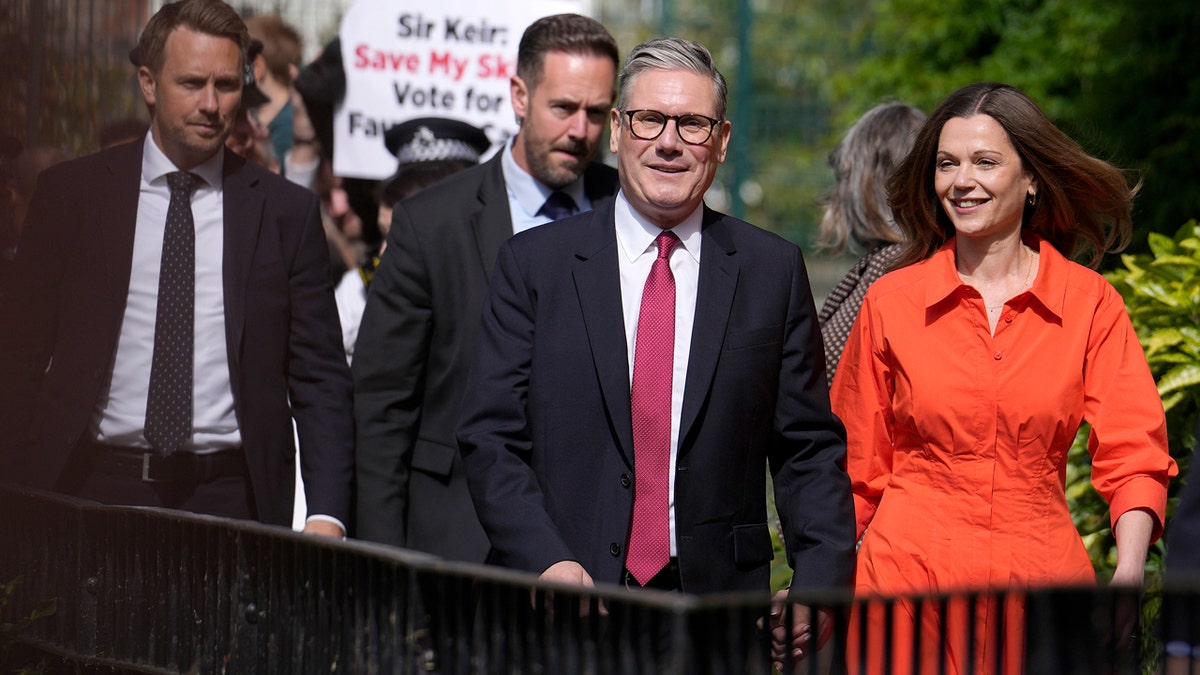
The British press is currently addicted to a specific brand of fan fiction. They call it the "Starmer Resignation Watch." It is a lazy, recycled narrative built on the shaky premise that a few plummeting poll numbers and a standard internal row over "freebies" or fiscal policy will send a sitting Prime Minister with a historic majority packing his bags.
It won't. Also making waves in this space: The Invisible Walls Holding the World Together.
If you are waiting for Keir Starmer to resign, you aren't watching politics; you are watching a soap opera. The punditry class is applying the volatility of the Boris Johnson era to a man whose entire career is defined by a slow, agonizingly methodical consolidation of power. They are mistaking a lack of charisma for a lack of control.
The consensus suggests that Starmer is one crisis away from a 1922 Committee-style execution. This is fundamentally wrong. To understand why Starmer isn't going anywhere, you have to stop looking at the headlines and start looking at the plumbing of the Labour Party. Additional details into this topic are detailed by The New York Times.
The Tyranny of the 174-Seat Cushion
The most basic math in Westminster is being ignored. Starmer sits on a majority of 174. In the history of British democracy, a majority of this size has never been overturned by internal bickering within a single term.
When people ask "Will Keir Starmer resign?", they are usually comparing him to Liz Truss or Rishi Sunak. This is a false equivalence of the highest order. Truss fell because she didn't have the numbers and she spooked the bond markets. Starmer has the numbers, and the markets—while perhaps uninspired—are not in a state of revolt.
The "People Also Ask" sections of the internet are currently obsessed with whether the Labour Party can trigger a leadership vote. Here is the brutal reality: They can't. Unlike the Conservative Party, where 15% of the parliamentary party can trigger a confidence vote with a handful of letters, the Labour mechanism is designed to protect the incumbent.
To challenge a sitting Labour leader, you need a massive groundswell from the PLP (Parliamentary Labour Party) and a conference vote. It is a labyrinthine, bureaucratic nightmare. Starmer, the former Director of Public Prosecutions, knows the rulebook better than the people trying to use it against him. He didn't just win the leadership; he re-engineered the party's internal DNA to ensure that the "loony left" or disgruntled centrists have no lever to pull.
The "Freebie" Fallacy
The noise surrounding Taylor Swift tickets and designer glasses is a classic Westminster bubble distraction. It is "optics-bad" but "mechanically-irrelevant."
I have seen political careers end over scandals, but they are almost always scandals of legality or parliamentary viability. Starmer’s gift-gate is a scandal of hypocrisy. Hypocrisy is a stain, but in the world of raw power, it isn't a terminal illness. Voters might find it distasteful, but backbenchers don't commit political suicide—which is what toppling a leader with a 170+ majority looks like—over a pair of spectacles.
The pundits argue that his personal approval ratings are "the worst for a new PM in decades." True. Also, irrelevant.
Starmer does not care about being liked. He cares about being the only viable option. By purging the Corbynite wing and marginalizing the loudest critics, he has created a vacuum where there is no "King across the water." Who replaces him? Rachel Reeves? She is tethered to the same fiscal rules that are making the government unpopular. Angela Rayner? The establishment would sooner dissolve Parliament.
The Fiscal Trap is a Feature, Not a Bug
The most sophisticated critique of Starmer is that his "poverty of ambition" and fiscal conservatism will lead to a stagnation that forces him out.
This assumes Starmer is an idealist who is failing. He isn't. He is a manager who is succeeding at his specific goal: making Labour the "safe" party of capital.
The Chancellor’s tight grip on the purse strings isn't a mistake that Starmer is accidentally overseeing. It is the strategy. They are betting that by 2028, the memory of the "tough choices" of 2024 will be replaced by a narrative of "stability regained."
Imagine a scenario where Starmer did exactly what the critics wanted—borrowed billions for immediate public sector pay rises and scrapped the two-child benefit cap in month one. The headlines would be better for a week. Then, the gilt markets would twitch, the "Labour Spendthrift" narrative would return, and the right-wing press would have a roadmap to his destruction.
By taking the pain now, Starmer is effectively "front-loading" his unpopularity. It is a high-stakes gamble, but it is one made from a position of absolute structural strength.
Why the Media Wants Him to Quit
The media’s obsession with a Starmer resignation isn't based on evidence; it's based on boredom.
The 2010-2024 era of British politics was a high-octane circus. We had Brexit, a pandemic, the fall of a "World King," a 44-day premiership, and the slow-motion collapse of the Tory party. The press corps is addicted to the adrenaline of a leadership crisis.
Starmer is boring. His government is a gray, technocratic machine. For a political journalist, a Prime Minister who refuses to implode is a disaster for clicks. Therefore, they must manufacture the possibility of an implosion. They frame every cabinet disagreement as a "civil war" and every dip in the polls as a "death spiral."
The truth is much less exciting: Keir Starmer will likely be Prime Minister for the next five to ten years.
The Real Threat Isn't the Party—It's the Inertia
If Starmer ever does resign prematurely, it won't be because of a scandal or a coup. It will be because of the "Gray Rot."
This is the only nuance the mainstream analysis gets right by accident: a leader can become so synonymous with stagnation that their own party stops defending them. But we are years away from that.
Right now, the Labour Party is filled with hundreds of new MPs who owe their entire careers to the fact that Starmer moved the party to the center. They aren't going to sharpen the knives while the ink is still wet on their expenses claims. They are scared, they are disciplined, and they are acutely aware that the alternative to Starmer isn't a more popular Labour leader—it's a resurgent right.
The Wrong Question
Stop asking if Keir Starmer will resign. It’s the wrong metric for the current political climate.
The question you should be asking is: "What does Starmer do with a power base that has no effective opposition?"
He has neutralized the left. He has broken the right (for now). He has a majority that makes him a constitutional dictator for five years. He isn't looking for the exit; he's looking at the foundations.
To expect a man who spent years ruthlessly dismantling his predecessor’s legacy to simply walk away because of a bad month of headlines is to fundamentally misunderstand the nature of the person in Number 10. He is a prosecutor. He builds cases. He waits. He wears the opposition down.
The resignation rumors are just noise from a gallery that misses the circus. The ringmaster is staying put, and he doesn't care if you like the show.