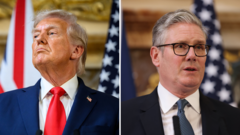
The British media is currently hyperventilating over a ghost. They’ve spent the last week clutching their pearls because Donald Trump compared Keir Starmer to Winston Churchill—unfavorably, to say the least. The consensus in Westminster is that this "jibe" marks a crisis in the "Special Relationship."
They’re wrong. You can’t have a crisis in something that doesn’t exist.
The obsession with whether a U.S. President likes a British Prime Minister is a pathetic vestige of a post-war era that ended decades ago. While pundits worry about "recovering" the bond, they’re missing the brutal reality: the U.S. has moved on, and the UK is still standing by the phone like a jilted lover.
The Churchill Myth is a Strategic Liability
Stop calling it the Special Relationship. In Washington, it’s rarely called that outside of state dinners where the wine is expensive and the sentiment is cheap. For the U.S., the UK is a useful mid-sized satellite, not an equal partner.
The "Churchill jibe" isn't a diplomatic disaster; it’s a moment of clarity. By mocking Starmer’s lack of "Churchillian" grit, Trump isn't just insulting a man; he’s insulting the British delusion that 1945 still matters. The UK treats its history like a defensive shield, but in the halls of the Mar-a-Lago or the West Wing, it’s seen as a dusty relic.
When the British press asks "Can the relationship recover?" they are asking the wrong question. The real question is: Why do we still want it to?
The Asymmetry of Need
I’ve sat in rooms where UK trade delegations try to "leverage" historical ties to get better terms. It never works. American negotiators don't care about the beaches of Normandy; they care about the Silicon Fen, intelligence sharing, and who is going to buy their liquefied natural gas.
The UK needs the U.S. for:
- Nuclear Deterrent: The Trident system is fundamentally American.
- Intelligence: Five Eyes is the only place where the "special" tag carries actual weight.
- Finance: The London-New York corridor is the lifeblood of the global economy.
The U.S. needs the UK for:
- A convenient aircraft carrier in the North Atlantic.
- A reliable vote at the UN Security Council.
That’s it. It’s a transaction. When Starmer tries to play the "grown-up in the room," he’s bringing a butter knife to a drone strike. Trump respects power, ego, and clear-cut wins. He doesn't respect "protocol" or "traditional alliances."
The "Adults in the Room" Fallacy
The common refrain from the Starmer camp is that they will provide "stability" and "pragmatism." This is a fundamental misunderstanding of the current American political climate. In a world of populist upheaval, "stability" is just another word for "stagnation."
If you want to influence a Trump administration—or any modern U.S. administration—you don't do it by being polite. You do it by being indispensable or being a nuisance. The UK is currently neither.
The British government is terrified of being "belittled." They should be terrified of being ignored. Being insulted by Trump means you’re on his radar. Being ignored means you’re irrelevant. The current panic over the "No Churchill" comment shows that the UK establishment is still playing by 20th-century rules in a 21st-century cage match.
The Real Cost of Fawning
The "Special Relationship" acts as a cognitive tax on British foreign policy. Because the UK is so desperate to maintain the illusion of closeness, it frequently ignores its own strategic interests.
Take trade. The UK spent years chasing a U.S. free trade deal that was never going to happen. Why? Because the "Special Relationship" convinced them they were first in line. They weren't. They were just another medium-sized economy in a world of giants.
By the time the UK realized the U.S. was pivoting to protectionism, they had already burned bridges with their closest neighbors. That’s the price of nostalgia. It’s expensive, and it buys you nothing but a condescending pat on the head and a mean tweet.
Dismantling the "People Also Ask" Delusions
Does the U.S. still value the UK as its top ally?
No. The "top ally" is whichever country is most useful for the specific problem of the week. Sometimes it's Poland. Sometimes it's Japan. Sometimes it's Israel. The UK is a reliable partner, but the idea of a "top" spot is a fantasy the British tell themselves to feel better about their declining global influence.
Can Starmer and Trump work together?
Of course they can. They’re both politicians. But it won't be based on shared values or "the spirit of 1940." It will be a cold, hard exchange of favors. If Starmer wants Trump’s respect, he needs to stop trying to be a "statesman" and start being a dealmaker.
Is the Special Relationship over?
It never existed in the way the public thinks it did. It was a wartime necessity that turned into a marketing slogan. The marketing is finally failing.
The Pivot to Reality
Instead of trying to "repair" a broken myth, the UK needs to build a new identity.
- Stop referencing the World Wars. Every time a British politician mentions Churchill to an American audience, an angel loses its wings and a trade negotiator loses interest.
- Double down on tech and defense. Be the indispensable hub for AI regulation or the primary provider of specialized military tech. Make it so the U.S. can't ignore you, regardless of who is in the Oval Office.
- Accept the asymmetry. Stop pretending this is a partnership of equals. It’s a client-patron relationship. Once you accept that, you can actually start negotiating effectively.
The "Churchill jibe" isn't the end of an era; it’s the unveiling of the truth. Trump didn't break the Special Relationship. He just pointed out that it was already a corpse.
Stop trying to perform CPR on a ghost. Look at the world as it is, not as the history books say it should be. The U.S. isn't looking for a "special" partner. It's looking for a partner that brings something to the table other than a stiff upper lip and a collection of old medals.
If the UK can’t find something new to offer, it should get used to being the punchline.
Stop mourning the "Special Relationship." It’s the most liberating thing the UK could do.
The phone isn't going to ring just because you're polite. Either buy the lunch or leave the restaurant.