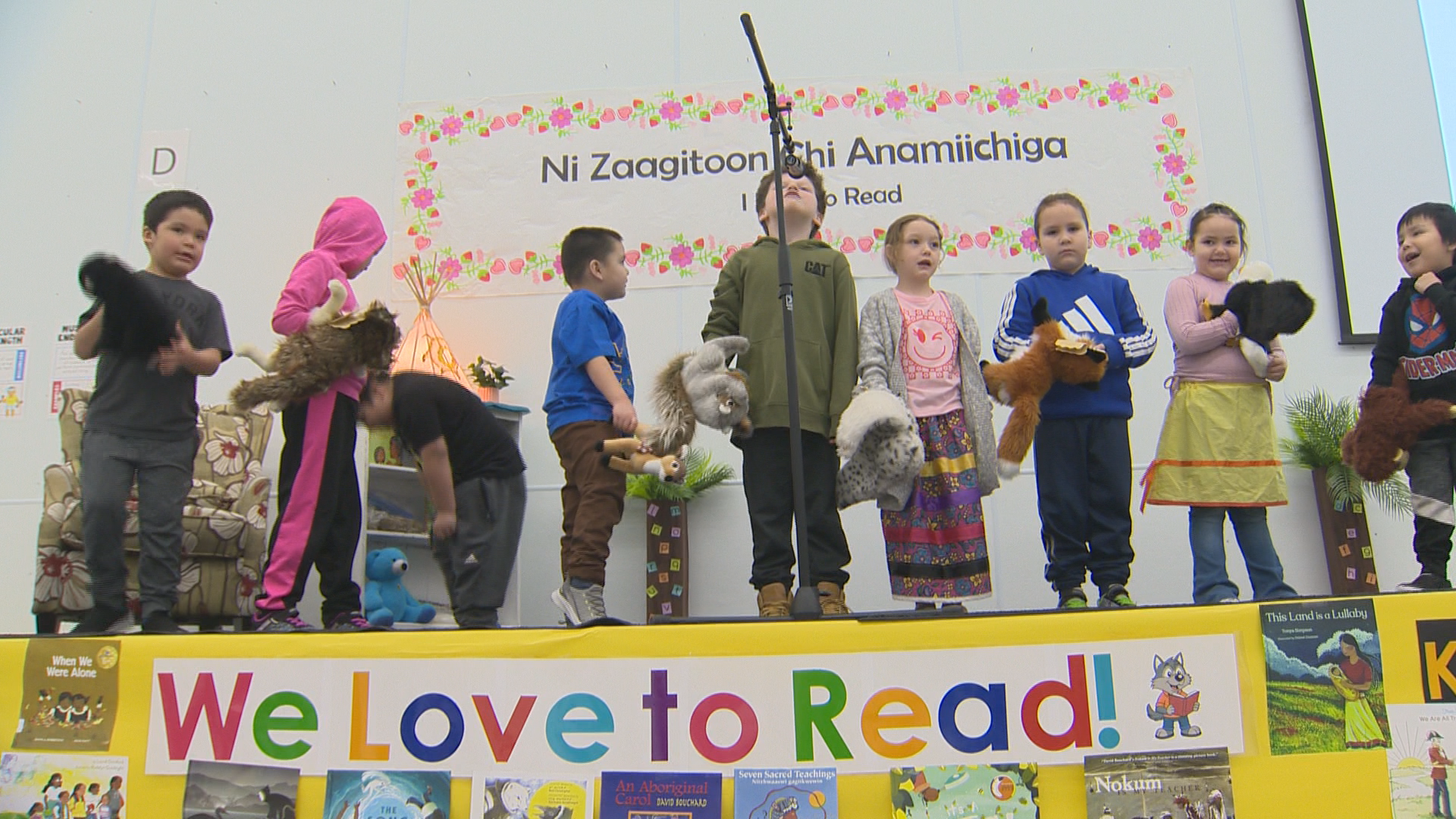
In the quiet stretches of the Brokenhead Ojibway Nation, silence usually carries the weight of the wind or the distant hum of a passing truck. But inside the walls of Sergeant Tommy Prince School, silence used to be a heavier thing. It was the weight of a child looking at a string of black marks on a white page and seeing only a locked door. It was the stillness of a classroom where the teacher asks a question and twenty sets of eyes drop to the floor, hoping to become invisible.
Illiteracy isn't just about failing a test. It’s a ghost that haunts a dinner table when a father can’t read the dosage on a medicine bottle or a mother can’t help with homework because the words feel like a foreign language. For a long time, the statistics at Sergeant Tommy Prince School told a story that many had heard before—one of struggle, of systemic gaps, and of a literacy rate that refused to budge.
Then, the rhythm changed.
The recent data coming out of the school doesn't just show a minor uptick; it shows a transformation. Literacy rates are climbing, not by accident, but through a deliberate, human-centric overhaul of how these children interact with their own voices. To understand how they did it, you have to look past the spreadsheets and into the small, messy moments of a primary classroom.
Consider a hypothetical student named Leo. At seven years old, Leo is a master of deflection. If you ask him to read, he’ll tell you his stomach hurts. He’ll drop his pencil. He’ll crack a joke to make the class laugh because being the "funny kid" is infinitely better than being the "kid who can't read." For Leo, the alphabet isn't a tool; it’s a barrier between him and the rest of the world.
When a school decides to tackle literacy, they usually start with more books. But Sergeant Tommy Prince School realized that books are useless if the child doesn't feel safe enough to fail. They shifted the focus toward a "Science of Reading" approach, which sounds clinical until you see it in practice. It’s the process of breaking the code. It’s teaching Leo that letters make sounds, sounds make words, and words are the keys to his own history.
The teachers didn't just stand at the front of the room. They became co-conspirators in a grand decoding project. They utilized intensive, small-group sessions where the shame of "getting it wrong" was replaced by the curiosity of "how it works." They moved away from the old method of "balanced literacy"—which often encouraged kids to guess words based on pictures—and moved toward phonemic awareness. They taught the mechanics of the engine before asking the kids to drive the car.
The results were immediate and visceral.
The school reported that a significant percentage of students who were previously "at risk" have moved into the "proficient" category. But what does that actually look like? It looks like Leo sitting in the corner of the library, not hiding, but hunting. He’s looking for a book about wolves because he realized that he no longer needs someone else to tell him what the caption says. He can claim that knowledge for himself.
This isn't just a win for the school board. It’s a reclamation of power. For Indigenous communities, literacy is inextricably linked to sovereignty and the preservation of culture. When a child learns to read English fluently, they gain the tools to navigate the modern world, but more importantly, they gain the cognitive foundations to revitalize their own language. The discipline of decoding—understanding how symbols represent sounds—is the same muscle used to learn Anishinaabemowin.
We often treat education like a factory line. We put the raw material in at age five and expect a finished product at eighteen. But Sergeant Tommy Prince School treated it like a garden. They recognized that the soil was packed hard by decades of intergenerational trauma and underfunding. You can't just throw seeds on hard dirt and get angry when nothing grows. You have to till the earth. You have to provide the right nutrients.
The "nutrients" in this case were a combination of specialized training for staff and a cultural integration that made the school feel like an extension of the home. They didn't just teach reading; they celebrated it. They made the act of finishing a book feel as significant as scoring a goal in hockey.
The real problem with the way we talk about "literacy rates" is that the term is too cold. It suggests a binary—you can either read or you can't. It misses the middle ground: the stuttering start, the frustrated tear, the moment of clarity when the word cat stops being three shapes and starts being an animal. It misses the pride in a grandmother’s eyes when her grandson reads her a letter from the government.
There is a specific kind of electricity in a room when a child realizes they are no longer trapped. You can see it in the way they sit up straighter. Their shoulders drop. The world, which once felt small and confusing, suddenly expands in every direction.
The success at Sergeant Tommy Prince School serves as a rebuttal to the quiet, cynical belief that some gaps are too wide to close. It proves that the "gap" isn't a lack of intelligence or potential; it’s a lack of the right bridge. They built a bridge out of phonics, patience, and a refusal to let any child remain invisible.
As the sun sets over Scanterbury, the school building sits quiet. But the silence is different now. It’s the silence of a community that has found its rhythm. It’s the pause between chapters.
Somewhere in a house nearby, a light is still on. A child is tucked under a blanket, squinting at a page, moving a finger slowly under a line of text. They aren't guessing anymore. They are knowing. The ghost is gone, and in its place is the steady, rhythmic sound of a page turning.
The door is finally open.


