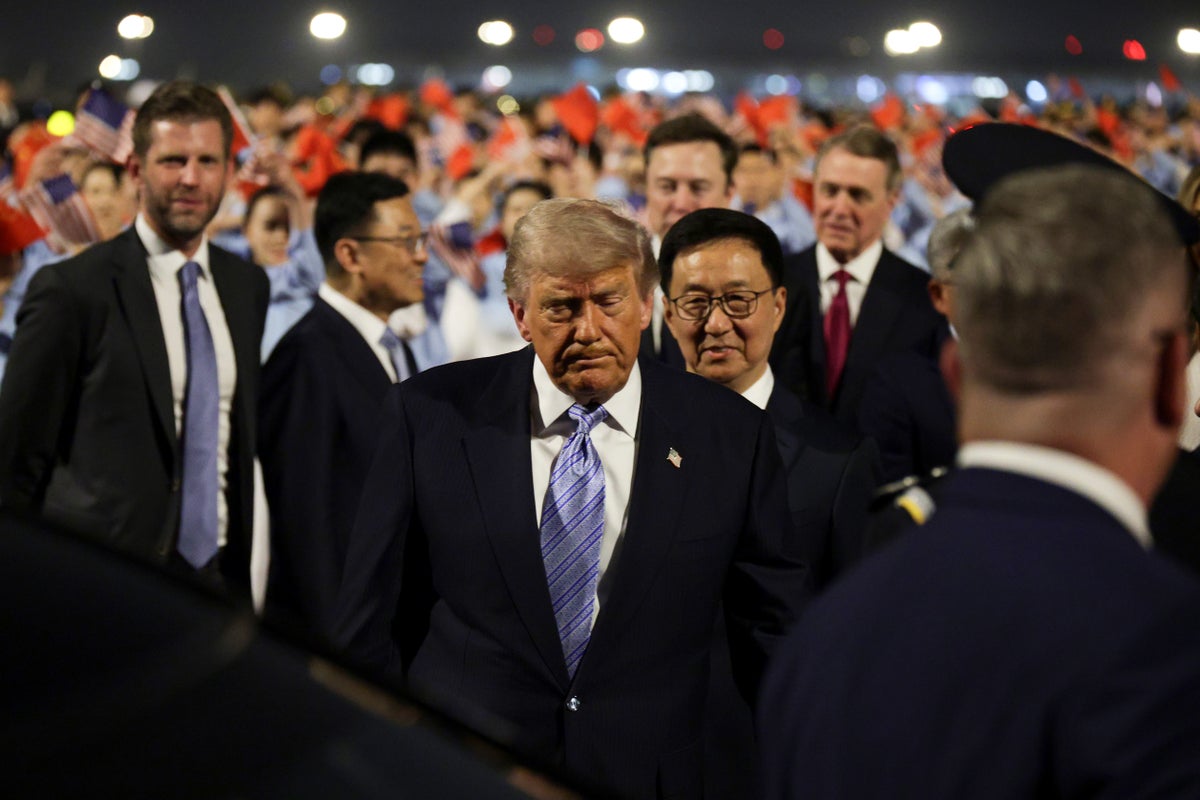
The arrival of the American executive delegation in Beijing signals a transition from decoupled containment to a high-stakes recalibration of global supply chains. While public-facing imagery emphasizes ceremonial optics—red carpets and choreographed welcomes—the underlying structural reality is an urgent negotiation over the fundamental architecture of the 21st-century economy. This visit is not a diplomatic formality; it is a critical synchronization of the world’s two largest capital markets at a moment of extreme friction.
The presence of the Tesla and SpaceX leadership alongside the U.S. Presidency indicates that the "Two-Track Diplomacy" model has reached its logical conclusion. The first track handles the political theater of sovereignty and trade barriers, while the second track—the industrial track—manages the literal flow of atoms and bits that sustain modern civilization.
The Trilateral Power Dynamics of the Beijing Summit
Understanding the gravity of this meeting requires deconstructing the participants into their functional roles rather than their titles. We are witnessing a convergence of three distinct power centers:
- The Sovereign Arbitrator (The U.S. Presidency): Responsible for the regulatory environment, tariff structures, and the "Small Yard, High Fence" policy regarding sensitive technologies.
- The Industrial Integrator (Elon Musk/Tesla/SpaceX): Represents the physical manifestation of cross-border manufacturing. Tesla’s Giga Shanghai remains the gold standard for foreign direct investment (FDI) efficiency in China, serving as the bridge between American software design and Chinese hardware scale.
- The State Capitalist (The CCP Leadership): Managing a domestic economic pivot from real estate-driven growth to "New Productive Forces" such as electric vehicles (EVs), lithium-ion batteries, and photovoltaic cells.
The strategic misalignment between these groups has created a bottleneck in global markets. The U.S. seeks to "de-risk" without sacrificing the consumer price index, while China seeks to export its way out of a domestic demand slump. The Beijing summit is the primary venue for negotiating the terms of this uneasy coexistence.
The Cost Function of Decoupling vs. Managed Interdependence
Decoupling was never a binary switch; it is a cost function. The previous four years demonstrated that removing China from the global supply chain carries a premium that Western consumers and corporations are increasingly unable or unwilling to pay.
The Elasticity of the Supply Chain
The "China Plus One" strategy—moving manufacturing to Vietnam, India, or Mexico—has revealed significant hidden costs:
- Infrastructure Deficits: Port congestion and unreliable power grids in emerging markets add a 15-20% inefficiency tax compared to China’s integrated logistics.
- Skill Gaps: The specialized labor force required for high-precision electronics and battery assembly is not yet at scale outside of the Pearl River and Yangtze River Deltas.
- Sub-tier Dependency: Even products "Made in Vietnam" often rely on 60-80% Chinese-made sub-components, rendering total decoupling a mathematical impossibility in the short term.
The Beijing visit serves to codify a "Managed Interdependence" framework. In this model, the U.S. maintains its restrictions on high-end semiconductors (the "High Fence") while loosening the grip on mid-tier industrial manufacturing and consumer goods. This allows the U.S. to curb inflation while China secures the foreign currency inflows necessary to stabilize its banking sector.
The Tesla Proxy and the EV Geopolitics
Elon Musk’s role in this delegation is uniquely tactical. He functions as a sovereign-level entity whose interests are often more aligned with the physical reality of manufacturing than the ideological requirements of Washington or Beijing.
The Gigafactory Leverage
Tesla’s presence in China provides the CCP with a "demonstration effect"—a high-profile proof of concept that China remains open for business despite geopolitical tensions. For the U.S., Tesla acts as an intelligence and influence vector within the heart of China’s high-tech manufacturing sector.
The negotiation focuses on several critical variables:
- Data Sovereignty: The terms under which Tesla can export Full Self-Driving (FSD) training data to U.S.-based servers.
- Market Access vs. IP Transfer: The traditional "market for technology" swap is being renegotiated. China now possesses the superior EV battery technology (CATL, BYD), meaning the flow of innovation is increasingly moving from East to West.
- The SpaceX Variable: While SpaceX does not operate in China for obvious national security reasons, Musk’s control over Starlink and heavy-lift launch capabilities provides him with a unique seat at the table. He is the only private citizen capable of influencing the orbital economy, a domain where both nations are currently in a cold war-style race.
The Three Pillars of the New Trade Accord
If this visit is successful, it will manifest in three specific policy shifts over the next eighteen months.
I. Rationalized Tariff Structures
The current blanket tariffs are blunt instruments that have outlived their utility. The administration is likely moving toward a "Component-Specific" tariff model. This would involve lowering duties on non-critical components that are essential for the American green energy transition—such as battery anodes and solar glass—while maintaining or increasing protectionist barriers for finished goods like fully assembled Chinese EVs.
II. The Neutral Zone for Artificial Intelligence
AI remains the most volatile point of friction. The logic of the Beijing talks suggests an attempt to define "Red Lines" for AI application. This includes mutual agreements on:
- AI in Nuclear Command and Control: A commitment to keeping humans in the loop for strategic weapons.
- Autonomous Weapons Systems (AWS): Initial discussions on limiting the deployment of fully autonomous lethal drones.
- Biological Synthesis: Controls on the use of Large Language Models (LLMs) for the engineering of novel pathogens.
By establishing these guardrails, both nations can pursue domestic AI dominance without risking an accidental escalatory spiral.
III. Financial Market Reciprocity
China’s domestic economy is facing a structural debt crisis. To avoid a "Lost Decade" similar to Japan’s in the 1990s, Beijing requires a resumption of Western institutional investment. The presence of high-level American executives signals a potential thawing of the regulatory freeze on Chinese firms seeking U.S. IPOs, provided they adhere to the PCAOB (Public Company Accounting Oversight Board) audit standards.
The Bottleneck of Domestic Politics
The primary limitation of this strategic pivot is not economic, but political. Both the U.S. and Chinese leadership face significant internal pressure to appear "tough" on their counterpart.
In the U.S., the bipartisan consensus on China is overwhelmingly hawkish. Any perceived concession in Beijing will be weaponized by political rivals as a sign of weakness. This necessitates the "ceremonial red carpet" mentioned in early reports; the pageantry allows the Chinese leadership to save face domestically, presenting the visit as an American acknowledgment of China’s status as a peer competitor.
In China, the leadership must balance the need for foreign capital with the goal of "Total National Security." Every American executive on the ground in Beijing is viewed through a lens of suspicion, even as they are welcomed with state honors. The CCP’s concern is that deep economic integration provides the U.S. with "chokepoint" leverage that could be used in the event of a conflict in the South China Sea or the Taiwan Strait.
Identifying the Educated Hypothesis vs. Known Fact
It is a known fact that the U.S. trade deficit with China has narrowed, and that FDI into China reached historic lows in late 2025. It is also a fact that Tesla’s margins are increasingly dependent on the efficiency of its Shanghai operations.
The hypothesis is that this summit represents a "Grand Bargain." The theory suggests the U.S. will trade a relaxation of certain financial sanctions for Chinese cooperation in curbing the flow of precursor chemicals used in the fentanyl trade and exerting pressure on regional proxies to stabilize global shipping lanes. The success of this bargain depends on the ability of both leaders to control their respective hardline factions.
The Strategic Play for Institutional Investors and Industrial Leads
Organizations must move beyond the headlines and adjust their risk models based on the following logistical shifts:
- Pivot to "In-Country, For-Country": The era of using China as a low-cost export hub for the U.S. market is ending. The new model is "China for China"—manufacturing in China specifically to serve the Chinese and Southeast Asian markets, while building separate, redundant supply chains for the West.
- Intellectual Property Partitioning: Firms must adopt a "dual-stack" R&D approach. Developing software and hardware that can be siloed to meet differing security standards in the U.S. and China is now a baseline requirement for multinational operations.
- Commodity Hedging: Given the volatility of the lithium and rare-earth markets, expect the summit to result in new "Long-Term Supply Agreements" (LTSAs) that bypass traditional spot markets. Securing these contracts now is the only way to insulate against the next inevitable flare-up in trade tensions.
The Beijing summit is the formal recognition that neither superpower can afford the total collapse of the other. The "red carpet" is the lubricant for a machine that is grinding toward a new, more friction-heavy equilibrium. The goal is not friendship; it is the management of inevitable competition through a series of interlocking dependencies that make conflict too expensive to contemplate.