The air inside the courtroom doesn't move. It is heavy, thick with the scent of floor wax and the metallic tang of anxiety. In El Salvador, a country where the sun usually bites with a fierce, tropical heat, the interior of this judicial chamber feels like a tomb. There are no benches for families here. There is only the clinical glow of computer screens and the rhythmic tapping of keys.
Behind those screens, 486 names are being read into the record. Read more on a similar topic: this related article.
These are not just names. They are the alleged architecture of a shadow nation. They are the street captains, the lookouts, the financial enforcers, and the hitmen of MS-13. For decades, the Mara Salvatrucha was more than a gang; it was a ghost that sat at every dinner table in the barrios. It was the tax paid on a loaf of bread. It was the reason a mother would keep her son indoors after 4:00 PM. It was the omnipresent "extra" member of every family, demanding loyalty or blood.
Now, that ghost is being processed by the state in a mass trial that defies the traditional scale of justice. More analysis by TIME explores similar views on the subject.
The Logistics of a Leviathan
To understand the magnitude of this moment, you have to look past the legal jargon. Imagine a small town. Not a village, but a functioning town of nearly five hundred people. Now, imagine trying to prove, individually and collectively, that every single person in that town conspired to run a criminal empire that spanned borders.
The Salvadoran government isn't just trying men; they are trying a structure. This particular group belongs to the "clicas" that once throttled the capital and its surrounding veins. The evidence isn't measured in pages, but in terabytes. There are wiretaps where voices crackle with the casual discussion of murder. There are ledgers that track the "rent"—the extortion money wrung from bus drivers who were just trying to make enough to buy milk.
Critics of the process point to the speed and the scale. They worry about the "innocent bystander," the hypothetical youth caught in a dragnet because he lived on the wrong block or wore the wrong shoes. It is a valid fear. When justice moves in bulk, the individual can easily be crushed under the weight of the collective. But for the people living in those blocks, the perspective is often different.
Consider a woman we will call Elena. She is not a lawyer. She is a grandmother who spent twenty years paying twenty dollars a week to a teenager with a machete just so she could keep her small pupusa stall open. For Elena, the mass trial isn't a breach of judicial nuance. It is the sound of a lock turning.
The State of Exception
This trial is the crown jewel of President Nayib Bukele’s "War on Gangs." Since March 2022, El Salvador has lived under a state of exception. Constitutional rights—the kind we often take for granted, like the right to a lawyer or the requirement to be told why you are being arrested—have been suspended.
The results are undeniable and, for many, deeply uncomfortable.
The homicide rate has plummeted. The streets of Soyapango, once a labyrinth of "no-go" zones, are now filled with children playing soccer after dark. The price of this peace is a prison population that has swelled to over 2% of the entire country's adult population. El Salvador now has the highest incarceration rate in the world.
The 486 defendants currently facing the judge represent the "Ranfla," the upper and middle management of the terror. Unlike the low-level lookouts swept up in the early days of the emergency regime, these men are accused of directing the horror. They are the ones who signed the death warrants.
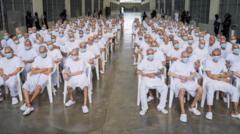
The courtroom functions as a digital theater. Many of the defendants aren't even physically present. They appear on massive monitors, beamed in from the "CECOT"—the Terrorism Confinement Center—a mega-prison built specifically to hold tens of thousands of gang members. They sit in white tunics, heads shaved, rows of men appearing as a flickering mosaic of pixels.
It is a strange, modern purgatory.
The Human Cost of Both Sides
The tragedy of MS-13 is that it was built on the wreckage of the Salvadoran Civil War. It started in the streets of Los Angeles among refugees and was deported back to a country that had no infrastructure to stop it. It grew because it offered a sense of belonging to the discarded.
But that "belonging" was a parasite.
In the narrative of this trial, the defense will argue that the state is overreaching. They will say that 486 people cannot possibly receive a fair hearing in a single proceeding. They will argue that the evidence is circumstantial, tied more to association than specific acts of violence. And in a traditional legal sense, they might be right. The scale is unprecedented. The risk of error is high.
Yet, the prosecution counters with a reality that is equally hard to ignore. How do you dismantle a hive if you only catch one bee at a time? The gang operated as a single organism. The "will" of the gang was the sum of its parts. To try them individually, the state argues, would take a hundred years, during which the survivors would simply reorganize and the witnesses would "disappear."
Fear is a powerful witness. In previous years, trials often collapsed because witnesses knew that even if a gang member went to jail, his "brothers" remained on the street. The mass trial is designed to break that cycle of intimidation by removing the entire hierarchy in one fell swoop.
The Echoes in the Barrio
Outside the court, the country is changing.
In the markets, people talk in lower voices about the "old days," which were only two years ago. There is a palpable sense of relief, but it is shadowed by a new kind of tension. If the gangs are gone, what replaces them? The state is now the only power. The police are the only law. For many, that is a massive improvement over the erratic cruelty of the MS-13, but it carries its own weight.
The trial of the 486 is a test of endurance. It will likely last months. Thousands of documents will be read. Hundreds of hours of audio will be played. It is a grueling, bureaucratic exorcism.
We often think of justice as a scale, perfectly balanced. In El Salvador, the scale has been broken for so long that the government has decided to use a sledgehammer instead. They are betting that the public prefers the blunt force of the state to the sharp edge of the gang’s knife.
The defendants on the screens remain mostly silent. They watch the proceedings with unreadable expressions. Some have tattoos that crawl up their necks and across their foreheads—marks of a life lived in defiance of the very laws now being used to bury them. Those tattoos were once a warning to the world. Now, they are evidence.
The End of the Ghost
There is no easy way to end a story that involves so much pain. For the families of the victims—the thousands of "disappeared" whose bodies are still being pulled from clandestine graves—there is no sentence long enough. For the families of those caught in the sweep who may truly be innocent, there is no apology loud enough.
The 486 members of MS-13 represent a chapter of history that El Salvador is desperate to set on fire. The mass trial is the match. Whether it creates a clean slate or merely leaves behind a different kind of scar is a question that won't be answered by the verdict.
As the sun sets over San Salvador, the lights in the courtroom stay on. The names continue to be read. One by one, the ghosts are being turned into case numbers.
A young boy walks past the court building, gripping his father’s hand. He doesn't look at the guards with the rifles. He doesn't look at the cameras. He is looking at a kite caught in a nearby tree, unaware that he is living through the most significant judicial experiment in his country's history. He is simply walking through a city that, for the first time in his life, doesn't belong to the shadows.
The gavel falls, not with a bang, but with the muffled thud of a door closing on an era that everyone is trying to forget.