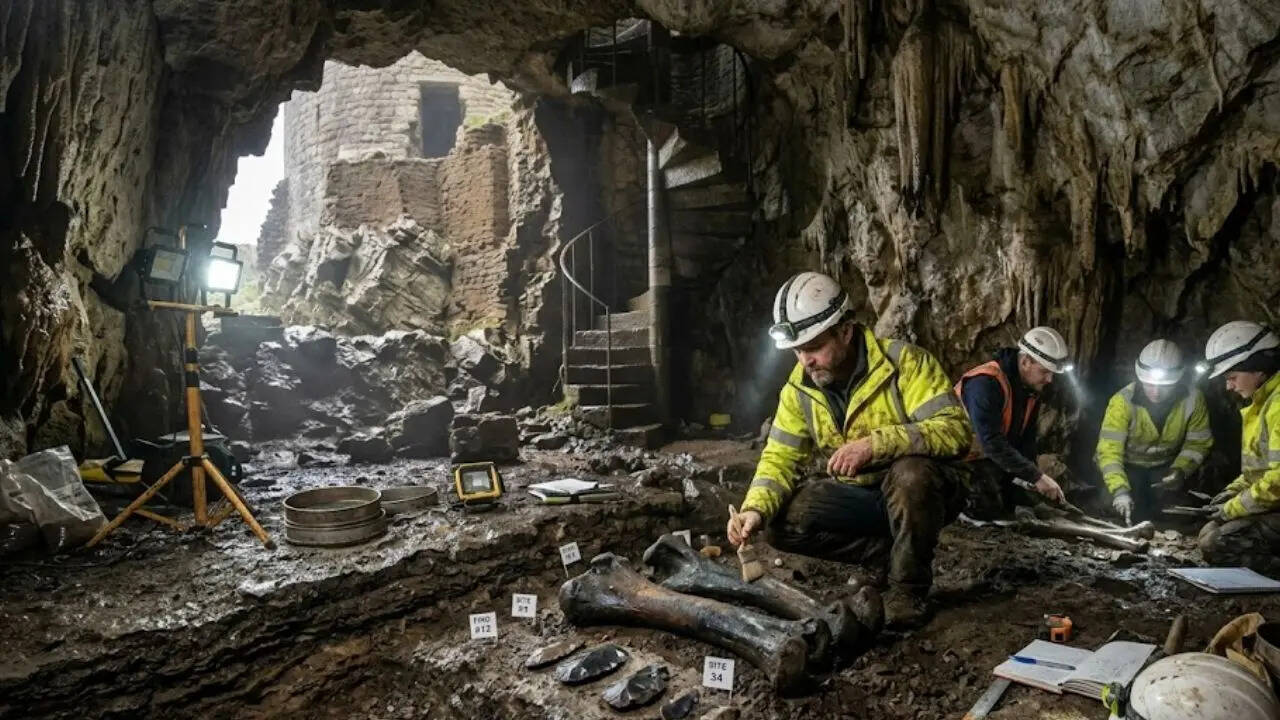
The floorboards of Pembroke Castle feel solid. They feel like the kind of permanence that only centuries of Norman stone and Welsh rain can forge. Tourists walk across the manicured grass of the inner ward, looking up at the Great Circular Keep, their necks straining to see where William Marshal once stood. But the real weight of this place isn't in the towers. It is beneath the soles of your boots.
Deep under the limestone foundation lies Wogan Cavern. For years, it was a footnote—a damp, cavernous space used as a storeroom or a secondary defense. We treated it like a cold basement. We were wrong.
Recent excavations have peeled back the layers of the Wogan, and what they found wasn't just dirt and rock. They found a ledger of survival that spans 120,000 years. This isn't a story about a hole in the ground. It is a story about the guests who stayed there long before the first stone of the castle was ever laid.
The Ice and the Bone
Imagine a cold so profound it cracks the air. This was the Pembrokeshire of the Middle Palaeolithic. There were no kings here. No flags. Only the rhythmic, predatory breathing of creatures we now know only through museum glass.
Archaeologists sifted through the sediment of the cave to find the remains of reindeer, woolly mammoths, and rhinoceros. To a modern traveler, these feel like mythical beasts. To the inhabitants of the Wogan, they were a moving larder—and a constant threat. But the most haunting discovery wasn't the megafauna. It was the evidence of the Neanderthals.
We often imagine our evolutionary cousins as hulking, mindless brutes. The dirt tells a different tale. These individuals chose this cave with intent. It was a vantage point. A fortress provided by the earth itself. They sat where you can stand today, scraping hides and knapping flint tools by a fire that died out 100,000 years ago.
The "invisible stakes" here are our own origins. Every time a researcher pulls a flint scraper from the mud, they are touching the hand of someone who refused to let the ice win.
The 10,000-Year Gap
The cave has a peculiar way of holding its breath. Between the time the Neanderthals vanished and the modern humans arrived, there is a silence in the soil. It represents a period when the climate became so hostile that the land simply broke. The ice moved in, and the Wogan was abandoned.
Then, the world thawed.
About 12,000 years ago, as the last glacial period retreated, a new kind of human walked into the cavern. These were the Mesolithic hunter-gatherers. They didn't have the heavy brows of their predecessors, but they shared the same primal need for a roof that wouldn't leak. They left behind microliths—tiny, razor-sharp stone segments used for hunting.
When you look at these artifacts, the scale of time becomes dizzying. We talk about "old" buildings in Britain being 500 years old. We are currently looking at a site where the gap between two different groups of residents was longer than the entirety of recorded human history. The Wogan isn't a room; it’s a time machine with a broken clock.
The Castle Built on a Grave
By the time the Normans arrived in the 11th century, they saw the Wogan as a tactical asset. They built their massive stone walls directly over the cave, incorporating it into the castle’s defenses. They used it as a water gate, a place where supplies could be hauled up from the river below.
But the Normans were latecomers. They were the noisy teenagers moving into an ancient manor.
Archaeologist Dr. Rob Dinnis and his team have spent seasons in the damp dark of the cave, meticulously brushing away centuries of debris. What they’ve uncovered suggests that the Wogan wasn't just a pantry for the Earls of Pembroke. It was a site of continuous human significance. They found Roman coins and pottery, proving that even as the Empire was collapsing elsewhere, people were still seeking refuge in this limestone womb.
The irony is thick enough to touch. The castle was built to project power, to scream of the dominance of the de Clare and Marshal families. Yet, the true power of the site lay in the cave that had already protected humans for a hundred millennia before the first knight put on a suit of armor.
The Fragility of the Find
Working in a cave like the Wogan is a lesson in humility. You are constantly damp. Your knees are perpetually caked in grey mud. You are working in a space where a single careless swing of a trowel could shatter a bone that hasn't seen the light of day since the Earth’s orbit was slightly different than it is now.
The team had to navigate the "clutter" of the medieval period to get to the "gold" of the prehistoric. It is a slow, agonizing process. They found a bone from a reindeer that bore the distinct marks of butchery. Someone—a person with a name we will never know, with dreams we can’t imagine—sat in that exact spot and prepared a meal for their family.
They weren't "prehistoric man." They were a mother. A brother. A survivor.
Why the Dirt Matters
It is tempting to look at a list of animal bones and stone tools and see a grocery list from the dawn of time. But look closer.
The Wogan Cavern is one of the most important archaeological sites in the United Kingdom precisely because it is so undisturbed. Most caves of this age were cleared out by Victorian "antiquarians" who were little more than glorified looters. They took the shiny objects and threw away the dirt. But the dirt is where the data lives.
By analyzing the pollen trapped in the sediment, scientists can reconstruct the forest that existed outside the cave 40,000 years ago. They can tell you if it was a summer of drought or a winter of endless snow. They can tell you what the world looked like before we decided to pave it.
This isn't about the past. It’s about understanding the resilience of life. We live in an era where we feel the world is shifting beneath our feet, where the climate is changing and the future feels uncertain. The Wogan reminds us that we have been through this before. We have sat in the dark, watching the ice approach, and we have figured out how to keep the fire going.
The Echo in the Stone
If you visit Pembroke Castle today, you can descend the spiral stone staircase into the Wogan. The air changes as you go down. It gets heavier, cooler, and smells faintly of wet earth and salt.
The castle above is silent now, a monument to a feudal system that burned out long ago. But the cave remains. It was a home before there were houses. It was a fortress before there were walls. It is a reminder that our history isn't just a series of dates and battles fought by men in crowns. It is a long, unbroken chain of ordinary people finding a place to hide from the wind.
When you stand in the center of that cavern, the 120,000 years don't feel like a vast, empty void. They feel like a crowded room. You can almost hear the scratching of flint on bone, the low murmur of a language that died before the first pyramid was built, and the drip of water that has been falling from the same stalactite since the mammoths screamed in the valley.
The stone doesn't forget. It just waits for us to be quiet enough to listen.