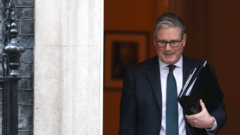
Rain lashed the windows of a non-descript office in Westminster, the kind of gray, heavy drizzle that makes the stone of London look like it’s weeping. Inside, the air was different. It was thin. It tasted of filtered oxygen and the metallic tang of high-stakes adrenaline. Keir Starmer sat behind a desk, the weight of a nation—and the fragile architecture of global peace—resting on his shoulders. He wasn’t just a politician in that moment. He was a man staring at a map of the world where the lines were blurring into fire.
Across the Atlantic, the rhetoric was screaming. Donald Trump had authorized strikes against Iran, a move that sent shockwaves through every diplomatic channel from Brussels to Tokyo. The headlines were easy to write: "Aggression," "Retaliation," "Strength." But headlines are flat. They don't capture the hollow feeling in the pit of a leader's stomach when they realize that one wrong word could turn a regional skirmish into a generational catastrophe. Learn more on a similar subject: this related article.
Starmer’s task was not just to respond, but to steady a ship that was being rocked by a hurricane of American volatility.
The Weight of a Word
Imagine standing on a tightrope stretched over a canyon. On one side is the Special Relationship, that historical anchor that keeps the UK tethered to the world’s largest superpower. On the other is the precipice of an avoidable war. This is the reality of modern British statecraft. It is not about grand speeches or victory laps. It is about the excruciating precision of language. Further journalism by Al Jazeera highlights related views on the subject.
When Starmer stepped to the microphone to criticize the Trump administration’s unilateral strikes, he wasn't just scoring points. He was drawing a line in the sand. He defended the UK’s position—one of strategic restraint and de-escalation—while the world watched for even a flicker of hesitation.
"We do not seek escalation," is a phrase we hear often in the news. It sounds like jargon. It sounds like a script. But consider a hypothetical young sailor on a British destroyer in the Gulf. To him, "de-escalation" isn't a policy. It’s the difference between a quiet night shift and a missile alert that ends his life before he can remember his mother’s face. When a Prime Minister speaks, he is speaking for that sailor. He is speaking for the families in Tehran and the shopkeepers in London who all share the same basic human desire: to wake up tomorrow in a world that is still standing.
The Ghost of 2003
Every British leader lives in the shadow of a ghost. It is the ghost of the Iraq War, a specter that haunts the hallways of Number 10. The memory of being led into a conflict based on flawed intelligence and a "ride or die" loyalty to a US President is etched into the collective consciousness of the British public.
Starmer knows this. He feels it in the skepticism of the voters and the sharp questions from the press. By distancing himself from Trump’s "fire and fury" approach, he was performing a delicate exorcism. He had to prove that the UK is a partner, not a puppet. This requires a specific kind of courage—the courage to say "no" to your most powerful friend while the cameras are rolling.
The strikes ordered by Trump were framed as a necessary show of force. The logic is ancient: hit them hard so they don't hit back. But the modern world is a web, not a boxing ring. Pull one string in the Middle East, and you vibrate the entire structure of global energy prices, refugee movements, and domestic security. Starmer’s critique was a recognition that "strength" is often a mask for a lack of a better plan.
The Human Cost of High Policy
Let’s step away from the podiums and the polished mahogany. Think about the invisible stakes.
When tensions rise between Washington and Tehran, the price of a liter of petrol at a station in Manchester creeps up. A grandmother on a fixed income has to decide if she’s going to turn on the heating for an extra hour. A tech startup in Bristol loses its funding because the markets have gone into a defensive crouch. These are the micro-tragedies of macro-politics.
The UK's position, defended by Starmer, is built on the unfashionable idea of "international law." It’s a dry term. It evokes dusty books and long-winded lawyers. But international law is the only thing that stands between us and a world where the person with the biggest stick decides who gets to live. By insisting on a coordinated, legal response rather than a series of impulsive strikes, Starmer was trying to keep the walls of the global house from caving in.
A Study in Contrast
The friction between the two leaders wasn't just about military strategy; it was a clash of temperaments. Trump operates on instinct, a businessman’s sense of leverage and dominance. Starmer operates on process, a lawyer’s sense of evidence and consequence.
One thrives in the chaos. The other survives by containing it.
This isn't just a political disagreement. It's a fundamental question about how we want our world to be governed. Do we want a world of "Big Men" making sudden, violent moves that ripple across the globe? Or do we want a world of steady hands and predictable outcomes? The UK’s defense of its position was an argument for the latter. It was a plea for a return to the "boring" diplomacy that prevents the "exciting" wars.
The Silence After the Strike
There is a specific kind of silence that follows an explosion. It is the silence of shock, of dust settling, and of a world holding its breath to see what happens next. In the hours following the strikes, that silence was filled with the frantic communication of diplomats.
Starmer’s phone would have been humming. Calls to Paris, to Berlin, to Riyadh. Each conversation was a stitch in a wound that was threatening to tear wide open. While the headlines focused on the "criticism," the real work was in the alignment. The UK had to signal to Iran that it was not seeking war, while signaling to the US that it remained a committed ally—just not a blind one.
It is a grueling, thankless task. If it works, nothing happens. No bombs fall. No ships sink. The news cycle moves on to the next scandal, and the Prime Minister goes home to a cold dinner. Diplomacy is the art of ensuring that the most interesting thing about the day is the weather.
The Invisible Guardrails
We often forget that our safety is a manufactured product. It is built by thousands of people in windowless rooms who analyze satellite imagery, decode signals, and draft memos that will never be read by the public. When a Prime Minister defends a national position against a superpower, he is standing on the shoulders of these invisible workers.
The UK's stance on Iran is not an accident. It is the result of decades of intelligence gathering and regional expertise. To abandon that for the sake of a quick headline or a show of "unity" with a volatile ally would be a betrayal of that expertise. Starmer was, in effect, defending the integrity of the British state itself.
He was saying that we have our own eyes. We have our own ears. And we have our own conscience.
The tension between London and Washington over these strikes serves as a reminder that even the closest friendships have boundaries. A friend who doesn't tell you when you're making a mistake isn't a friend; they're an accomplice. By speaking out, Starmer wasn't weakening the alliance. He was trying to save it from its own worst impulses.
The Long Shadow of the Future
As the rain continued to fall over London, the immediate crisis began to simmer down, but the underlying heat remained. The world is moving into an era of deep uncertainty, where the old rules are being rewritten by leaders who prefer the sledgehammer to the scalpel.
Starmer’s defense of the UK position was more than a rebuttal of a single military action. It was a manifesto for a middle power trying to find its way in a fractured world. It was a statement that the United Kingdom would not be a passenger in someone else's crusade.
The Red Phone sat on the desk, silent for a moment. But the room was still heavy. The map on the wall hadn't changed, but the way we look at it had. We are reminded that peace is not the absence of conflict, but the presence of people brave enough to navigate it without pulling the trigger.
The lights in the office stayed on long into the night. Outside, the city moved on, unaware of the thin threads that hold it all together, and the man who, for one gray afternoon, had to make sure they didn't snap.
The ink on the morning papers would be dry soon, but the consequences of those few hours in the silent room would ripple through the decades, a quiet testament to the power of the word "no."