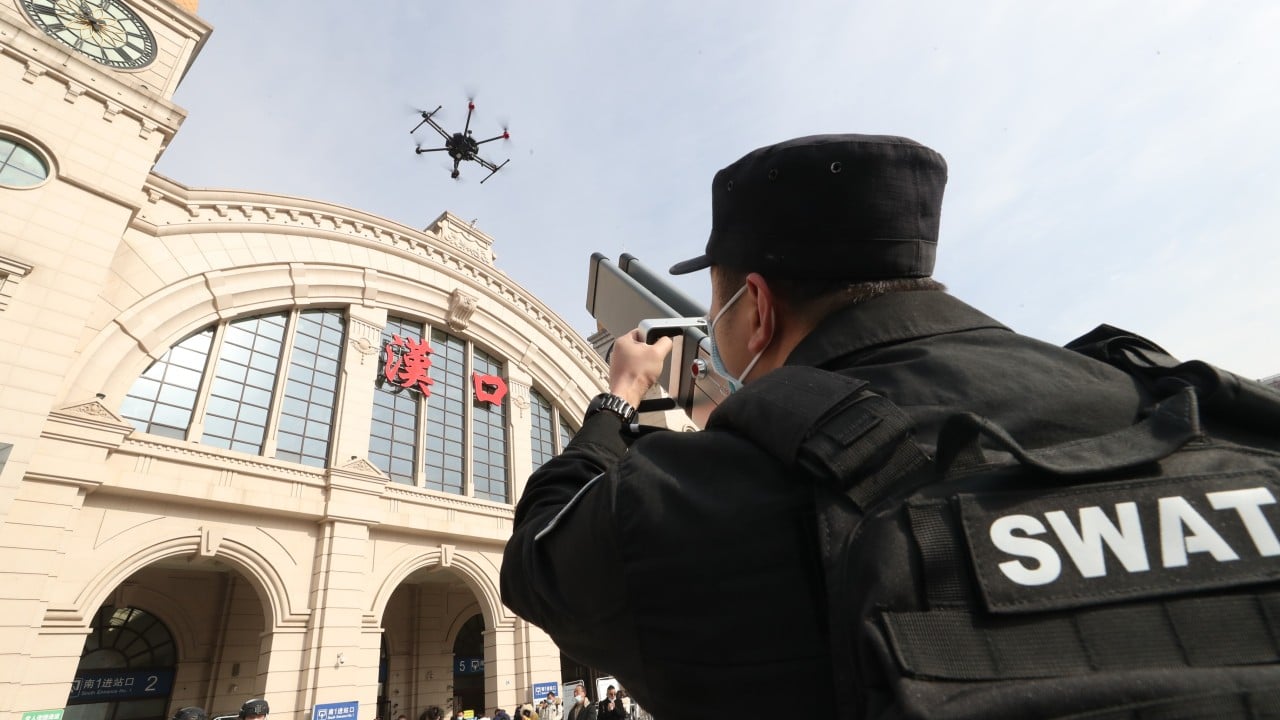
China’s Ministry of Public Security announced a sweeping enforcement action under its "Clean Skies" initiative, revealing the arrests of 16 individuals across 10 distinct cases involving the illegal modification and hacking of drone flight control systems. The state’s public narrative frames this as a vital defense against aviation collisions and national security leaks. Yet, the aggressive nature of the crackdown points to a deeper institutional anxiety. Beijing is moving swiftly to secure absolute command over its domestic airspace before modified commercial hardware can be exploited by informal economic networks or internal dissent.
For years, the commercial drone industry thrived on a subculture of firmware modifications. Software patches that removed factory-enforced altitude limits and bypassed geographic no-fly zones were easily obtained on the open market. This latest enforcement action demonstrates that the period of official indifference has ended. The state is systematically dismantling the gray market for drone modifications, treating code alteration not as a consumer policy violation, but as a direct challenge to state sovereignty.
The Technology of Airspace Subversion
To understand the scale of the crackdown, one must look at how easily commercial restrictions are neutralized. Most consumer and agricultural drones rely on GPS-linked geofencing to prevent flight near airports, military installations, or sensitive political zones. These boundaries are maintained via software.
[Standard Drone Firmware] ---> Enforces Geofencing & Altitude Caps
                                      |
                     (Modded Software Overwrite)
                                      v
[Cracked Flight Controller] -> Ignores GPS Restrictions & Payload Limits
Hackers exploit vulnerabilities in the drone's flight control firmware, forcing the hardware to ignore geographic coordinates and altitude caps.
In one of the benchmark cases highlighted by the ministry, police in Fengxian district, Shanghai, arrested a 40-year-old man surnamed Li. Since 2022, Li had been writing and distributing bespoke software designed to strip out altitude restrictions and geofencing parameters, selling the tools directly through mainstream e-commerce platforms. By the time of his arrest, Li had successfully modified over 100 aircraft.
Removing these digital walls allows standard aircraft to ascend directly into commercial flight paths. A consumer drone operating at 2,000 meters presents a catastrophic risk to commercial aviation, lacking the transponders required for civil air traffic control visibility.
Heavy Infrastructure and the Payload Threat
The investigation reveals that the technical subversion is not limited to hobbyist hardware. The state is increasingly concerned with the modification of large-scale industrial and agricultural platforms.
In Luzhou, Sichuan province, authorities dismantled a criminal ring led by a 29-year-old man surnamed Hou. Operating since early 2025, Hou’s group focused exclusively on altering the factory-set payload parameters of heavy agricultural drones. The group had modified more than 30 large-scale units before their arrest.
+----------------------------+----------------------------+
| Factory Specification      | Modified Capability        |
+----------------------------+----------------------------+
| Enforced weight limits     | Disabled safety overrides  |
| Regulated battery scaling  | Altered motor output max   |
| Controlled ascent rates    | Unrestricted lift velocity |
+----------------------------+----------------------------+
By disabling the software checks that monitor structural stress and motor output, these operators forced the drones to lift weights far exceeding their certified structural capacity.
The immediate economic motive is simple. Operators can move more cargo per flight, slashing operational costs in rural or industrial transport. However, the physical consequences of overriding these parameters are severe. An overloaded drone risks structural failure, unpredictable battery depletion, and sudden loss of motor synchronization.
The ministry’s report specifically noted that these modified heavy platforms posed immediate threats to critical infrastructure, citing risks of catastrophic battery failure over high-voltage power lines, uncommanded descents in populated zones, and structural breakups during flight.
The Dual Use Dilemma
The broader geopolitical reality informs every aspect of this enforcement strategy. The ongoing conflict in Ukraine has served as a global testing ground for modified commercial drones, proving that consumer hardware can be transformed into precise military tools via simple software overrides. Beijing has watched this evolution closely.
The ease with which software can turn a crop-spraying drone into an unmonitored transport mechanism represents a significant security loophole. By altering flight control software, an operator can render a drone invisible to standard civilian monitoring networks. It removes the digital fingerprint of the flight.
This creates an acute vulnerability near sensitive installations. A drone with disabled geographic restrictions can loiter over military shipyards, testing grounds, or communication hubs, collecting high-resolution imagery without triggering automated remote ID systems. The threat of state secrets leaking through commercial hardware is no longer a hypothetical scenario for the Ministry of Public Security. It is an active operational vulnerability.
Enforcing the Digital Border
The legal mechanisms deployed in these cases reflect a shift toward maximum deterrence. Rather than relying on simple administrative fines or civil aviation penalties, prosecutors are using the heavy machinery of China’s Criminal Law.
Suspects face charges under statutes governing the illegal control of computer information systems and the provision of tools for intruding into secure digital infrastructure. These charges carry significant prison sentences, elevating firmware hacking to the same legal tier as network espionage or major cyber-attacks against state infrastructure.
For the end-user, the risks have changed completely. Under the current regulations on unmanned aircraft flight management, flying a modified drone in controlled airspace now triggers immediate asset confiscation, heavy financial penalties, and administrative detention.
The "Clean Skies" campaign is designed to send an explicit signal to the domestic tech community. The state demands total visibility over its airspace. Any attempt to build a private, unmonitored alternative using modified commercial hardware will be met with immediate criminal prosecution.
The era of open, experimental firmware modification in the domestic market is officially over, replaced by strict structural compliance dictated by national security priorities.

/arc-anglerfish-arc2-prod-mco.s3.amazonaws.com/public/BHPBP5TJJFF5XBWKSOQWZ6G55A.JPG)