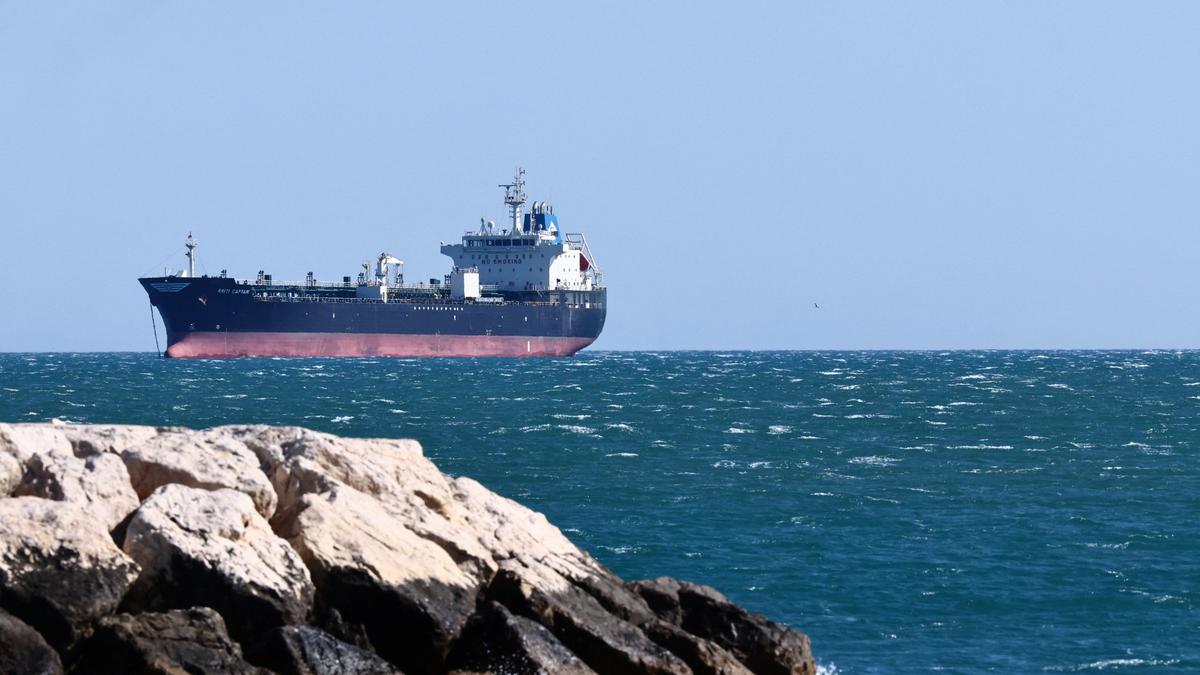
The sudden reversal of a sanctioned tanker toward the Strait of Hormuz represents more than a localized navigational shift; it is a clinical case study in the collision of maritime logistics, geopolitical risk premiums, and the breakdown of dark fleet operational continuity. When a vessel exits the Persian Gulf only to return 24 hours later, the movement signals a failure in the secondary market’s ability to clear a specific cargo or a sudden escalation in the cost of non-compliance that outweighs the sunk cost of the voyage.
The Triad of Maritime Constraints
To analyze why a vessel would abandon a planned trajectory after clearing the world’s most sensitive chokepoint, we must examine the three variables that dictate sanctioned transit: jurisdictional risk, counterparty solvency, and technical obfuscation.
1. Jurisdictional Risk and the Shadow Toll
Sanctioned vessels operate within a "shadow toll" system. The profit margin on a barrel of illicit or sanctioned crude is high, but it is constantly eroded by the escalating cost of insurance (often P&I clubs outside the International Group), higher freight rates for aging hulls, and the threat of seizure. A reversal indicates that the destination port or a necessary transit point—such as a bunkering hub—became inaccessible due to a real-time update in sanctions enforcement or a withdrawal of local political cover.
2. Counterparty Solvency
In the opaque world of sanctioned trading, the buyer of the cargo often lacks the institutional backing of a major oil firm. Payment is frequently contingent on the successful transfer of the product via Ship-to-Ship (STS) operations. If the buyer’s financial vehicle is flagged or their credit line in a non-traditional currency (e.g., CNY or AED) is frozen, the vessel becomes a floating liability. Returning to the Strait of Hormuz is often a strategic retreat to a "safe harbor" or a region where the vessel’s sovereign sponsor can provide physical security while the trade is renegotiated.
3. Failure of Technical Obfuscation
The "dark fleet" relies on AIS (Automatic Identification System) manipulation, often referred to as "spoofing" or "going dark." However, modern satellite imagery and synthetic aperture radar (SAR) allow regulators and analysts to track vessel displacement—and thus cargo weight—regardless of AIS status. If a vessel realizes its spoofing signature is being actively monitored by naval assets or that it has been "burned" by maritime intelligence services, continuing the voyage increases the probability of an interdiction that the owner cannot afford.
The Economic Calculus of the U-Turn
The decision to turn back is never a matter of whim. It is a response to a sharp change in the Expected Loss Function ($E_L$). A simplified model for the vessel operator looks like this:
$$E_L = P(s) \cdot C_s + P(i) \cdot C_i + O_c$$
Where:
- $P(s)$ is the probability of a seizure.
- $C_s$ is the total capital value of the vessel and cargo.
- $P(i)$ is the probability of a permanent blacklisting.
- $C_i$ is the present value of all future lost earnings for the ship.
- $O_c$ is the immediate operational cost (fuel, crew, insurance).
When $E_L$ exceeds the projected net profit from the delivery, the only rational move is to abort. In the context of the Strait of Hormuz, returning to the Gulf allows the vessel to reintegrate into a high-traffic environment where state actors can offer protection or where the cargo can be offloaded to an offshore storage unit until a less "hot" buyer is found.
The Fragility of STS Logistics
The Strait of Hormuz and the waters off Fujairah are hubs for STS transfers, the primary mechanism used to wash the origin of sanctioned crude. A vessel exiting the Gulf and then returning suggests a breakdown in the STS Synchronicity.
Modern enforcement agencies now focus on the "shuttle" and "mother" ship relationship. If the "mother" ship—the vessel intended to receive the cargo and transport it to a final destination—fails to arrive or is detected by a patrolling frigate, the "shuttle" (the sanctioned tanker in question) is left with a perishable window of opportunity. The fuel cost of idling in open water, combined with the visibility of a stationary tanker, makes a return to a more congested, protected maritime zone the preferred tactical choice.
Institutional Friction and the "Whack-a-Mole" Effect
Regulators have moved away from targeting individual ships to targeting the entire ecosystem of maritime service providers. This creates a specific type of friction: Service Layer Paralysis.
- Bunkering Delays: A sanctioned ship needs fuel. If the local provider receives a warning that fueling this specific IMO (International Maritime Organization) number will lead to secondary sanctions, they will refuse service.
- Classification Society Withdrawal: Without a valid class certificate, a ship cannot enter most major ports. The sudden withdrawal of these certifications while a ship is at sea can force an immediate turnaround.
- Flag State De-flagging: If a flag of convenience (like Panama or Liberia) de-registers a ship mid-voyage under pressure from the U.S. Treasury, the ship becomes "stateless." Under international law, stateless ships are subject to boarding and inspection by any nation's navy on the high seas.
The return to the Strait of Hormuz is likely a reaction to one of these service layers being stripped away. A stateless, unclassed, or un-bunkered ship is a ghost that cannot safely traverse the high seas.
Strategic Realignment of the Dark Fleet
The frequency of these "failed transits" provides a metric for the efficacy of maritime sanctions. Historically, these tankers operated with near impunity by simply changing names or owners. However, the integration of AI-driven behavioral analysis by maritime tech firms means that even with a new name and a fresh coat of paint, the Vessel's Operational DNA (speed, draft changes, historical routes) remains detectable.
The reversal signifies that the "risk-free" era of the dark fleet has ended. We are entering a phase of High-Friction Sanctions Evasion, where the costs of delivery are becoming so volatile that they threaten the underlying economics of the illicit oil trade.
To maintain operational viability, shadow fleet managers will likely transition toward:
- Sovereign Escorts: Moving tankers in convoys under the protection of national navies, effectively daring interdiction.
- Internalized Supply Chains: Buying their own bunkering barges and repair yards to eliminate third-party service friction.
- Complex Financial Layering: Using decentralized finance or commodity-for-commodity swaps to bypass the dollar-denominated banking system entirely.
For commodity traders and geopolitical analysts, the movement of a single tanker is a lead indicator. When a sanctioned asset retreats, it confirms that the cost of passage has temporarily spiked, signaling a tightening of the regulatory net that will eventually manifest in the premiums found on the global oil market. The next logical move for enforcement agencies is to increase the frequency of "unscheduled" naval exercises near STS hotspots, further increasing the $P(s)$ variable and forcing more vessels to choose between the risk of seizure or the cost of retreat.