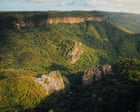
Brazil is currently executing a structural shift in land management by transitioning from isolated "paper parks" to an integrated system of long-distance trails known as the Rede Brasileira de Trilhas (Rede Trilhas). This strategy operates on the premise that conservation is a function of public utility rather than mere exclusion. By codifying recreational access through a standardized, tiered trail system, the Brazilian government aims to solve the chronic underfunding of its 2,600+ protected areas. The success of this initiative depends on three interdependent variables: ecological permeability, decentralized maintenance costs, and the psychological "ownership" of the biome by the domestic populace.
The Architecture of Connectivity: From Islands to Corridors
Traditional conservation models in South America often result in "island biogeography," where protected areas are surrounded by degraded land, leading to genetic stagnation and increased vulnerability to external shocks. The Rede Trilhas model attempts to reverse this by using trail systems as the skeletal structure for ecological corridors. If you liked this post, you might want to read: this related article.
The logic follows a specific spatial framework:
- Core Zones: High-protection areas where human impact is strictly minimized.
- Buffer Zones: Managed areas where the trail serves as the primary interface between the public and the environment.
- Connectivity Links: The "Long-Distance" component that utilizes private lands and mixed-use zones to connect disparate federal and state parks.
This connectivity addresses the Island Effect Bottleneck. When a trail like the Caminho dos Goyazes spans hundreds of kilometers, it creates a continuous strip of managed land that allows for seed dispersal and fauna movement. The trail is not just a path; it is a monitored perimeter. For another perspective on this story, refer to the recent coverage from Travel + Leisure.
The Economic Logic of Decentralized Maintenance
The primary barrier to effective conservation in Brazil is the "Cost of Presence." Federal agencies like ICMBio (Chico Mendes Institute for Biodiversity Conservation) lack the liquid capital to patrol every hectare. The Rede Trilhas solves this by offloading the operational expenditure ($OpEx$) to civil society through a "Sense of Belonging" mechanism, which is actually a labor-equity model.
The Volunteer Maintenance Function
In a centralized model, the cost of trail maintenance ($C_m$) is a function of government salary and logistics:
$$C_m = (L \times R) + T$$
Where $L$ is labor hours, $R$ is the hourly rate, and $T$ is transport.
Under the Rede Trilhas framework, $C_m$ approaches zero for the state because it is replaced by volunteer groups and local hiking clubs. These stakeholders do not view their labor as a cost but as a "recreational contribution." This shifts the government’s role from a service provider to a regulator and certifier.
Revenue Injection into Secondary Markets
The economic impact is measured via the Trailside Multiplier. Hikers require three specific inputs:
- Logistics: Transport to trailheads.
- Subsistence: Food and lodging in "gateway cities."
- Equipment: Purchase of gear from regional retailers.
Unlike mass tourism, which often concentrates capital in large hotel chains, long-distance hiking distributes capital horizontally. A hiker walking the Trilha Transmantiqueira spends smaller amounts of money across dozens of micro-enterprises. This creates a localized economic incentive to prevent illegal logging and mining; the forest becomes more valuable as a backdrop for a guesthouse than as a source of raw timber.
Standardizing the Wild: The Yellow and Black Signage System
A critical failure in previous Brazilian eco-tourism attempts was the lack of predictability. The Rede Trilhas has implemented a standardized signaling protocol—yellow and black "footprint" icons—that functions as a brand identity. This standardization reduces the "Risk Barrier" for entry-level hikers.
The psychology of this system is rooted in Wayfinding Certainty. When a hiker knows that a specific icon indicates a specific level of difficulty and a guaranteed path, the cognitive load of navigating the wilderness is reduced. This increases the addressable market of users from elite mountaineers to the general urban population.
This signage also serves a dual purpose as a boundary marker. In areas where land tenure is contested, a clearly marked federal trail asserts state presence and public use, making land grabbing ($grilagem$) more difficult to execute unnoticed.
The Social Feedback Loop: Belonging as a Security Asset
The "Sense of Belonging" mentioned by proponents is not a sentimental byproduct; it is a security asset. In many Brazilian biomes, the greatest threat to conservation is the disconnect between urban citizens and the natural resources that provide their water and climate stability.
By physically placing citizens within the Atlantic Forest or the Cerrado, the government creates a constituency of "witnesses." This is the Social Surveillance Effect. A monitored trail with constant foot traffic is a high-friction environment for illegal activities. A poacher or illegal logger is less likely to operate in a space where they might encounter twenty witnesses in a single afternoon.
Furthermore, the domestic hiker becomes a political advocate. When a trail user sees the direct impact of a forest fire or an illegal clearing, their likelihood of supporting conservation-focused legislation increases. The trail is the laboratory where environmental awareness is converted into political capital.
Structural Challenges and Systemic Risks
The Rede Trilhas model is not without significant friction points. The most prominent is the Land Tenure Conflict. Approximately 53% of the planned long-distance routes pass through land that is either privately owned or has undefined legal status.
The Right of Way Bottleneck
In the United States, the Appalachian Trail is protected by the National Trails System Act. Brazil lacks a similarly robust legal framework to compel private landowners to allow passage. This creates "Gaps in the Chain" where a 500km trail may be severed by a single 5km stretch of hostile private property.
Biodiversity Displacement
There is a fundamental tension between "Public Use" and "Total Protection." High-density hiking can lead to:
- Soil Compaction: Increasing runoff and erosion.
- Fauna Stress: Human presence can disrupt the mating and hunting patterns of sensitive species like the Jaguar (Panthera onca).
- Invasive Species: Seeds from urban areas attached to hikers' clothing and boots can infiltrate deep-forest ecosystems.
To mitigate this, the Rede Trilhas must implement Carrying Capacity Thresholds. This requires a data-driven approach where trail usage is capped based on the regenerative rate of the specific biome.
Tactical Implementation: The Regional Hub Model
The scaling of the network follows a decentralized "Hub and Spoke" strategy. Instead of a single federal authority managing every kilometer, the system is divided into regional trail units.
- Regional Hubs: Local NGOs and municipal governments manage the day-to-day operations.
- Federal Oversight: ICMBio provides the "Stamp of Approval" and ensures adherence to national signage and environmental standards.
- Private Partners: Concessionaires may manage high-traffic sections to generate revenue for the broader network.
This model allows for regional variation. A trail in the Amazon requires different infrastructure (water-based logistics, specialized signage) than a trail in the dry Caatinga or the high-altitude grasslands of the Mantiqueira.
Strategic Forecast: The Infrastructure of the 21st Century
The Rede Trilhas represents a shift in how Brazil views its territory. In the 20th century, infrastructure meant roads and dams that bisected ecosystems. In the 21st century, the trail network positions conservation as a form of "Soft Infrastructure."
The long-term play is the integration of these trails into the Global Conservation Corridor movement. By connecting the Atlantic Forest fragments from the south of Brazil to the northeast, the country is essentially building a continental-scale climate adaptation tool.
The immediate tactical priority for stakeholders must be the formalization of "Right of Way" legislation to ensure the continuity of these paths across private holdings. Without this legal bridge, the network remains a collection of impressive but isolated segments. Investors and NGOs should focus their capital on the "Gateway Infrastructure" (hostels, specialized transport, and guide training) in the municipalities adjacent to these trails, as these will be the primary engines of the Trailside Multiplier. The forest will only remain standing if the local population finds it more profitable to protect the view than to harvest the wood.
Ensure your regional development plan prioritizes the "Buffer Zone" micro-economies, as these stakeholders represent the frontline defense against biome encroachment.