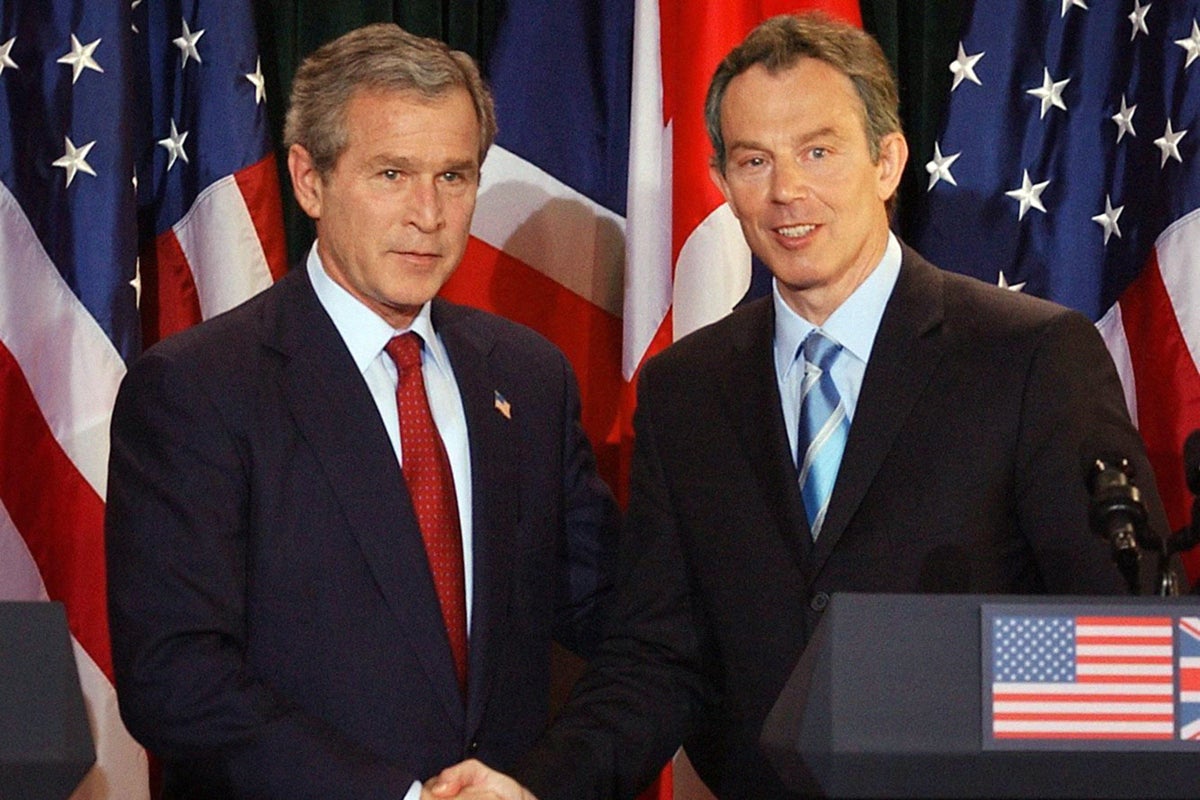
For over eighty years, the "Special Relationship" has served as the bedrock of British foreign policy, a convenient shorthand for a partnership that supposedly elevates the United Kingdom above its middle-power status. The reality is more transactional and far more lopsided. While the public narrative focuses on shared values and historical bonds, the internal mechanics of the UK-US alliance are driven by a desperate British need for relevance and a cold American requirement for a junior partner to provide international legitimacy. Britain has spent decades following Washington into deserts and mountains, often against its own strategic interests, simply to maintain a seat at a table where the menu is written in Washington.
The UK’s decision to join or shun American military adventures is not a matter of shared morality. It is a calculated gamble on access. When London says "yes," it is buying intelligence sharing, nuclear technology, and a diplomatic ear in the Oval Office. When it says "no," it is usually because the domestic political cost has finally outweighed the perceived benefit of American approval.
The High Cost of the Ticket to the Front Row
The most stark example of this subservience remains the 2003 invasion of Iraq. Tony Blair’s government did not join the war because of a genuine belief in an imminent threat from weapons of mass destruction; the intelligence was notoriously thin and contested. Instead, the driver was a fear of abandonment. The British establishment calculated that if the US went alone, the UK would lose its status as the primary lieutenant to the world’s only superpower.
British troops were sent to Basra with inadequate equipment and a vague mandate. The result was a strategic failure that tarnished the UK’s reputation for decades. Unlike the US, which can absorb the blow of a failed intervention through sheer economic and military mass, Britain’s smaller footprint means its failures are systemic. The Chilcot Inquiry eventually laid bare the lack of planning, yet the underlying impulse—the need to be seen standing "shoulder to shoulder"—remains the default setting for the Ministry of Defence.
This compliance isn't just about boots on the ground. It’s about the integration of the British state into the American military-industrial complex. From the Trident nuclear program to the F-35 fighter jet, Britain has traded its autonomy for high-end capabilities it cannot afford to develop alone. This creates a feedback loop. Because the UK relies on US technology, it must stay in Washington's good graces to keep that technology functional, which in turn makes it harder to say no when the next deployment request arrives.
The Rare Moments of British Defiance
It is a mistake to think Britain never pushes back. However, when the UK refuses to follow, it is rarely due to a sudden surge of independence. It is usually a result of exhaustion or a fundamental misalignment of survival instincts.
The Vietnam War stands as the most significant "no" in the history of the alliance. Harold Wilson, facing a collapsing economy and a slim parliamentary majority, resisted intense pressure from Lyndon B. Johnson to send even a token force of Black Watch Highlanders to the jungle. Wilson knew that joining Vietnam would bankrupt the country and destroy his party. He chose domestic survival over the "Special Relationship." The price was a period of frostiness in Transatlantic relations, but the UK avoided the generational trauma that reshaped American society.
A more recent example occurred in 2013, when the House of Commons voted against military intervention in Syria following chemical weapons attacks. This was a watershed moment. For the first time in centuries, a British Prime Minister was barred by Parliament from going to war. It wasn't that the UK disagreed with the US objective; it was that the British public, still reeling from the lies of Iraq and the stalemate in Afghanistan, simply refused to sign another blank check. The rejection was so definitive that it forced Barack Obama to pivot his own strategy.
The Intelligence Trap
One of the strongest tethers keeping London tied to Washington is the "Five Eyes" intelligence sharing agreement. To the British intelligence community, this is the crown jewel. The sheer volume of signals intelligence provided by the NSA is something GCHQ could never replicate.
This creates a hidden tax on British sovereignty. If the UK diverges too sharply from US foreign policy, it risks being throttled back from the data flow. This isn't just theory; during the Suez Crisis of 1956, the US used economic pressure and intelligence blackouts to force a British withdrawal. The lesson learned by the British Deep State was clear: never get on the wrong side of the American treasury or the American intelligence apparatus again.
Suez was the last time Britain tried to act as a truly independent Great Power. The humiliation of being forced to retreat by its supposed best friend fundamentally broke the British psyche. Every Prime Minister since has been haunted by the ghost of Suez, terrified that a similar rift would expose Britain as a hollowed-out power with no real influence.
The Pivot to the Indo-Pacific
As Washington shifts its gaze from the Middle East to the South China Sea, it is demanding its allies do the same. The AUKUS pact—a deal between the US, UK, and Australia to provide nuclear-powered submarines—is the latest evolution of this dependency. On the surface, it’s a massive win for British industry and a sign of enduring trust. Under the hood, it’s a commitment that ties the Royal Navy to American strategy in the Pacific for the next fifty years.
By choosing AUKUS, Britain has effectively chosen a side in the coming cold war with China. This move was not made because of a direct threat to the British Isles. It was made because the UK believes that by becoming indispensable to the US in the Pacific, it can secure its own future as a global player. It is a high-stakes gamble that assumes American hegemony will remain the stable center of the world order.
The Reality of Lopsided Interests
We must acknowledge the fundamental asymmetry of the relationship. To Britain, the alliance is an existential necessity, a way to project power far beyond its actual weight. To the United States, Britain is an "added extra." The US values the UK for its diplomatic cover and its capable, if small, special forces. But the US will always act in its own interest, regardless of the impact on London.
Look at the withdrawal from Afghanistan in 2021. The US made the decision to leave, and the UK was forced to follow suit, despite protests from senior British military figures that the withdrawal was premature. The UK simply did not have the logistical capability to stay without American support. It was a cold reminder that while the two nations might be in the same car, only one person has their hands on the steering wheel.
The Illusion of Influence
Proponents of the relationship argue that Britain’s closeness allows it to "guide the hand" of the American giant. This is largely a myth sustained by the British diplomatic corps to justify their relevance. While there are occasional instances of British officials smoothing over American rough edges, the big strategic shifts in Washington—from the "War on Terror" to the current obsession with "Great Power Competition"—are driven by internal American dynamics. Britain is rarely the architect; it is the contractor brought in to help with the construction.
The cost of this proximity is a loss of flexibility. Because Britain is so tightly bound to the US, it struggles to build independent relationships with other emerging blocs. It is seen by many in the Global South not as an independent actor, but as Washington's messenger. This limits the UK's ability to act as a bridge or a mediator in a multipolar world.
A Future Defined by Dependency
The UK currently finds itself in a precarious position. Post-Brexit, the "bridge to Europe" role is gone. This has made the link to Washington even more critical, and consequently, made the UK even more compliant. The fear of being isolated in the North Atlantic drives a policy of pre-emptive agreement.
The British public is often told that this partnership makes them safer. In some ways, it does. The technical and military cooperation is undeniably deep. But it also makes the UK a target and drags it into conflicts that have little to do with the defense of the realm. The wars in Iraq and Afghanistan did not make Britain safer; they overstretched the military, polarized the country, and arguably increased the domestic terror threat.
The "Special Relationship" is less a romance and more a long-term lease. Britain pays the rent in blood, treasure, and diplomatic capital. In exchange, it gets to live in a house it no longer owns. As long as the British establishment believes that being a junior partner is better than being a sovereign middle power, this cycle of compliance will continue. The question isn't whether Britain will fight alongside the US again, but how much it is willing to lose to prove its loyalty.
Check the current state of the Royal Navy’s carrier strike group—it is the physical embodiment of this dilemma, a massive investment that only truly functions when plugged into the American command structure.