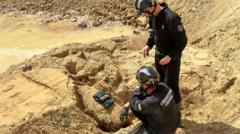
The discovery of unexploded ordnance (UXO) in a dense metropolitan area like Paris represents a catastrophic failure of historical record-keeping meeting the rigid requirements of modern civil engineering. When an Allied or Axis bomb remains dormant for eight decades, it transitions from a weapon of war into a complex geotechnical and chemical liability. The neutralization of such a device is not merely a demolition task; it is a multi-dimensional optimization problem involving mass evacuation logistics, blast radius physics, and the preservation of high-value infrastructure.
Successful resolution depends on the precise execution of a three-stage operational framework: Detection and Identification, Containment and Risk Zoning, and Neutralization Mechanics.
The Chemical and Mechanical Degradation of Legacy Munitions
To understand the risk, one must first categorize the degradation of the firing chain. A WWII-era bomb, typically a General Purpose (GP) high-explosive variant, utilizes a chemical composition that becomes increasingly volatile over time. Picric acid or TNT-based fillers can undergo "exudation," where the explosive material seeps into the screw threads of the fuse.
Mechanical instability creates a non-linear risk profile. The fuse, often a clockwork or striker-spring mechanism, may be locked by corrosion. Any physical disturbance—the vibrations from a subway line, the pressure change of a construction drill, or temperature fluctuations—can overcome the frictional resistance of a rusted firing pin. This creates a "hair-trigger" state where the energy required for detonation is significantly lower than the original design specifications.
The Physics of Blast Radius and Kinetic Mitigation
The primary threat to the Parisian urban fabric is the shockwave, a high-pressure front that travels faster than the speed of sound. This is followed by a "suction" phase as the vacuum created by the blast collapses. Urban planners must calculate the Minimum Evacuation Distance (MED) based on the net explosive weight (NEW) of the device.
A 500lb bomb (approx. 227kg) typically contains around 120kg of high explosives. The fragmentation zone—where pieces of the steel casing become lethal projectiles—extends much further than the lethal blast overpressure zone.
Engineering the containment involves a trade-off between Reflection and Absorption:
- Hesco Barriers and Sand Piles: By surrounding the device with hundreds of tons of sand, engineers force the blast energy into the ground and the sky. The sand acts as a high-density dampener, converting kinetic energy into heat and localized displacement.
- Water Suppression: In specific scenarios, water-filled bladders are used to attenuate the shockwave. Water’s density and incompressibility allow it to absorb energy through phase change and misting, reducing the peak overpressure that reaches nearby buildings.
- Trenching: Digging "interceptor trenches" between the bomb and critical infrastructure (such as gas mains or fiber optic hubs) disrupts the transmission of seismic shockwaves through the soil, protecting subterranean assets.
The Logic of Mass Evacuation Logistics
Evacuating thousands of residents is a resource-intensive operation that creates its own set of secondary risks. The evacuation zone is determined by the "Glass Breakage Radius," which is often 2–3 times larger than the "Structural Damage Radius." Flying glass is the primary cause of civilian injury in urban detonations.
The operational bottleneck is not the evacuation itself, but the verification of a "Clear Zone." This involves:
- Thermal Imaging Overlays: Using drones to identify heat signatures in supposedly empty buildings to ensure no residents have remained behind.
- Vulnerability Mapping: Categorizing individuals into "High Mobility" and "Assisted Mobility" cohorts. The speed of the operation is dictated by the slowest unit of the assisted population.
- Perimeter Hardening: Establishing cordons that prevent re-entry, particularly by media or curious civilians, which would reset the countdown to detonation and increase the risk window for the bomb disposal team.
Neutralization Methods: Deflagration vs. Controlled Detonation
The bomb disposal unit (EOD) must choose between two primary end-states: destroying the bomb in situ or rendering it inert.
High-Order Detonation
If the fuse is deemed too unstable for removal, the team triggers a controlled explosion. While this is the "simplest" solution, it maximizes the kinetic impact on the environment. The containment structures described above must be at their maximum structural integrity for this path.
Low-Order Deflagration (Burn-off)
This is a more sophisticated approach. A small, shaped charge is used to pierce the casing and ignite the explosive filler without triggering a full-scale detonation. The filler burns away (deflagrates) at a subsonic speed. This reduces the pressure wave significantly but carries the risk of a "transition to detonation" if the heat buildup becomes too rapid.
Robotic De-fusing
In rare cases, remote-operated vehicles (ROVs) use abrasive water jets to cut out the fuse section entirely. This removes the "brain" of the bomb from the "body." Once the fuse is separated, the main explosive mass is inert and can be transported to a military range for disposal.
Economic and Structural Resilience Assessment
The true cost of a UXO discovery exceeds the direct expenses of the police and EOD teams. The "Economic Friction" includes:
- Transportation Gridlock: Paris relies on a hyper-dense rail and road network. A four-hour shutdown of a major artery or a Gare du Nord-connected line creates a ripple effect throughout the European transit corridor.
- Labor Productivity Loss: Thousands of displaced workers and closed businesses represent a measurable dip in localized GDP for the duration of the event.
- Insurance and Liability: The legal framework for historical war damage remains complex. If a controlled detonation causes structural damage to a modern building, the liability chain between the state, the construction firm that found the bomb, and the original combatant nations is often murky.
The frequency of these events in cities like Paris, Berlin, and London suggests that our current "reactive" model is insufficient. As urban density increases and we dig deeper for geothermal energy and high-speed transit, the probability of encountering high-yield legacy munitions grows.
Strategic Operational Imperatives
The management of legacy munitions must transition from an emergency response to a standardized civil engineering phase.
Municipalities must mandate high-resolution subsurface magnetometry surveys for all brownfield developments exceeding a specific depth. Relying on historical bombing maps is no longer a viable risk-mitigation strategy due to the inaccuracy of WWII-era targeting and the lack of records for duds.
Infrastructure resilience must also be "hardened by design." Vital utilities should be housed in shock-resistant conduits within high-risk zones (identified by historical payload density). Finally, the development of standardized, rapidly deployable "Blast Blankets"—high-tensile synthetic shields—could replace the archaic and slow process of moving hundreds of tons of sand, shortening the evacuation window and reducing economic friction.
The objective is to move from a state of paralysis to one of calculated, rapid neutralization. The presence of these devices is a known variable; the failure to integrate their removal into the standard urban development lifecycle is an avoidable systemic risk.