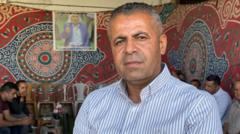
The stability of any territorial governance model depends on the integrity of property rights and the state’s monopoly on the legitimate use of force. In the West Bank, specifically within Area C, these two pillars are currently undergoing a process of structural decomposition. The incident involving the forced exhumation of a deceased individual by settler groups is not a random act of cruelty but a data point in a broader strategic framework designed to achieve total territorial control through psychological and physical displacement. This analysis deconstructs the mechanisms used to override civilian protections and the logical progression of non-state actor dominance in contested zones.
The Triad of Non-State Territorial Control
The conversion of contested land into "captured" land relies on three distinct operational layers. When these layers overlap, the cost of remaining on the land for the original inhabitants exceeds the biological and economic utility of the property.
- Kinetic Harassment: This involves immediate physical threats, destruction of agricultural assets, and interference with basic life functions—including burial rites.
- Psychological Siege: The targeting of cultural and religious taboos (such as the sanctity of the dead) serves to break the communal psyche, signaling that no space—not even the grave—is a sanctuary.
- Legal and Administrative Friction: The exploitation of zoning laws and military orders to retroactively justify the presence of one group while criminalizing the existence of another.
The incident of forced exhumation occupies the intersection of kinetic harassment and psychological siege. By forcing a son to dig up his father’s body, the aggressors execute a "symbolic erasure." It communicates that the family’s presence is not merely temporary but illegitimate to the point of being physically expunged from the soil.
The Cost Function of Civilian Resistance
For a Palestinian resident in Area C, the decision to remain is a constant calculation of risk versus heritage. We can define the resistance threshold as a function where the value of the land ($V$) must be greater than the sum of physical risk ($R$) and economic depletion ($E$).
Settler strategies are designed to maximize $R$ and $E$ simultaneously.
- Physical Risk ($R$): Intensifies when non-state actors operate with the perceived or actual protection of state security forces. If a civilian cannot appeal to a neutral arbiter (the police or military) to prevent the desecration of a grave, the value of $R$ becomes potentially infinite, as there is no floor to the level of violence expected.
- Economic Depletion ($E$): Achieved through the destruction of olive groves, the cutting of water lines, and the restriction of grazing movement. When the land no longer produces a caloric or monetary surplus, the resident is forced into a state of managed poverty, making them more susceptible to "voluntary" displacement.
When a group forces a family to exhume a body, they are attacking the $V$ variable. They are attempting to make the land so traumatizing that its value becomes negative.
Structural Asymmetry in Security Enforcement
The primary driver of the current escalation is the breakdown of the "Enforcement Monolith." In a healthy security environment, the state applies a singular standard of law. In the West Bank, a bifurcated legal system creates a vacuum.
- Delegated Authority: There is a growing trend where the state effectively "outsources" the friction of displacement to ideologically driven civilians. This provides the state with "plausible deniability" while achieving the strategic objective of territorial expansion.
- The Inaction Loop: When security forces are present during an illegal act (like a forced exhumation) but do not intervene, they establish a new "de facto" law. The absence of an arrest is an implicit endorsement of the tactic. This creates a feedback loop where settlers feel emboldened to increase the severity of their actions, moving from property damage to the violation of human remains.
The Logic of Targeted Sacrilege
Why target a grave? From a strategic standpoint, targeting the dead is more "efficient" than targeting the living.
A living person can resist, flee, or retaliate. A grave is a fixed, defenseless asset that represents a permanent claim to the land. In the logic of territorial conflict, a cemetery is a deed written in stone. Forcing the removal of a body is the equivalent of shredding that deed. It is a tactical move to reset the historical clock of a specific plot of land to "Zero," as if the family never existed there.
This creates a "Displacement Cascade." Once one family is forced to desecrate their own lineage, neighboring families perceive a total loss of protection. The psychological contagion of this act is far more effective at clearing a hill than a standard eviction notice.
The Bottleneck of International Accountability
The current geopolitical landscape has created a bottleneck for traditional accountability mechanisms. While international law (specifically the Fourth Geneva Convention) strictly prohibits the displacement of civilians and the mistreatment of the deceased, the enforcement of these laws relies on state cooperation or external sanctions.
- The Sanction Gap: While some Western nations have begun sanctioning individual "extremist settlers," these measures target the symptoms rather than the systemic framework that allows them to operate.
- Documentation vs. Action: The rise of smartphone documentation has increased the "data density" of these events, but it has not translated into a change in the "on-the-ground" power dynamics. The aggressors in these scenarios often do not fear being filmed because the local judicial path to prosecution is effectively blocked for the victims.
The Mechanism of "Grey Zone" Annexation
We are witnessing a transition from "Legalistic Annexation" (using courts and maps) to "Operational Annexation" (using facts on the ground).
In operational annexation, the map is irrelevant. If a family is physically prevented from accessing their father's grave or their own home through consistent, high-intensity harassment, the land is annexed in practice. The forced exhumation is the ultimate expression of this. It is a physical manifestation of a "no-go zone."
The strategic goal is to create a patchwork of these zones that eventually coalesce, making a contiguous Palestinian presence impossible. This is "Territorial Fragmentation" at a cellular level.
Forecasting the Strategic Pivot
The escalation from property destruction to the desecration of the dead indicates that the conflict has entered a "Total Erasure" phase.
Future indicators of this trend include:
- Normalization of Physical Coercion: Expect to see more instances where civilians are forced to participate in their own displacement (e.g., being forced to demolish their own structures or, as seen here, dig up their own kin).
- Infrastructure Decoupling: The systematic removal of Palestinian communities from the regional water and power grids, replaced by settler-controlled infrastructure.
- The Erasure of Evidence: Increased targeting of journalists and human rights monitors to reduce the "E" (Evidence) in the accountability equation.
The operational recommendation for observing parties is to move beyond the "human rights" lens and view these events as a sophisticated, multi-tiered campaign of territorial engineering. The "incident" is not a tragedy; it is a tactic. To address it, the counter-strategy must address the cost-benefit analysis of the aggressors. Until the state’s monopoly on force is reapplied with a singular standard, the "Cost of Staying" for Palestinian residents will continue to be driven toward infinity.
The immediate tactical play for local stakeholders is the establishment of "Communal Hardening"—the creation of multi-family cooperatives that share the security burden, though the effectiveness of this is limited against state-backed actors. The only structural solution is the re-establishment of a singular legal authority that recognizes the sanctity of property and personhood regardless of the claimant’s identity. Without this, the West Bank will continue its descent into a high-friction, low-trust environment where power is the only valid currency.