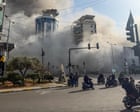
Beirut is a city that knows how to bleed, but it shouldn't have to. Right now, the Lebanese capital is witnessing a hollowed-out transformation that feels less like a temporary evacuation and more like a permanent uprooting of an entire culture. When you see hundreds of thousands of people packing their lives into the back of battered sedans, it isn't just about avoiding a missile. It's about the terrifying realization that the places they call home might not exist when the smoke clears.
The scale is staggering. Estimates from the International Organization for Migration (IOM) and local Lebanese authorities suggest that over 1 million people have been displaced across the country since the escalation of Israeli airstrikes. A huge chunk of that number comes from the southern suburbs of Beirut, known as Dahiyeh, and towns in the south that have been effectively leveled. This isn't a "strategic relocation." It's a desperate scramble for survival.
The impossible choice of staying or leaving
Most people watching from a distance think leaving is the easy part. It isn't. In Beirut, the "choice" to flee is usually made in a split second when the windows rattle and the sky turns a sickly shade of orange. You grab your identity papers, whatever cash is hidden under the mattress, and maybe a photo album if you're lucky. Everything else stays.
I've seen reports of families sleeping on the sidewalks of the Corniche or in the middle of Martyrs' Square. The schools turned into shelters are overflowing. They were never designed to hold this many people. Sanitation is failing. Privacy is a memory. When a mother has to decide whether to spend her last few dollars on bread or a plastic sheet to keep the rain off her kids, the international community's slow response feels like a slap in the face.
People aren't just fleeing bombs. They're fleeing the collapse of a system that was already on life support. Lebanon was already reeling from a multi-year economic meltdown, the 2020 port explosion, and political paralysis. The current bombardment is the final blow for many.
Why the infrastructure can't handle the load
Lebanon's infrastructure is a ghost of itself. Before this conflict even started, the state couldn't provide more than a few hours of electricity a day. Now, with hundreds of thousands of displaced people flooding into Beirut’s "safer" neighborhoods and mountain villages, the strain is visible.
- Rents have skyrocketed. Landlords are charging astronomical prices for tiny apartments, exploiting the desperation of those coming from the south.
- The medical system is buckling. Hospitals are trying to treat war injuries while managing the chronic needs of a displaced population without access to regular meds.
- Water shortages are rampant. More people in tight spaces means the already fragile water delivery system is failing.
The reality on the ground is that the "safe" areas aren't actually that safe. Airstrikes have hit targets deep within the city and in the mountains, areas previously thought to be outside the line of fire. This creates a psychological state of "nowhere is safe," which is often more damaging than the physical threat. When you don't know if the building next to yours is on a target list, you don't sleep. You just wait.
The cultural cost of the exodus
Beirut has always been a city of neighborhoods. Every street has a personality, a specific baker, a corner shop where the owner knows your grandfather’s name. This mass displacement is shredding that social fabric. When an entire neighborhood like Dahiyeh empties out, you aren't just losing buildings. You’re losing the collective memory of a community.
The phrase "the memories stay behind" isn't just poetic. It's literal. People are leaving behind the keys to houses that are now rubble. They’re leaving behind businesses they spent decades building. For the younger generation, this is another chapter in a history of trauma that seems never-ending. They see their parents’ lives reduced to a few bags of clothes and wonder why they should even try to build a future here.
A failed international response
Let’s be honest. The global response has been pathetic. While there are statements of "deep concern" from various capitals, the actual aid reaching the streets of Beirut is a trickle compared to the flood of need. The UN’s flash appeals for funding are rarely met in full. Meanwhile, the political maneuvers in high-level meetings don't put blankets on the backs of the kids sleeping in public parks.
We need to stop looking at this as a localized military conflict and start seeing it as a regional catastrophe with global implications. When a country's population is displaced at this percentage, the state ceases to function in any meaningful way. That vacuum is never filled by anything good.
What needs to happen right now
If you're looking for a way to actually help or understand what needs to change, stop waiting for a grand political solution that might take months. The immediate needs are grounded in basic survival.
Support local NGOs that are actually on the ground. Groups like the Lebanese Red Cross and local grassroots kitchens are doing the heavy lifting that the government can't. They need funding for food, hygiene kits, and fuel for generators. Demand that your representatives prioritize humanitarian corridors. It’s not enough to send food if the roads to deliver it are being bombed.
If you want to contribute, look for organizations with direct ties to local communities. Avoid the massive bureaucracies where 40% of your donation goes to "administrative costs." Direct aid is the only thing keeping the city from a total health collapse. The crisis in Beirut isn't going away when the news cycle moves on. The people who fled will have no homes to return to, and the city they left behind will be a different place entirely.