The Smell of Scraped Knuckles and Aviation Fuel
If you step into an old RAF hangar, the first thing that hits you isn't the scale of the flying machines. It is the scent. A thick, heavy mixture of mineral oil, aged aluminum, damp canvas, and the ghost of high-octane fuel. It is a smell that clings to the back of your throat. For decades, that exact aroma defined the evenings and weekends of a quiet suburban garden in Britain.
Most people use their garden sheds to store lawnmowers, tangled green twine, and rusted trowels.
Jack Brown did not.
For forty years, Jack crossed his lawn, unlocked a wooden door, and stepped directly into 1943. While his neighbors watched television or tended to their petunias, Jack was meticulously rebuilding the entire cockpit section of an Avro Lancaster bomber. Completely from scratch. He did it with scraps of metal, salvaged switches from scrap yards, and a self-taught mastery of wartime engineering blueprints.
When Jack passed away, he left behind more than just a grieving family. He left them with an inheritance that weighed several tons and occupied most of the backyard. They faced a choice that many families eventually confront when a patriarch’s obsessive lifelong passion outlives him. Do you scrap it? Do you sell it to a private collector who will hide it away in a basement? Or do you find a way to make the world remember why he built it in the first place?
The story of Jack’s cockpit is not a dry chronicle of aviation preservation. It is a window into a generation that refused to let the past fade, and a testament to the family that carried his heavy legacy across the finish line.
The Obsession Behind the Blueprints
To understand why a man spends four decades riveting aluminum sheets in a drafty shed, you have to understand the shadow that the Second World War cast over British life. Jack was not a pilot. He was a craftsman, a man who understood how things fit together, how wires carried currents, and how aluminum buckled under pressure.
Consider the sheer scale of a Lancaster bomber. It was the backbone of RAF Bomber Command, a massive, four-engined leviathan designed to carry immense payloads over freezing, hostile night skies. Most young men who climbed into those cockpits were barely old enough to shave. They sat in cramped, uninsulated metal tubes, surrounded by hundreds of dials, levers, and glowing gauges. For many, that cockpit was the last thing they ever saw.
Jack understood that when these aircraft were scrapped after the war, a piece of living history was being melted down into pots and pans. He could not save an entire airfield. But he could save the cockpit.
"He didn't just collect parts," his son, Peter, remembers, tracing a finger over a perfectly restored altimeter. "He collected stories. Every single dial had to be the exact right serial number for a 1943 Avro Lancaster B Mark I. If it wasn't right, he’d spend three years hunting for the one that was."
Imagine the patience required for this endeavor. Today, we live in an era of instant gratification. If we want a vintage part, we tap a screen and it arrives on our doorstep inside forty-eight hours. Jack did not have the internet. He had handwritten letters. He had rainy weekend drives to obscure military surplus stores in the middle of nowhere. He had the local scrap metal dealer on speed dial.
Hour after hour. Year after year. The shed grew its own ecosystem. The walls were lined with technical manuals, their pages stained with grease from Jack’s fingers. The floor was permanently dusted with fine silver aluminum shavings. His wife, Mary, learned to accept that dinner conversations would inevitably veer into the mechanics of the Lancaster’s pneumatic braking system or the exact shade of interior green paint used by the Avro factory in Manchester.
Living in the Shadow of the Leviathan
Growing up with a father who is building a bomber in the garden does strange things to a family’s sense of normalcy.
For the Brown children, the Lancaster was simply a permanent member of the household. It was a giant, metallic sibling that required constant feeding, attention, and financial sacrifice. While other families saved up for holidays to Spain, Jack’s spare cash was frequently swallowed by a rare drift sight or a pristine pair of pilot’s rudder pedals.
There is a particular kind of madness in this level of devotion, but it is a beautiful, fiercely protective madness. Jack was running a race against time. He watched as the veterans who flew these machines grew old and passed away. He watched as the fields they flew from were turned into housing estates and supermarkets. He knew that text in a history book can never compete with the raw, tactile reality of sitting in a pilot’s seat, looking out through a framed windscreen, and realizing just how vulnerable those young crews really were.
The cockpit became a local legend. Enthusiasts would whisper about the man in the suburbs who had a Lancaster in his shed. Occasionally, an old veteran would visit. These were the moments that justified the forty years of scraped knuckles and empty pockets.
Peter recalls an afternoon when a former Lancaster bomb aimer, a man in his late eighties, climbed up the makeshift steps and lowered himself into the nose compartment. The old man didn't speak for twenty minutes. He just rested his hands on the bomb sight housing. His fingers shook slightly. He wasn't looking at a reproduction; he was feeling the exact contours of his youth, remembering the cold, the roar of the Merlin engines, and the friends who never came home.
That was what Jack was actually building: a time machine.
The Weight of Inheritance
Then, the music stopped. Jack’s health failed, and the shed fell silent. The tools remained exactly where he left them on the workbench, a half-finished rivet line frozen in time.
When a collector passes away, the family is often left with a profound sense of vertigo. The object that defined their father’s life is suddenly an anchor, a massive responsibility that they are ill-equipped to manage. The Lancaster cockpit was safe in the shed, but it couldn't stay there forever. The wooden structure was aging, damp was a constant threat, and the family lacked the technical expertise to maintain the delicate wiring and instruments Jack had spent a lifetime restoring.
Offers came in. Private buyers, some from overseas, smelled an opportunity. They offered significant sums of money. For a family facing funeral costs and the practicalities of estate management, the temptation was real.
But Peter and his sister knew that selling the cockpit to a private collection would be a betrayal of their father’s quiet mission. Jack didn't build this to hide it in a rich man’s private basement. He built it to keep a memory alive for the public. They needed to find a home for Jack’s lifetime of work where it would be honored, protected, and used to educate future generations.
They needed an airfield.
The Final Flight
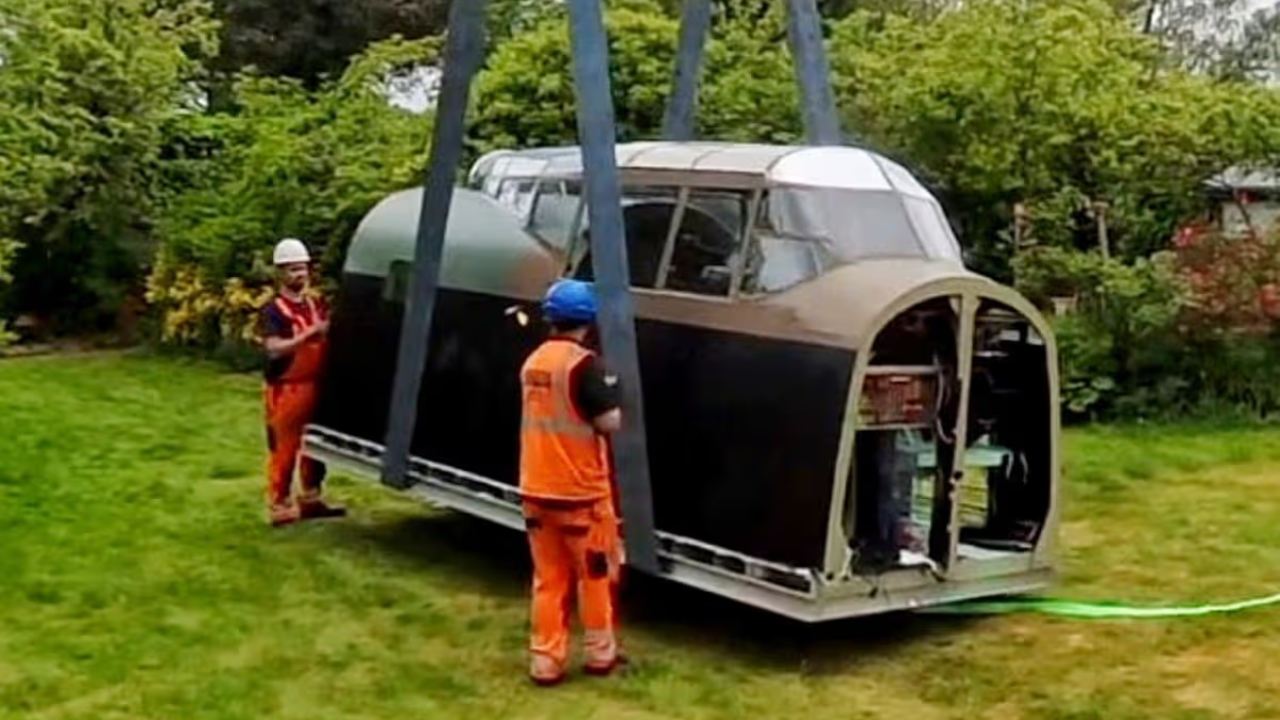
The logistics of moving a hand-built, multi-ton Lancaster cockpit out of a suburban residential garden are the stuff of nightmares. It required a crane, a flatbed truck, a team of specialized volunteers, and a terrifying amount of nerve. One wrong move, one snapping cable, and forty years of devotion would be reduced to a pile of twisted scrap metal.
The destination was an operational RAF heritage airfield, a place where the sound of vintage engines still tears through the sky. The curators there didn't just see a collection of parts; they saw a masterpiece of amateur engineering that rivaled the work of professional museum restoration teams.
On the morning of the move, the neighborhood turned out to watch. The crane extended its long yellow arm over the roof of the house, dipping down into the garden like a giant predatory bird.
When the cockpit rose above the treeline, it was the first time it had been in the open air since Jack began his project four decades earlier. It gleamed in the pale British sunlight, a magnificent, imposing wedge of black and green camouflage. For a moment, suspended between the earth and the sky, it looked less like a relic and more like a living aircraft, eager to find its element.
Peter watched from the patio, holding his father’s old cap.
The move was a success. The cockpit was transported down the narrow country lanes, passing through villages that had once been surrounded by wartime air bases. It felt less like a delivery and more like a homecoming parade.
A Seat at the Control Column
Today, Jack’s cockpit does not sit behind a velvet rope in a sterile museum gallery. It is the centerpiece of an active heritage center, positioned where visitors can actually look inside, see the complexity of the instrument panel, and understand the sheer scale of the machine.
The smell is there, too. That unmistakable mix of oil, metal, and history.
The real triumph of the project is that it remains alive. Schoolchildren stand where Jack stood, looking at the thousands of rivets he hammered in by hand. They ask questions about the war, about the crews, and about the ordinary man who decided his garden shed was the perfect place to build a monument to heroes.
The family lost a father, but they gained a permanent monument to his character. Every dial that glows under the exhibition lights, every switch that clicks with a satisfying, heavy mechanical thud, is a heartbeat. Jack’s heartbeat. He didn't just build a cockpit; he ensured that when the last witnesses to that great conflict are gone, their stage remains, perfectly set, waiting for the curtain to rise.