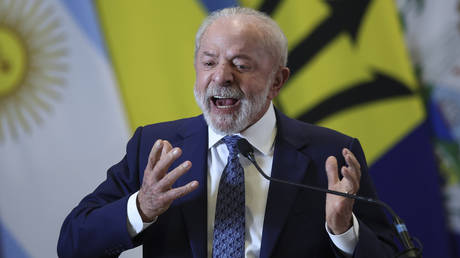
The rhetoric coming out of Brasília isn’t just a flare-up of old-school leftist sentiment. It is a calculated geopolitical pivot. When Brazilian President Luiz Inácio Lula da Silva stands before a room of Latin American heads of state and accuses the United States of seeking to "colonize us again," he is not merely playing to his base. He is signaling the end of the unipolar era in the Western Hemisphere. This shift is fueled by a desperate need for regional autonomy in a world where trade routes and raw materials have become the new battlefields.
For decades, the relationship between Washington and its southern neighbors followed a predictable pattern of "Big Brother" diplomacy. The U.S. provided security and investment; Latin America provided resources and political alignment. That bargain is dead. Lula’s recent summons of South American leaders to the Palácio Itamaraty marks a deliberate attempt to resurrect the Union of South American Nations (UNASUR), a bloc designed specifically to bypass North American influence.
The friction is not just about speeches. It is about the "Green Squeeze." As the Global North transitions to renewable energy, the mineral-rich veins of South America—specifically the lithium triangle of Chile, Argentina, and Bolivia—have become the most contested real estate on earth. Lula views the U.S. demand for these minerals not as a partnership, but as a modern extraction scheme that mirrors the colonial gold rushes of the 18th century.
The Lithium Trap and the New Resource Nationalism
The primary driver of this modern defiance is the "White Gold" rush. Lithium is the heartbeat of the electric vehicle revolution. While the U.S. seeks to secure supply chains through the Inflation Reduction Act and various "nearshoring" initiatives, South American leaders see a familiar, predatory pattern. They see a future where they export raw dirt and import expensive batteries.
Lula’s argument is straightforward: if the world wants South American minerals, the world must pay for South American industrialization. He is pushing for a model where processing plants and battery factories are built on-site, rather than in the suburbs of Detroit or the industrial hubs of China. This is "Resource Nationalism" with a 21st-century coat of paint. It is an attempt to break the cycle of being a perpetual provider of commodities.
The U.S. response has been sluggish. By focusing heavily on security and migration at the border, Washington has left an economic vacuum that Lula is now trying to fill with a home-grown alternative. He knows that without a unified front, individual nations like Uruguay or Paraguay will be picked off by larger powers offering quick cash for long-term mineral rights.
The Currency War in the Backyard
Perhaps the most radical element of Lula’s "anti-colonial" push is his obsession with a common regional currency. He calls it the "Sur." The goal is to strip the U.S. dollar of its status as the default medium of exchange for regional trade.
Doing business in dollars means being subject to the whims of the U.S. Federal Reserve. When interest rates rise in Washington, capital flees São Paulo and Buenos Aires. This creates a cycle of debt and devaluation that keeps South American economies in a state of permanent fragility. By proposing a regional trade unit, Lula is attempting to build a financial moat around the continent.
Critics argue that the "Sur" is a fantasy. The economic disparities between a powerhouse like Brazil and a basket case like Venezuela make a shared currency technically nightmarish. However, the technical feasibility is almost secondary to the political message. The message is that the dollar is a tool of hegemony, and South America is tired of paying the subscription fee.
China as the Silent Partner
You cannot discuss the "re-colonization" narrative without looking at the elephant in the room: China. While Lula warns of U.S. intentions, he has been rolling out the red carpet for Beijing. This creates a glaring contradiction in his anti-colonial stance. Is trading a master in Washington for a master in Beijing truly independence?
China is now the top trading partner for almost every major South American economy. They don't lecture about human rights or democratic norms; they just build dams, railways, and ports. For a leader like Lula, who is focused on immediate infrastructure and poverty moving, the Chinese "no strings attached" model is intoxicating.
However, the "strings" are simply invisible. China’s loans are often backed by future commodity deliveries. This is just another form of extraction, but one that comes with a smile and a heavy checkbook. Lula’s gamble is that he can play both sides against each other, using Chinese investment to build the leverage needed to say "no" to the U.S.
The Institutional Ghost of UNASUR
Lula’s attempt to revive UNASUR is the logistical backbone of his strategy. Originally founded in 2008 during the first "Pink Tide," the organization crumbled as the continent shifted to the right. Its revival is seen by many as a vanity project, but it serves a vital functional purpose: regional integration of energy and defense.
South America is a paradox of proximity. Countries that share thousands of miles of borders often have better infrastructure links to Europe or North America than to each other. Lula wants to change this. He envisions a continent where power grids are linked and defense industries are collaborative.
If South America can act as a single market of 430 million people, it ceases to be a collection of "client states" and becomes a global player. This is the "why" behind the colonization rhetoric. It creates a common enemy—the northern colonizer—to bridge the deep ideological gaps between leaders like the socialist Maduro in Venezuela and the more centrist Boric in Chile.
The Washington Blind Spot
Washington’s mistake has been treating South America as a solved problem. While the U.S. was distracted by the Middle East and the South China Sea, the ground shifted in its own hemisphere. The old tools of diplomacy—sanctions and aid packages—no longer have the same bite.
The U.S. Treasury recently warned that the shift away from the dollar could undermine the effectiveness of American sanctions. They are right. If Lula succeeds in creating a regional trade bloc that operates outside the SWIFT system, the U.S. loses its most potent non-military weapon.
There is also a deep-seated resentment regarding the "Monroe Doctrine." Even two centuries later, the idea that the U.S. has a proprietary right to oversee the affairs of the Americas rankles. Lula uses this history as a tool. By framing current economic disputes as a continuation of 19th-century imperialism, he makes cooperation with the U.S. look like a betrayal of national sovereignty.
Why This Time is Different
We have seen Latin American populism before. We have seen the fiery speeches and the nationalization of oil fields. But this moment feels distinct because of the global context. The world is no longer binary.
In the 1970s, you were either with the West or the Soviet bloc. Today, there is a "Non-Aligned 2.0" movement. Brazil is a leading member of the BRICS nations, which recently expanded to include more Global South players. Lula isn't just shouting into the void; he is part of a growing club of nations that believe the post-WWII order is obsolete.
The reality of the "re-colonization" claim is that it is a negotiation tactic disguised as a grievance. Lula wants better terms. He wants technology transfers. He wants a seat at the table where the rules of the 21st-century economy are being written. If the U.S. continues to offer nothing but lectures on "democratic values" while neglecting the hard economic realities of the region, the drift toward Brasília’s new regionalism will only accelerate.
South American leaders are no longer waiting for an invitation to the global stage. They are building their own stage, and they are using the language of anti-colonialism to keep the old gatekeepers at bay. The "US wants to colonize us" line isn't a historical observation; it is a declaration of economic war.
Western investors should stop looking at these statements as mere political theater. They represent a fundamental restructuring of how business will be done in the southern hemisphere. The era of easy access to South American resources is over. From here on out, everything will be contested, every contract will be scrutinized for "colonial" overtones, and the price of entry will be the industrialization of the continent itself.