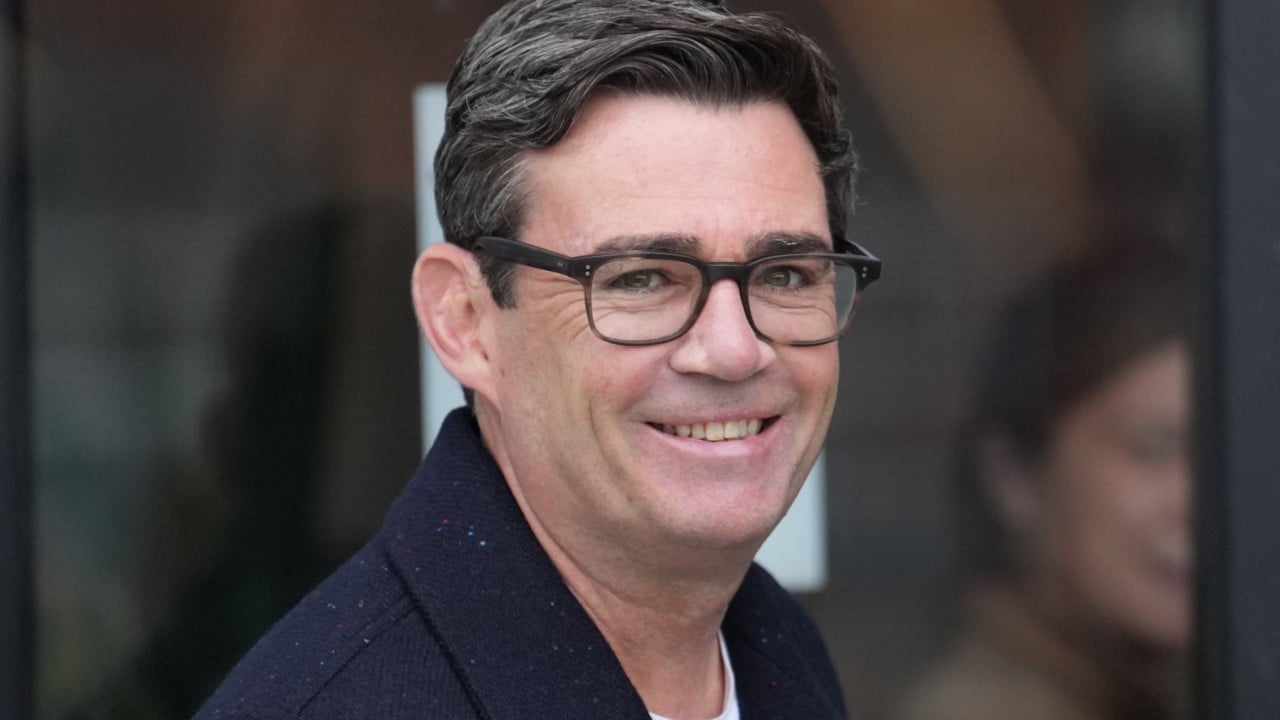
The rain in Manchester doesn't just fall. It settles. It’s a fine, persistent gray mist that clings to the wool of overcoats and the brickwork of old warehouses, a constant reminder of the city’s industrial grit. On a morning like this, at a train station where the coffee is lukewarm and the commuters are huddled against the damp, you might see a man who carries the weight of the North on his shoulders. He isn't a king, despite what the headlines shout. He is a politician who has learned that power isn't always found in the velvet-lined rooms of Westminster. Sometimes, it’s built on a damp platform in Piccadilly.
Andy Burnham, the Mayor of Greater Manchester, has spent years perfecting a specific kind of alchemy. He takes the frustration of a missed bus, the anger over a shuttered factory, and the exhaustion of a region that feels overlooked, and he turns it into political capital. For a long time, he was the outsider. The man who left the London bubble to find his soul in the rain. But the weather is changing. The wind is blowing south.
The Friction of Two Worlds
To understand why this matters, you have to look at the map of Britain not as a series of borders, but as a series of tensions. On one side, you have the centralized machinery of Whitehall—a place of ancient protocols and high-speed careers. On the other, you have the "Northern Powerhouse," a term coined by Londoners but lived by people who just want their trains to run on time.
Keir Starmer sits at the top of that first world. He is the man with the keys to Number 10, a leader defined by caution and the slow, methodical rebuilding of a fractured party. He plays the long game. He weighs every word. He is the architect of a new establishment.
Then there is Burnham.
If Starmer is the architect, Burnham is the foreman on the ground, shouting over the noise of the machinery. Their relationship isn't a simple rivalry; it’s a collision of philosophies. Burnham’s recent moves—his push for more control over housing, his demand for a "technical education" revolution, and his refusal to back down on regional funding—are the first shots in a battle for the soul of the Labour movement. It is a challenge to the idea that London knows best.
The Ghost in the Machine
Think of a small business owner in Bury. Let’s call her Sarah. Sarah runs a print shop. She doesn't care about the intricacies of shadow cabinet reshuffles or the specific wording of a policy white paper. She cares that the electricity bill is three times what it was two years ago and that the local high school is struggling to produce kids with the skills she needs to hire them.
When Burnham talks about a "Greater Manchester Baccalaureate," he isn't just talking about exams. He’s talking to Sarah. He’s telling her that the current system—a one-size-fits-all model designed in a London office—is failing her. He’s proposing a world where a kid in Bolton has a path to a career that doesn't require a three-year detour into a degree they don't want and debt they can't afford.
This is where the friction becomes heat.
By championing these local fixes, Burnham is highlighting a national void. Every time he succeeds in Manchester, it raises a quiet, uncomfortable question for Starmer: Why isn't the rest of the country doing this? This isn't just administrative tinkering. It’s an indictment of the status quo. It is the king of a smaller realm showing the emperor that the clothes might be a bit thin.
The Price of Defiance
Power has a cost. In politics, that cost is usually isolation. For years, Burnham was treated as a regional curiosity by the national press—a man who liked his football and his indie music, perhaps a bit too loud for the refined tastes of the capital. They called him "King of the North" with a smirk, a title that felt more like a cage than a crown.
But a cage only works if the person inside stays put.
Burnham has spent his time building a fortress. He took control of the buses—the first city outside London to do so since the 1980s. He became the face of the resistance during the lockdowns, standing on a rainy street and demanding fair treatment for his workers. He proved that you could win by being difficult.
Starmer’s team knows this. They watched as Burnham’s popularity in the North surged even as the national party struggled to find its footing. There is a deep, structural anxiety in the leadership about a man who doesn't need their permission to be popular. He has his own mandate. He has his own media machine. He has the rain.
The Invisible Stakes
We often talk about politics as a game of chess, but it’s more like a game of poker where nobody is quite sure how many decks are in play. The stakes aren't just about who sits in which chair. They are about the very definition of what the United Kingdom is going to be in the next decade.
Are we a country that radiates outward from a single, hyper-productive city in the southeast? Or are we a collection of powerful regions, each with the autonomy to solve its own problems?
Starmer’s vision is one of national unity through central discipline. He wants a steady hand on the tiller. Burnham’s vision is more chaotic, more localized, and arguably more democratic. He wants to smash the tiller and give everyone an oar.
This tension creates a strange paradox. Starmer needs Burnham’s North to win a general election. He needs those "Red Wall" seats to stay red. But to keep them, he has to empower the very man who could eventually replace him. It’s a deal with the devil, signed in damp ink.
The Anatomy of a Challenge
A challenge in British politics rarely looks like a duel. There are no gloves slapped across faces. Instead, it looks like a series of "constructive suggestions." It looks like a mayor standing in front of a microphone and saying, "We support the national party, but here in Manchester, we’re going to do it better."
It’s a slow-motion heist of the narrative.
When Burnham calls for the abolition of the House of Lords or a total overhaul of the social care system, he isn't just throwing ideas at the wall. He is creating a shadow manifesto. He is positioning himself as the "common sense" alternative to the "cautious" leadership. He is waiting for the moment when the national mood shifts from a desire for stability to a hunger for radical change.
And that moment usually comes when people feel like they’ve been waiting too long on a cold platform.
The Human Element
If you sit in a pub in Ancoats, you won't hear people debating the finer points of devolution. You’ll hear them talking about the rent. You’ll hear them talking about the fact that it takes two weeks to see a GP.
The brilliance of the "King of the North" persona is that it bridges the gap between those pub conversations and the halls of power. Burnham has managed to make himself the avatar of northern grievance. Whether or not he can actually fix the problems is almost secondary to the fact that he is seen to be fighting them.
Starmer, by contrast, often feels like a man trying to explain a spreadsheet to a crowd that wants a battle cry. He is competent. He is serious. He is, by all accounts, a decent man. But he is not a fighter in the way the North understands fighting. He doesn't have the scars of a hundred local battles. He hasn't had to look a bus driver in the eye and explain why their route was cut.
The Unspoken Agreement
There is a dance happening between London and Manchester. One step forward, two steps back.
Starmer has recently started to adopt some of Burnham’s language. He talks more about "taking back control"—ironic, given the phrase's history—and moving power away from Westminster. This is a victory for the Mayor. He has forced the national leader to play on his turf.
But adoption is not the same as surrender. The national party is still wary. They see the "Burnham Model" as a risk—a localized power base that could become a rival center of gravity. They are trying to fold him into the fold without letting him lead the flock.
It is a delicate, dangerous game. If Starmer ignores Burnham, he loses the North. If he embraces him too closely, he risks being overshadowed by a man who is simply better at the "theatre" of politics.
The Long Road
The train from Manchester to London takes about two hours. It’s a journey Andy Burnham has made thousands of times. Each time he steps onto that train, he is moving between two different versions of reality.
In one, he is the undisputed leader of a rising region, a man who has revitalized a city's transport and given it a sense of pride. In the other, he is a former cabinet minister who moved away and is now trying to claw his way back into the national conversation.
The challenge to Starmer isn't about a leadership vote tomorrow. It’s about the gravity of ideas. It’s about who defines what "Labour" means in a post-Brexit, post-pandemic Britain.
Is it the party of the careful lawyer in the suit, or the party of the mayor in the rain?
As the train pulls out of Piccadilly, passing the old mills that have been converted into expensive lofts and the social housing blocks that are still waiting for a coat of paint, the stakes couldn't be higher. The man in the seat is looking out the window at a landscape he helped shape, wondering if he can do the same for the rest of the country.
He knows the road is long. He knows the weather will be harsh. But he’s from Manchester. He’s used to the rain.



