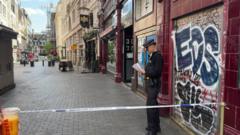
The siren-heavy silence of central London was shattered earlier today when a vehicle veered into a crowd of pedestrians, leaving a trail of wreckage and a city once again questioning the fundamental safety of its most famous thoroughfares. Met Police officers acted with brutal efficiency, apprehending a man on suspicion of attempted murder at the scene. While the initial panic suggested a repeat of the high-profile vehicular terror attacks that scarred the last decade, early indicators point toward a more localized, though no less terrifying, brand of violence. This was not a failure of intelligence. It was a failure of the physical environment to protect those within it.
We are seeing a shift in the nature of metropolitan danger. As the threat of organized, large-scale plots fluctuates, the "lone actor" or the individual using a vehicle as a weapon of opportunity has become the primary nightmare for security planners. In this instance, the vehicle didn't just hit people; it tore through the perceived safety of a high-traffic zone during a period of peak visibility.
The Anatomy of the Impact
Eyewitness accounts describe a scene of calculated chaos. The vehicle didn't just drift; it accelerated into a space where human bodies are most vulnerable. When a two-ton machine meets a crowd, the physics are unforgiving. This is why the charge is attempted murder. The intent is inferred by the trajectory and the lack of braking before the point of contact.
For the veteran observer, the most striking element isn't the act itself, but the location. Central London is supposed to be a fortress of "ring of steel" surveillance and hostile vehicle mitigation (HVM) measures. If a driver can still find a gap wide enough to mount a curb and strike multiple targets, then the millions spent on bollards and planters have failed their primary test. We have built a city that looks safe, but remains porous to anyone with enough momentum and a steering wheel.
The Problem with Soft Targets
Security experts classify busy shopping districts and tourist hubs as soft targets. You cannot wall off a city without killing the very commerce and culture that makes it worth living in. This creates a paradox. To keep the city "open," we leave it exposed.
- Hostile Vehicle Mitigation (HVM): These are the heavy-duty bollards you see outside Parliament. They work.
- The Aesthetic Compromise: Many councils prefer "street furniture"—benches or planters—that look nice but lack the deep-foundation reinforcement required to stop a speeding SUV.
- Response Times: Armed response units in London are among the fastest in the world, yet they still arrive after the damage is done.
The Suspect and the Search for Motive
The man currently in custody is the center of a massive forensic scrub. Detectives are currently tearing through his digital history, his bank records, and his social circles. The central question remains: was this a political statement or a personal breakdown?
In the current climate, we often rush to label these events as "terrorism" before the dust has settled. However, the legal threshold for terrorism requires a specific ideological or political aim. If this driver was fueled by a private grudge or a psychotic break, the charge remains attempted murder. For the victims, the distinction is academic. The trauma is identical.
The investigation is currently focused on the vehicle's origin. Was it stolen? Was it a rental? The use of rental vehicles has been a recurring theme in urban attacks because they bypass the red flags associated with purchasing a weapon or building an explosive device. They are the ultimate "everyday" threat.
The Data of Danger
Statistically, the likelihood of being involved in a vehicular attack remains lower than that of a standard traffic accident. Yet, the psychological impact is disproportionate. One driver can freeze an entire global capital.
| Metric | Estimated Impact |
|---|---|
| Response Duration | 4 to 8 hours of total area lockdown |
| Economic Cost | Millions in lost retail and transport revenue |
| Psychological Toll | Increased public anxiety for weeks following the event |
A Failure of Infrastructure
We need to talk about the bollards. Following the London Bridge and Westminster attacks, there was a flurry of activity to "harden" the city. Huge sums were diverted to ensure that sidewalks were protected. But look closely at any major London street today and you will see the gaps. You see where the bollards end to allow for delivery access or where the barriers are replaced by flimsy plastic markers.
These gaps are where people die. The reality is that the city’s infrastructure hasn't kept pace with the evolving tactics of urban violence. We are still using 20th-century urban planning to fight a 21st-century security war. If we are serious about preventing "attempted murder" via vehicle, the streetscape must change.
This doesn't mean more police on every corner. It means smarter engineering. It means kinetic energy recovery systems built into curbs. It means automated bollards that can retract for authorized vehicles but remain an impenetrable wall for everyone else.
The Intelligence Gap
While the Met Police are lauded for their rapid apprehension, the "investigative journalism" angle here requires us to ask why this person was on the road at all. Was he known to authorities?
Often, these suspects have a "gray" history. Not a terrorist, but a series of violent outbursts. Not a criminal mastermind, but someone who has slipped through the cracks of mental health services and community policing. The "lone wolf" is rarely a wolf at all; they are usually a person whose descent into violence was visible to those around them but ignored by the system.
We focus on the moment of impact because it is cinematic and tragic. We ignore the months of radicalization or mental decay that lead up to it. Until we bridge the gap between social services and security services, these arrests will continue to happen only after the sirens start.
The Legal Battle Ahead
The prosecution of this case will be a bellwether for how London handles "car-as-weapon" crimes. In the past, some defense lawyers have argued for "diminished responsibility" or "medical episodes" like hypoglycemia or sudden seizures. The Crown Prosecution Service (CPS) will have to prove intent. They will look at the angle of the wheels, the speed of the car, and the lack of skid marks. Every inch of that asphalt is a crime scene that tells a story of intent.
The Cost of the Open City
There is a grim reality that no politician wants to admit: you cannot protect everyone. The "Total Security" model is a myth sold to the public to keep them shopping. As long as we value the freedom to walk down a street, we accept the risk that someone might drive a car into that street.
The arrest today is a success for the police, but it is a reminder of our vulnerability. The man in the cell is just one variable. The street itself is the constant. We have spent decades making our cars safer for the people inside them. We have done almost nothing to make the streets safer for the people outside of them.
The blue lights will eventually stop flashing. The tape will be cleared. The shops will reopen. But for those who were there, the sound of a revving engine will never be the same. The city continues to move, but it moves with a limp.
Fix the streets. Harder. Faster. Now.