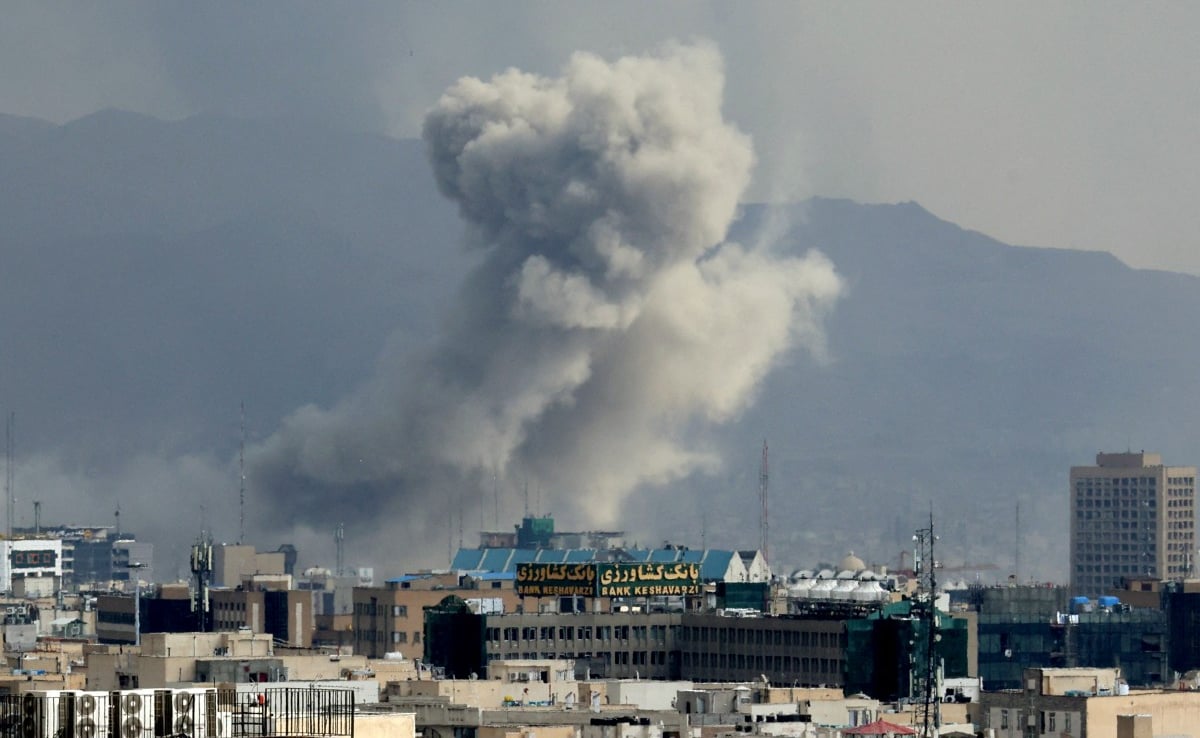
The March 3, 2026, ballistic missile impact at Al Udeid Air Base in Qatar signals a shift from symbolic posturing to a strategy of calibrated attrition. While the Qatari Ministry of Defense reported no casualties following the impact of one of two launched Iranian ballistic missiles, the event functions as a stress test for the regional Integrated Air and Missile Defense (IAMD) architecture. This strike is not an isolated tactical event but a data point in a broader retaliatory framework following the February 28 initiation of Operation Epic Fury (US) and Operation Roaring Lion (Israel).
The primary objective of this strike was not the destruction of personnel but the degradation of high-value sensing assets and the exhaustion of interceptor stockpiles. By forcing the activation of Patriot and THAAD batteries across the Gulf Cooperation Council (GCC) states, Iran is mapping the "sensor-to-shooter" latency of US and allied defenses.
The Triad of Iranian Retaliatory Objectives
Iranian strategy currently operates on three distinct logical planes, moving beyond the binary "war or peace" narrative:
- Symmetry of Cost: The strike on Al Udeid follows reports of significant damage to a US AN/FPS-132 Early Warning Radar, a system valued at approximately $1.1 billion. By targeting infrastructure that is difficult to replace due to long lead times in semiconductor and vacuum tube manufacturing, Tehran seeks to impose a financial and operational "Cost Function" that exceeds the political will of the US to sustain a month-long campaign.
- Sovereignty Erosion: By successfully penetrating the airspace of Qatar—a nation that hosts the forward headquarters of US Central Command (CENTCOM)—Iran demonstrates that US protection does not grant absolute immunity. This creates a diplomatic bottleneck for host nations, who must now weigh the utility of US presence against the physical risk to their domestic infrastructure.
- Information Gathering (ELINT): Every missile launch serves as a probe. As Qatari and US batteries engage, Iranian electronic intelligence (ELINT) units monitor the frequencies, radar signatures, and engagement patterns of the defensive systems. This data is likely being fed into real-time targeting adjustments for subsequent "waves," such as the 17th wave of Operation Honest Promise 4 reported by the IRGC.
Defensive Saturation and the Interception Deficit
The mechanics of the Al Udeid strike reveal a critical vulnerability in modern missile defense: the interception-to-target ratio.
- Saturation Threshold: Qatar reported detecting 101 ballistic missiles, 39 suicide drones, and 3 cruise missiles since the conflict’s start.
- Resource Depletion: Standard engagement doctrine often requires firing two interceptors (such as the PAC-3 MSE) at a single incoming threat to ensure a high Pk (Probability of Kill).
- The Bottleneck: Pentagon leaks suggest that if the current tempo of strikes continues for an additional 10 days, critical interceptor stocks will reach "redline" levels.
The successful impact of the second missile at Al Udeid suggests either a "leaker" through the defensive screen or a deliberate decision by automated fire-control systems to prioritize higher-value assets within the sprawling 24-square-kilometer base. The strike specifically targeted the radar dome, a critical node for secure communications and satellite data links (MET terminals).
Espionage and Internal Friction
Simultaneous with the kinetic strikes, the dismantling of two IRGC-linked spy cells in Doha on March 4 highlights the hybrid nature of the conflict. The 10 suspects arrested were categorized into two operational groups:
- Group A (Surveillance): Seven individuals focused on military infrastructure mapping.
- Group B (Sabotage): Three individuals tasked with kinetic operations within Qatari territory.
This internal friction is designed to force the Qatari Armed Forces to divert resources from border defense to internal security, effectively thinning the defensive layer. The admission of IRGC links by these suspects confirms a coordinated effort to synchronize "inside-the-wire" sabotage with "outside-the-wire" missile strikes.
Operational Constraints and the Strategic Forecast
Despite the high-profile nature of the Al Udeid hit, US and Israeli forces maintain air supremacy. The establishment of this supremacy within the first hours of the conflict has allowed for the destruction of nine Iranian naval vessels and the decapitation of the primary IRGC leadership structure in Tehran. However, the asymmetric advantage remains with the defender’s ability to hide mobile missile launchers (TELs) in rugged terrain.
The conflict now moves into a phase of logistical endurance. The US maintains a two-carrier strike group presence (USS Abraham Lincoln and USS Gerald R. Ford), but the naval weapons stockpile is under strain. The strategic play for the US is to complete the degradation of Iranian TELs before the interceptor "redline" is hit.
The most probable immediate outcome is an escalation of "tit-for-tat" strikes on energy infrastructure in the Strait of Hormuz. Iran’s claim of complete control over this waterway is likely hyperbole given the destruction of their naval headquarters, yet they retain the ability to use "stray" drones and mines to disrupt the 20% of global petroleum flow that passes through the transit point.
The strategic priority for CENTCOM must be the hardening of sensor nodes at Al Udeid and the rapid deployment of directed-energy (laser) defenses to handle lower-tier drone threats, thereby preserving expensive kinetic interceptors for the incoming ballistic waves. Failure to stabilize the interceptor inventory will result in a forced operational pause, ceding the initiative back to IRGC remnants.
I can provide a detailed technical analysis of the specific radar systems targeted or a breakdown of the interceptor logistics for the GCC region if you wish to evaluate the depletion timelines more closely.