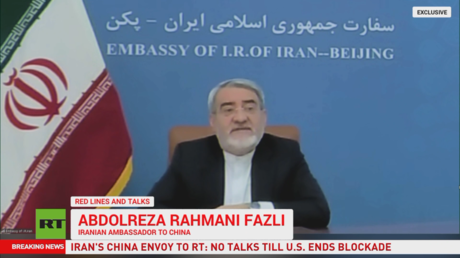
The headlines are breathless. They tell a story of defiance, of Tehran drawing a line in the sand, of an envoy standing tall in Beijing and refusing to engage with the West until the blockade ends. It is the classic narrative of the brave resistor against the imperial oppressor. It is a fairy tale for the intellectually lazy.
If you believe that the current situation in Iran is defined by a desire for talks being blocked by American sanctions, you have fundamentally misunderstood the nature of the game. You are watching a theatrical production and confusing the actors for the playwrights. The reality is not a deadlock. It is a mutually beneficial stasis.
The idea that Tehran wants to return to the bargaining table is a fantasy held by think tanks and diplomats who measure the world in memorandums of understanding rather than capital flows. Let us dismantle this charade.
The Myth of the Blockade as a Barrier
The mainstream consensus posits that sanctions act as a wall, preventing Iran from economic growth and forcing them into a corner where they must inevitably seek relief. This premise is archaic. It dates back to an era when global economies were monolithic and financial systems were transparent.
We are living in a post-sanction world where the so-called "blockade" functions less like a fence and more like a protected, high-margin market. When the West disconnects a nation from the global financial grid, it creates an immediate vacuum. That vacuum is not filled by nothingness. It is filled by shadow networks, parallel banking systems, and barter arrangements that are inherently immune to external regulation.
Iran has spent the better part of two decades perfecting the art of operating outside the Swift system. They do not view the blockade as a disaster to be mitigated. They view it as a structural advantage. It allows the regime to control the flow of hard currency, dictate the terms of trade for essential goods, and maintain a client list of regional players who have nowhere else to go.
If the US were to lift the sanctions tomorrow, the immediate result would not be a rush of prosperity for the average citizen. It would be the sudden influx of international competition that the regime’s favored conglomerates cannot handle. They would lose their monopoly on the black market routes they spent twenty years building. The blockade is the moat around their castle. Why would they want the drawbridge lowered?
The Envoy and the Beijing Theater
When the envoy in Beijing drops a statement about the refusal to talk, the commentary class treats it as a diplomatic signal. They analyze the timing, the venue, and the phrasing. They ask: "What does this mean for the future of the JCPOA?"
This is the wrong question.
The venue is the message. Beijing is not a neutral mediator; it is the primary beneficiary of the isolation of Iran. By making these announcements in the shadow of the Great Hall of the People, Iran is signaling its commitment to a non-Western economic axis. They are not talking to the Americans because they are already talking to their real customers.
The "talks" are the carrot on the stick. They exist to keep the West occupied. As long as Washington believes that a deal is just around the corner—that a phone call or a backchannel meeting could fix everything—the US remains reactive. They spend their policy energy trying to manage a "potential" outcome rather than acknowledging the reality of the current one.
The envoy’s statement serves a dual purpose. It satisfies the domestic hardliners by projecting strength, and it feeds the Western diplomatic machine the ambiguity it needs to justify its own lack of progress. Everyone involved is getting exactly what they need from the performance.
The Anatomy of the Shadow Economy
To understand why talks are never going to happen, you must follow the money. Look at the oil exports.
The conventional narrative focuses on how many barrels are being blocked. The actual data shows a persistent, rhythmic flow of crude to Asia, labeled as something else, transported on phantom tankers, financed through non-convertible currencies. This is not a leaking sieve; it is a finely tuned machine.
When you remove the constraints of international law, you do not lose efficiency. You gain adaptability. The transaction costs are higher, yes, but the margin captured by the state is total. There is no international auditor checking the books. There is no shareholder demanding transparency. The revenue goes directly into the machinery of state security and regional influence.
The West, meanwhile, treats this as a temporary failure of enforcement. They tighten the screws, authorize more patrols, and issue more warnings. This, too, is theatre. The enforcement agencies are often just collecting data for the next round of reports that will never be acted upon.
Consider the scenario where the sanctions were actually removed. The Iranian Rial would likely collapse in the short term as the pent-up demand for foreign goods flooded the market, and the internal power structures that rely on the scarcity of goods would be dismantled overnight. The political cost for the current leadership would be terminal. Survival, therefore, mandates the preservation of the crisis.
Washington’s Complicity
Do not assume this is purely a one-sided affair. Washington needs the "Bad Guy" image just as much as Tehran does.
In the domestic politics of the United States, the "Iran problem" is a reliable donor of political capital. It justifies defense budgets, maintains regional alliances with states that might otherwise be skeptical of US intentions, and provides a clear, black-and-white narrative in an increasingly chaotic world.
If Iran were to suddenly become a functional, normal state, what would the US do with the thousands of policy analysts, sanction enforcement officers, and think-tank experts who have built their entire careers on the assumption of Iranian hostility?
There is an inertia to this conflict. It is self-sustaining. The bureaucrats, the intelligence officers, and the lobbyists on both sides of the ocean have built their professional lives on the continuation of the status quo. To end the blockade would be to admit that the last decade of policy was a expensive, elaborate distraction.
The Strategy for the Real World
If you want to know what is actually happening, stop reading the official press releases from the State Department or the statements from Tehran. They are written for a different audience.
Look at the commodity traders. Look at the shipping insurance rates in the Strait of Hormuz. Look at the currency exchange nodes in the UAE and Iraq. These are the indicators that do not lie.
The reality is that we are in a era of fragmented markets. The idea of a unified global order is dead. Iran is not an outlier; it is the pioneer of this new, fractured reality. They have built an economic model that is resilient to the tools of the old order.
The failure of the "talks" is not a glitch. It is the feature.
The "blockade" is not preventing development. It is forcing a shift in the development model toward autarky and regional integration with powers that are explicitly hostile to Western influence. The more the West pushes, the deeper those connections become.
You may wonder if there is an alternative. Is there a way to break this?
Only if you are willing to abandon the pretense of "sanctions" as a tool for behavioral modification. If the intent is to stop the regime from pursuing its current path, sanctions are not only useless; they are counter-productive. They accelerate the very behavior they aim to prevent by making the regime more reliant on its own internal control mechanisms and more dependent on alternative power blocs.
But no one in power wants to admit that. It is far easier to keep the cycle going. It is far safer to repeat the same lines about "talks" and "blockades" than it is to acknowledge that the board has changed entirely.
The envoy in China isn't afraid of the blockade. He is celebrating its success.
The silence you hear from the negotiation rooms is not the sound of a wall. It is the sound of a transition. The era of the Western-dominated global market is eroding, and Iran has positioned itself in the ruins, trading with the new masters of the game.
You can wait for the talks to start. You can hold your breath for the breakthrough. Or, you can look at the data and admit that the world has already moved on. The negotiation is over because the deal has already been made elsewhere. The participants are just waiting for the rest of us to notice.
When the history of this decade is written, it will not be remembered for the sanctions that were applied or the talks that were held. It will be remembered for the moment the world stopped caring about the rules and started building their own.
Stop asking when the blockade will end. Start asking who benefits when it continues. Once you answer that, you will understand exactly why nothing is changing.
The game is rigged, the players are comfortable, and the audience is the only one losing money. Look away from the headlines. There is nothing there for you to find.