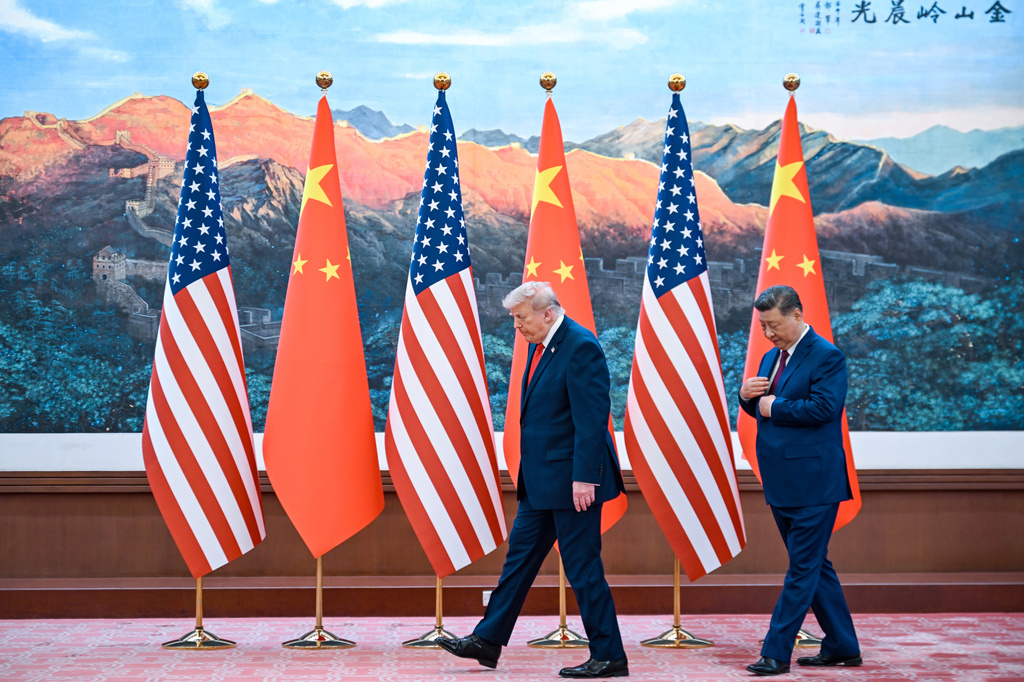
In the Great Hall of the People on Thursday, the air was thick with the scent of expensive tea and the stifling weight of a decades-old geopolitical stalemate. Chinese leader Xi Jinping sat across from Donald Trump and issued a warning that was as blunt as it was calculated. He stated that if the United States continues its current trajectory regarding Taiwan, the two superpowers are headed toward "clashes and even conflicts." While the public-facing cameras captured Trump offering high praise for his counterpart, calling him a "great leader" and a "friend," the internal readout from Beijing told a much darker story. The core of the issue is not just a territorial dispute; it is a fundamental disagreement over the global order that has now reached a breaking point.
The Red Line in the Strait
Xi Jinping has spent the better part of a decade consolidating power and modernizing the People’s Liberation Army with one specific goal in mind: the "reunification" of Taiwan. On Thursday, he made it clear that this is no longer a distant aspiration but an immediate priority. By using the word "conflict" rather than the more diplomatic "tensions" or "instability," Xi is signaling that the era of strategic patience has ended.
For the Chinese Communist Party, Taiwan is the "first red line." It is the one issue they are willing to tank their economy for, and potentially, go to war over. The U.S. has historically maintained a policy of "strategic ambiguity," helping Taiwan defend itself without explicitly promising to join a war. Trump’s return to the presidency has injected a fresh dose of unpredictability into this fragile balance. Beijing sees recent U.S. arms sales and high-level diplomatic visits as a deliberate provocation, a "playing with fire" that they are now threatening to extinguish with force.
Trump’s Transactional Diplomacy vs. Xi’s Ideological Wall
The disconnect between the two leaders was palpable during the Beijing summit. Trump approached the meeting through the lens of a dealmaker. He spoke of trade progress, energy alignment, and his desire for China to help broker an end to the war in Iran. In Trump’s view, almost everything is a bargaining chip. He sees the U.S.-China relationship as a series of transactions that, if managed correctly, can lead to a "better than ever" future for both nations.
Xi Jinping does not view Taiwan as a bargaining chip. To the Chinese leadership, the sovereignty of Taiwan is an existential matter of national pride and internal security. It is an ideological wall that cannot be negotiated away for better trade terms or energy deals. While Trump was looking for a "win" to bring back to his domestic audience, Xi was laying down the law for a global one. This fundamental mismatch in how the two leaders perceive value is exactly why the risk of a miscalculation is at an all-time high. If Trump believes he can trade Taiwan for a trade concession, and Xi believes the U.S. is preparing to recognize Taiwanese independence, the resulting "clash" won't be limited to a boardroom.
The Economic Fallout of a Kinetic Conflict
The business world often treats the "Taiwan Question" as a background hum—a persistent but manageable risk. That is a dangerous mistake. A direct conflict in the Taiwan Strait would be an immediate, catastrophic event for the global economy.
- Semiconductor Paralysis: Taiwan produces over 90% of the world's most advanced semiconductors. A blockade or invasion would instantly halt the production of everything from smartphones to fighter jets.
- Shipping Lane Chaos: The Taiwan Strait is one of the busiest shipping routes on the planet. A kinetic conflict would force global trade to reroute, causing a supply chain collapse that would make the 2020 disruptions look like a minor inconvenience.
- Asset Seizures: In the event of a clash, we would likely see the immediate freezing and seizing of Chinese assets in the West and Western assets in China, effectively ending the era of globalized finance as we know it.
The New Language of Escalation
Observers noted that Xi's language has shifted significantly since his 2022 calls with the previous administration. Back then, he spoke of "disruptive impacts." Now, he is speaking of "clashes." This isn't just semantics; it's a change in the rules of engagement. Beijing is no longer warning that the relationship will be "hurt"; they are warning that it will be "broken."
The Chinese Foreign Ministry’s spokesperson, Mao Ning, doubled down on this after the meeting, stating that "Taiwan independence" and peace are as "irreconcilable as fire and water." This framing leaves no room for the "middle ground" that has sustained the peace for fifty years. When one side views the status quo as an intolerable threat to its existence, the incentive for a preemptive strike grows every day.
The Illusion of Stability
Despite the booming cannons and the schoolchildren waving flags during Trump’s welcome ceremony, the summit failed to produce a substantive breakthrough on the Taiwan issue. The pageantry served as a thin veil over a widening chasm. Trump’s assertion that the relationship will be "better than ever" is a political statement intended for a domestic audience, but it ignores the reality of the military buildup occurring on both sides of the Strait.
Washington’s continued arms sales to Taipei are intended to turn the island into a "porcupine"—too painful for China to swallow. Beijing, meanwhile, is testing the limits of that defense with near-daily air and sea incursions. We are currently witnessing a high-stakes game of chicken where both drivers believe the other will swerve first. But if Xi Jinping’s words in Beijing are any indication, China has already locked its steering wheel in place.
The reality is that we are closer to a superpower conflict than at any point since the end of the Cold War. The "strategic stability" Xi called for is not a partnership of equals, but a demand for American retreat from what China considers its backyard. For an American president who prides himself on never backing down, the "Taiwan question" is no longer a diplomatic puzzle to be solved, but a fuse that has already been lit.
Prepare for a world where the "Pacific" is anything but.
Xi Stuns Trump With ‘Direct’ Warning Of US-China ‘Clashes’ Over Taiwan
This video provides a deep dive into the specific rhetoric used during the Beijing summit and analyzes the military implications of Xi's heightened warnings.