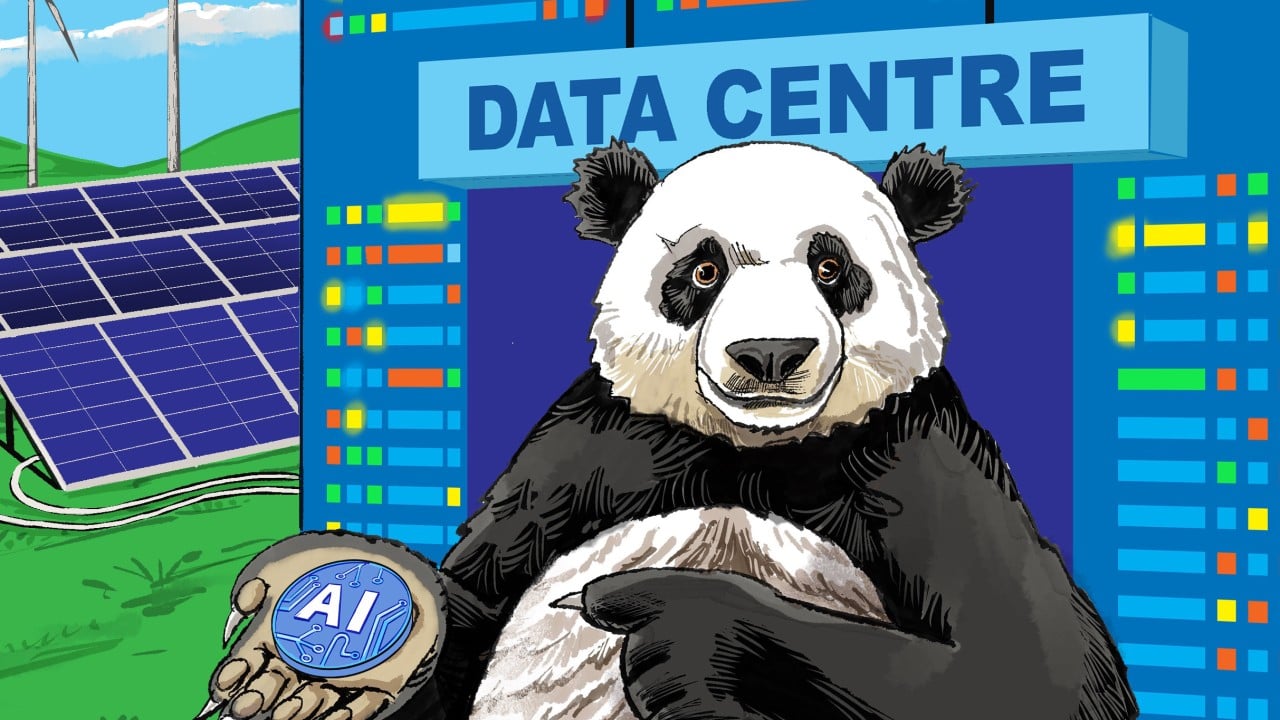
In the glass-walled boardrooms of Beijing and the frantic hardware hubs of Shenzhen, the conversation has shifted. It is no longer about the sheer brilliance of an algorithm or the pursuit of a sentient machine. The air is thick with a different kind of ambition. It smells like ozone and cooling fans. China is no longer just building a brain; it is building a nervous system that reaches into the furthest, dustiest corners of its map.
For years, the world watched the coastal giants—the Alibabas and Tencent—race to dominate the AI sphere. But a quiet, seismic shift is occurring. The central government is pushing a massive initiative to drive AI tokens—the fundamental units of data processing—into the inland provinces. This isn’t a charity project. It is a calculated, cold-blooded economic surgery designed to move the country’s heartbeat from the crowded east to the hollowed-out west.
The Ghost in the Data Center
Consider a hypothetical engineer named Chen. Chen grew up in Guizhou, a province once known primarily for its jagged mountains and its poverty. Ten years ago, a man like Chen would have boarded a train for a 20-hour journey to Shanghai, leaving his family behind to live in a "coffin apartment" just to be near the compute power.
Today, Chen stays home.
He works in a facility carved into the side of a mountain, where the naturally cool air slashes the electricity bills of massive server farms. This is the "East-to-West Computing" project in its physical form. By pushing AI token generation and data processing into the interior, China is attempting to solve a physics problem: heat and space. The coastal cities are running out of both. The inland provinces have them in surplus.
But the data isn't just sitting there. It is being weaponized to revive dying industries.
More Than Just Math
When we talk about "AI tokens," the eyes of the average person glaze over. It sounds like digital arcade money. In reality, tokens are the currency of thought for a Large Language Model. Every time an AI "reads" a sentence or "generates" a solution, it consumes these units. By subsidizing and driving the cost of these tokens down in the inland regions, the state is effectively giving local factories a free brain transplant.
Imagine a traditional textile mill in Ningxia. For decades, it survived on thin margins and manual labor. Now, with access to cheap, localized AI tokens, that mill can run real-time predictive maintenance. It can optimize its supply chain using models that were once the exclusive playthings of Silicon Valley elites.
The strategy is clear: commoditize intelligence.
If intelligence is cheap and ubiquitous, it doesn't matter if you are in a skyscraper in Pudong or a village in Gansu. You can compete. This is the democratization of "compute" as a utility, much like water or electricity. The goal is to ensure that the next industrial leap doesn't just happen in the "Golden Coast," but ripples through the entire 3.7 million square miles of the nation.
The Invisible Stakes
There is a desperation beneath this move that many analysts miss. China is facing a demographic crunch. The workforce is shrinking. To maintain its status as the world’s factory, it cannot rely on more hands; it must rely on smarter machines.
The inland provinces have long been the "back garden" of the country—providing raw materials and labor, then watching the finished wealth accumulate in the port cities. That model is breaking. If the interior doesn't modernize, it will hollow out completely, leading to a social instability that no amount of surveillance can fix.
The drive for AI tokens is a bridge. It is an attempt to tether the digital future to the physical reality of the hinterlands.
But this isn't without friction. The technical debt is staggering. It is one thing to build a data center; it is another to find the talent willing to live in a remote mountain town to run it. The government is betting that if they build the "compute," the people will follow. Or, more accurately, that the people will no longer feel the need to leave.
A Different Kind of Silk Road
The infrastructure required for this is gargantuan. We are talking about ultra-high-voltage power lines stretching across deserts and fiber-optic cables burrowing through ancient rock. It is a physical manifestation of a digital dream.
Think about the sheer scale of the power consumption. AI is a thirsty beast. A single high-end GPU can pull as much power as a small household. When you multiply that by millions, the coastal power grids begin to groan. By moving the "thinking" to the west—where wind and solar farms are abundant—China is effectively laundering its carbon footprint while securing its energy independence.
It is a clever bit of accounting. The west gets the jobs and the infrastructure; the east gets the relief from the crushing demand on its resources.
The Human Cost of the Shift
Change is never painless. For the workers in these inland regions, the "AI upgrade" often feels like a foreign language. There is a tension between the old guard—men and women who have worked with their hands for forty years—and the digital "tokens" that now dictate their quotas and efficiency metrics.
The machines are efficient, yes. But they are also relentless.
When a factory in Shaanxi integrates an AI-driven logistics system, it doesn't just "help" the workers. It reshapes their day. It tracks their movements. It identifies "inefficiencies" that a human supervisor might have overlooked out of kindness. This is the duality of the drive: it offers economic salvation at the cost of a certain kind of human autonomy.
We often view AI through the lens of science fiction—robots walking among us. The reality is much more mundane and much more pervasive. It is a line of code in a provincial tax office. It is an optimization algorithm in a coal mine. It is the invisible hand that makes a mid-sized city in the middle of nowhere suddenly relevant in a global market.
The Gravity of the Future
Why should the rest of the world care about token prices in Chongqing?
Because this is a blueprint. While Western nations debate the ethics of AI in philosophy departments, China is treating it as a civil engineering project. They are pouring concrete around their algorithms. They are treating "intelligence" as a raw commodity, like grain or steel.
If this succeeds, the cost of innovation drops to near zero for an entire half of a continent.
The competitive advantage moves from "who has the best researchers" to "who has the cheapest, most distributed compute power." It is a move toward a world where AI is so integrated into the bedrock of society that you don't even notice it's there. It becomes the hum in the wall. The water in the pipe.
The quiet mountains of the west are no longer silent. They are vibrating. Millions of silicon chips are "thinking" in the dark, processing the data of a billion lives, and rewriting the destiny of a nation that refuses to be left behind by the future.
The gamble is immense. The costs are astronomical. But as the sun sets over the Gobi Desert, the glow from the data centers suggests that for China, the path forward is already paved in silicon. They aren't just waiting for the future to arrive; they are shipping it, one token at a time, to the places the world forgot.
The mountain doesn't move for the man anymore. The man brings the mind to the mountain.