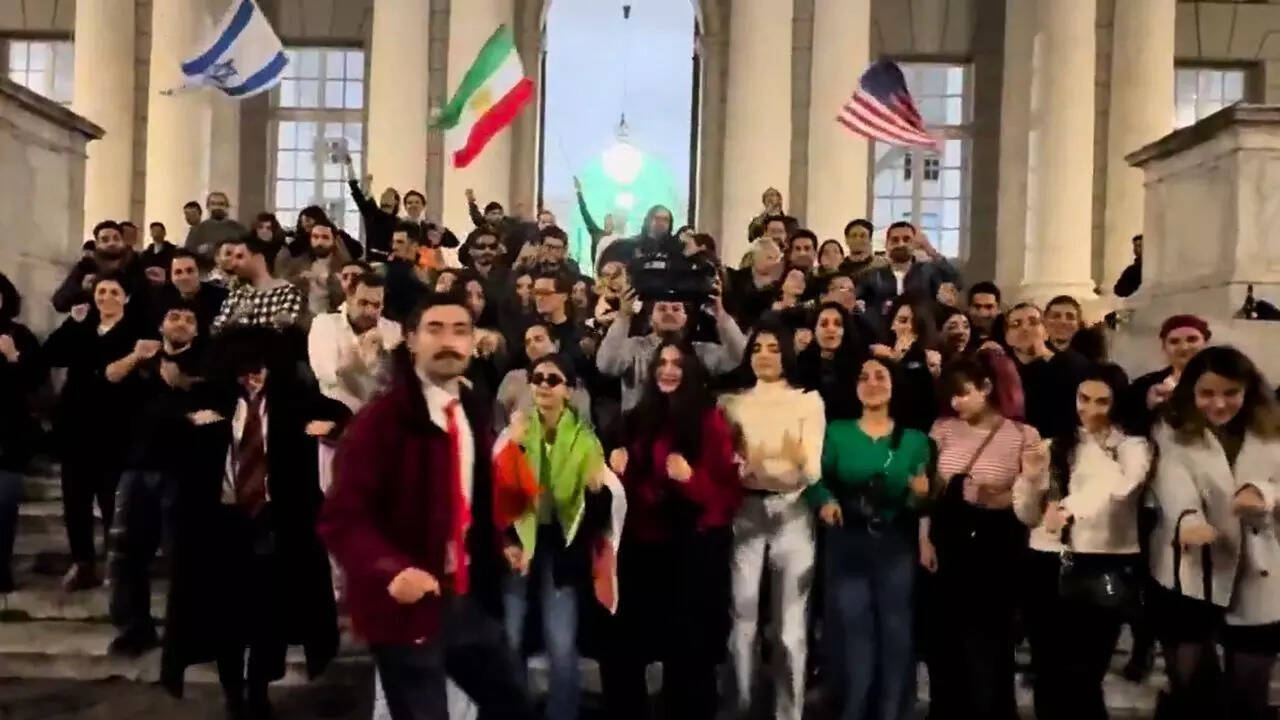
The death of Supreme Leader Ali Khamenei represents the single greatest point of failure for the Islamic Republic’s internal stability and its "Axis of Resistance" regional strategy. While surface-level reports focus on street celebrations and symbolic displays—such as the viral imagery of Iranians dancing with Israeli and American flags—these events are symptoms of a deeper structural decoupling between the Iranian citizenry and the clerical establishment. The core of the current crisis is not merely a vacuum of leadership, but the collapse of the social contract that has sustained the Velayat-e Faqih system for four decades.
The Triad of Institutional Destabilization
The transition of power in Iran operates under a high-entropy environment where three specific pillars of control are currently undergoing simultaneous stress tests:
- The Legitimacy Deficit: The participation of Iranians in symbolic acts of defiance, specifically utilizing the flags of "arch-enemies," signals a shift from reformist aspirations to total systemic rejection. This is a psychological break where the regime’s primary tool of control—ideological enmity toward the West—no longer serves as a unifying national narrative.
- The IRGC Command Bottleneck: The Islamic Revolutionary Guard Corps (IRGC) is a multi-billion dollar conglomerate as much as a military force. Without a Supreme Leader to mediate between competing factions within the IRGC and the traditional clerical assembly, the risk of internal "fiefdomization" increases. If the IRGC cannot align on a successor, the probability of a military-led transition that sidelines the clergy altogether moves from a fringe theory to a baseline scenario.
- The Economic Elasticity Limit: Iran’s economy has functioned in a state of permanent crisis management. However, the death of a central figurehead removes the "strategic patience" often demanded of the populace. When the state can no longer provide basic subsidies or currency stability, and the ideological justification for that suffering (Khamenei's "Resistance Economy") dies with the leader, the threshold for mass mobilization lowers significantly.
Strategic Miscalculation and the Risk of Kinetic Escalation
Outside observers often misinterpret domestic celebrations as a precursor to immediate democratic transition. This ignores the "Survival Calculus" of the Iranian security apparatus. History indicates that autocracies are most dangerous when they are most fragile. The Iranian leadership faces a binary choice: managed liberalization to appease the streets, or "The North Korea Path"—complete isolation and heightened external aggression to force domestic unity.
The presence of U.S. and Israeli flags during public celebrations creates a paradoxical threat for the West. While these symbols represent a desire for normalization among the youth, they provide the hardline elements of the Basij and IRGC with a pretext for "foreign interference" narratives. This creates a tactical dilemma for U.S. and Israeli intelligence agencies. Overt support for the protesters risks delegitimizing the movement as a CIA-Mossad construct, while silence may result in the crushing of the most significant internal opposition since 1979.
The Mechanics of Regional Proxy Decay
Iran’s regional influence is built on a "Hub and Spoke" model. Tehran provides the ideological and financial hub, while proxies in Lebanon, Yemen, and Iraq serve as the spokes. This model is highly dependent on the personal networks and religious authority of the Supreme Leader.
- Hezbollah’s Strategic Drift: Without the direct religious backing of a recognized Marja (Source of Emulation) like Khamenei, Hezbollah’s status as a religious movement becomes a purely political and mercenary one. This weakens their recruitment base in Lebanon.
- The Funding Chokepoint: A leadership vacuum in Tehran inevitably leads to an audit of external expenditures. If the IRGC is forced to prioritize domestic suppression of protesters, the flow of capital to the Houthis or Iraqi PMF will see a sharp contraction.
- The Israeli Pre-emptive Window: Israel views the transition period as a window of maximum vulnerability for the Iranian nuclear program. The "Octopus Doctrine"—targeting the head of the octopus rather than its tentacles—becomes more viable when the "head" is preoccupied with internal succession battles.
Quantifying the Successor Profiles
The Assembly of Experts is tasked with selecting the next leader, but the reality of Iranian power dynamics suggests the decision will be made in the shadows of the IRGC command centers. Two primary trajectories exist:
The Status Quo Clericalist
A weak, compromise candidate like Mojtaba Khamenei (the late leader’s son) or a mid-ranking cleric would be selected to provide a veneer of continuity. This creates a "shadow government" where the IRGC holds the actual levers of power while using the cleric as a ceremonial shield. The limitation here is that Mojtaba lacks the religious credentials to command the loyalty of the traditional seminaries in Qom, potentially leading to a schism in the religious establishment.
The Praetorian Shift
The IRGC moves toward a more nationalist, rather than Islamist, identity. This would involve a transition toward a military dictatorship that retains Islamic terminology but prioritizes Iranian sovereignty and regional dominance over global Shia revolution. This model might be more palatable to the middle class if it accompanies social loosening, but it remains fundamentally hostile to Western interests regarding nuclear proliferation and maritime security.
The Cost Function of Intervention
For the United States and its allies, the death of Khamenei does not automatically resolve the "Iran Problem." It changes the math of the engagement. The primary bottleneck for Western policy is the lack of a unified, credible "Government in Exile" or a domestic leadership structure that can absorb the collapse of the current state.
The celebration in the streets of Tehran is a data point, not a strategy. The "YMCA dance" with Israeli and American flags highlights a cultural alignment with the West that the IRGC cannot suppress, but culture does not hold territory. The IRGC holds the armories, the communication nodes, and the oil terminals.
Tactical Recommendation for Global Markets and Intelligence
The immediate priority for regional actors is the monitoring of the "Loyalty-to-Competence Ratio" within the Iranian regular army (Artesh). In previous revolutions, the tipping point occurred when the regular military refused to fire on civilians. If the current celebrations escalate into sustained occupation of government buildings, the reaction of the Artesh—not the IRGC—will determine if this is a momentary outburst or a systemic collapse.
Strategic stakeholders must prepare for a period of extreme volatility in the Strait of Hormuz. Hardline factions may attempt a "distraction strike" against global shipping to test the resolve of the U.S. Navy and to trigger a nationalist rally-around-the-flag effect. This is the "Dead Hand" protocol of the Islamic Republic: if the system is to fall, it will attempt to take regional stability with it.
The strategic play is to decouple the Iranian people’s aspirations from the regime’s provocations through hyper-targeted sanctions that hit the IRGC’s commercial wings while ensuring that the "Grey Market" for communication technology (Starlink and encrypted VPNs) remains flooded with hardware. The collapse of the Islamic Republic will not be a televised signing ceremony; it will be a slow-motion institutional rot followed by a sudden, violent reorganization of the security apparatus. Prepare for a decade of Iranian "Internalization," where the country’s primary export shifts from regional chaos to internal civil strife.