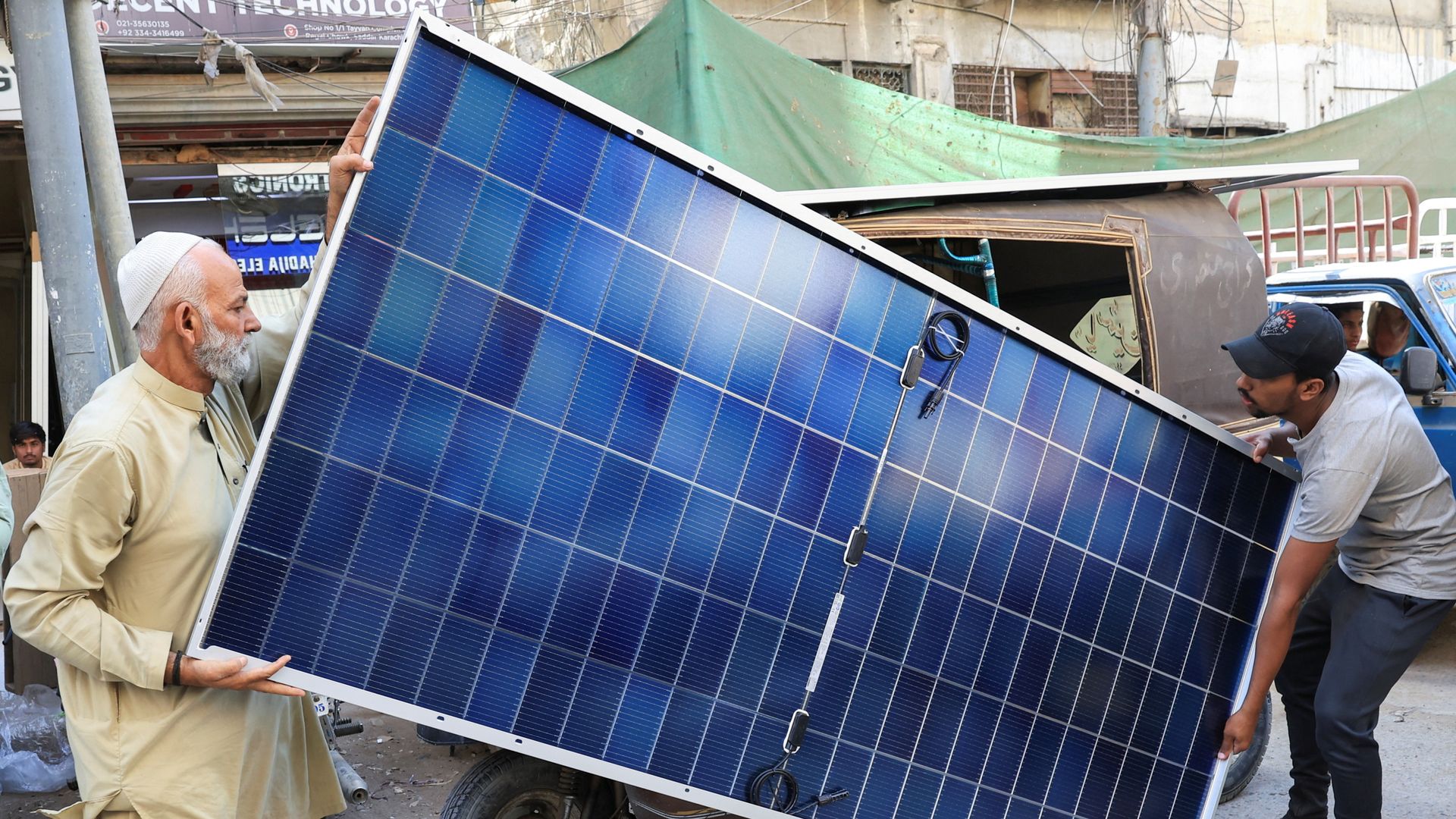
The traditional transition to renewable energy was historically driven by environmental mandates; however, the recent escalation of conflict in the Middle East has fundamentally decoupled decarbonization from climate idealism, rebranding it as a core component of national security. When UN climate officials describe a "boom" in renewable power, they are observing a shift in the global risk-mitigation function. Sovereign states are no longer prioritizing green energy for its carbon-neutral properties alone but for its ability to eliminate the "geopolitical risk premium" associated with imported hydrocarbons.
The Geopolitical Risk Premium and Decentralized Generation
Energy security traditionally relied on diversifying the geographic sources of oil and gas. The current conflict involving Iran and its proxies exposes the fragility of this model. The Strait of Hormuz remains a singular point of failure through which roughly 20% of the world’s liquid petroleum flows. In a high-tension environment, the cost of securing these trade routes—measured in insurance premiums, military escort costs, and potential supply shocks—becomes an unpriced externality that makes fossil fuels significantly more expensive than their market price suggests.
Renewable energy replaces this centralized, vulnerable supply chain with a localized capital expenditure (CapEx) model. Once a solar array or wind farm is commissioned, the marginal cost of fuel is zero, and the supply chain for that energy is contained within national borders. This creates a strategic buffer against the volatility of the Brent crude or TTF gas markets.
The Capital Reallocation Framework
The acceleration of renewable deployment can be mapped through three distinct pillars of capital reallocation:
The Insurance Arbitrage: Institutional investors are re-rating fossil fuel assets based on "interruption risk." As Iranian regional influence threatens shipping lanes, the risk-adjusted return on a natural gas plant dependent on LNG imports declines. Conversely, a domestic solar project, despite its intermittent nature, offers a predictable yield unaffected by foreign naval blockades.
Supply Chain Reshoring: The "boom" is not merely in the generation of power but in the manufacturing of the hardware. The UN's observations coincide with a massive push in the US and EU to onshore the production of photovoltaic cells and battery storage. This is a defensive industrial strategy to ensure that the transition away from Middle Eastern oil does not result in a new dependency on East Asian hardware.
Grid Hardening as Defense Spending: Governments are increasingly categorizing grid upgrades as defense expenditures. High-voltage direct current (HVDC) lines and decentralized microgrids are being prioritized because they are less susceptible to the cascading failures that characterize centralized, fuel-dependent grids during wartime or periods of intense cyber warfare.
The Intermittency Bottleneck and the Storage Equation
While the UN reports a surge in capacity, capacity is not equivalent to generation. The fundamental logic-gap in many optimistic reports is the failure to account for the "Dark Doldrums" or Dunkelflaute—periods where wind and solar output are negligible.
To bridge the gap between a "boom" in nameplate capacity and true energy independence, a specific ratio of storage-to-generation must be achieved. The current bottleneck is the Long-Duration Energy Storage (LDES) sector. Lithium-ion batteries are sufficient for 4-hour shifts to manage evening peaks, but they cannot solve the multi-day deficits caused by seasonal shifts or prolonged weather patterns.
The strategic pivot involves moving beyond chemical storage into mechanical and thermal vectors:
- Pumped Hydro: The most mature technology, yet limited by geography and environmental impact.
- Green Hydrogen: Using surplus renewable power during peak production to electrolyze water. This hydrogen acts as a "chemical battery" that can be stored in salt caverns and burned in existing turbines when the sun sets or the wind dies.
- Thermal Sand Batteries: Storing heat in low-cost materials for industrial processes, reducing the need for natural gas in manufacturing.
The Economic Displacement of the Petrodollar
The surge in renewable adoption has a secondary, often overlooked effect on the global financial architecture. The "petrodollar" system relies on the global demand for USD to purchase oil. As nations—particularly in Europe and the Asia-Pacific—reduce their oil imports in favor of domestic renewable electrons, the structural demand for the dollar shifts.
This creates a paradox: while the US may benefit from regional stability, its currency's dominance is partially tethered to the very fossil fuel volatility that renewables seek to eliminate. The move toward renewables is, by extension, a move toward a more fragmented, multi-currency energy trade environment.
Quantifying the Transition Velocity
The "boom" is best measured by the declining Levelized Cost of Energy (LCOE).
$LCOE = \frac{\sum_{t=1}^{n} \frac{I_t + M_t + F_t}{(1+r)^t}}{\sum_{t=1}^{n} \frac{E_t}{(1+r)^t}}$
Where:
- $I_t$: Investment expenditures in year $t$
- $M_t$: Operations and maintenance expenditures in year $t$
- $F_t$: Fuel expenditures in year $t$ (Zero for renewables)
- $E_t$: Electricity generation in year $t$
- $r$: Discount rate
- $n$: Expected lifetime of the system
In the context of the Iran-Israel tensions, the $F_t$ variable for fossil fuels is no longer a stable constant; it is a stochastic variable with high variance. For renewables, $F_t$ remains zero. Even if the initial investment ($I_t$) is higher due to high interest rates, the elimination of fuel price volatility makes the denominator of the risk equation far more attractive to long-term infrastructure funds.
The Role of Nuclear as a Strategic Floor
The UN's focus on renewables often ignores the necessity of a "baseload" that does not rely on weather. The current geopolitical climate has revitalized the case for Small Modular Reactors (SMRs). Unlike large-scale nuclear plants that take decades to build, SMRs offer a "plug-and-play" capability that fits the decentralized security model.
The strategy for nations seeking to insulate themselves from Middle Eastern instability is not "renewables only," but rather "domestic only." This includes:
- Aggressive deployment of solar and wind for bulk energy.
- Nuclear or deep-geothermal for constant baseload.
- Aggressive electrification of transport to kill the demand for crude oil.
The Limits of the Renewable Boom
The primary risk to this accelerated transition is the "Mineral Dependency Trap." A wind turbine requires significantly more copper, neodymium, and dysprosium than a gas-fired power plant. If the goal is to escape the geopolitical influence of oil-producing states, nations must be careful not to fall into a similar dependency on the states that control the Rare Earth Element (REE) markets.
Strategic stockpiling of these minerals and the development of "circular" recycling economies for battery components are now as vital as petroleum reserves were in the 1970s. The "boom" will stall if the transition from "molecules to electrons" is throttled by a shortage of "metals."
Operationalizing the Energy Pivot
The immediate strategic play for industrial leaders and sovereign planners is the "Electrification of Everything." This is not a sustainability initiative; it is a risk-reduction maneuver.
By shifting industrial heat, home heating (via heat pumps), and transport (via EVs) to a localized grid, a nation shrinks its "attack surface" regarding energy prices. The volatility of the Middle East becomes a secondary concern when the primary energy input for the economy is the wind blowing across the North Sea or the sun hitting the Iberian Peninsula.
The most effective hedge against Iranian-driven energy spikes is the rapid deployment of "behind-the-meter" storage and generation. Factories that produce their own power are immune to the shipping lane closures that bankrupted their predecessors. The roadmap forward requires a cold, calculated move toward total energy autonomy, utilizing the current "boom" as the foundational layer for a post-hydrocarbon security architecture.