Politics is often described as a game of chess, but that is far too clinical. Chess implies a board where every piece is visible and the rules are static. Diplomacy, especially the kind conducted between the two most powerful nations on earth, is more like a high-stakes dinner party held in a dark room. You navigate by the sound of breathing, the clink of silverware, and—most importantly—the presence of the people you actually trust to pass the salt.
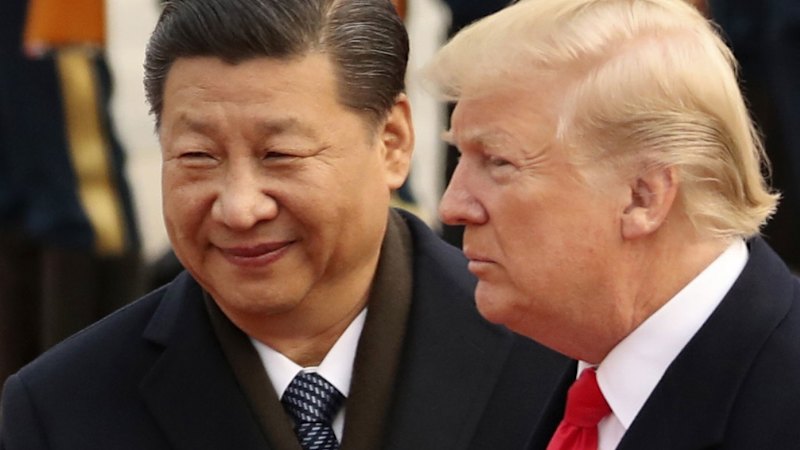
When Donald Trump recently moved to remove another high-ranking official known for a long-standing relationship with Xi Jinping, he didn’t just change a personnel roster. He flicked a light switch in that dark room. Now, as both sides scramble to arrange a summit that was supposed to steady a shaking world, they are finding that the chairs are empty. The bridge-builders are gone.
The Architecture of a Handshake
Consider the "Friend of China." In the dry vernacular of a State Department briefing, these individuals are often dismissed as "backchannels" or "interlocutors." But in reality, they are the human connective tissue that prevents friction from turning into fire.
Imagine a hypothetical diplomat named Elias. Elias doesn't just speak Mandarin; he understands the specific, heavy silence that follows a rejected proposal. He knows which Chinese officials prefer a blunt American "no" and which ones require a three-hour tea ceremony to save face while retreating. When a crisis hits—a submarine gets too close to a reef, a trade tariff is leaked prematurely—Elias is the person who picks up a burner phone at 3:00 AM. He doesn't call an office. He calls a kitchen.
By removing these figures, the Trump administration is betting on a new kind of physics. The theory is simple: if you remove the "sympathizers" and the "old guard," you're left with pure, unadulterated leverage. It’s a scorched-earth approach to negotiation. The problem is that when you scorch the earth, nothing grows. Not even a deal.
The Cost of Cold Certainty
The recent removal follows a pattern that has left Beijing squinting through the fog. For years, the Chinese leadership has relied on a predictable set of American faces—people they viewed as "rational actors" or, more colloquially, "old friends." These were the people who could translate "America First" into something the Politburo could digest without choking.
Now, those faces are being replaced by what many in Washington call "the hawks," but what Beijing sees as a wall of glass. You can see through it, but you can’t feel the heartbeat on the other side.
This isn't just about hurt feelings. It’s about the mechanics of a summit. A meeting between Trump and Xi isn't just two men sitting in gold chairs. It is the culmination of thousands of hours of "pre-work" done by the very people now being escorted out of the building. Without those intermediaries, the "pre-work" becomes a series of demands shouted through a megaphone.
The stakes are invisible until they aren't. We don't notice the value of a backchannel when things are going well. We notice it when a misunderstanding over a microchip factory in Ohio leads to a naval standoff in the South China Sea because there was no one left to say, "Wait, that's not what we meant."
A Masterclass in Misreading
There is a fundamental psychological gap at play here. The American side, under the current doctrine, views these "friends of Xi" as compromised. The logic is that if you're friendly enough to get a callback from Beijing, you’ve probably gone soft. It’s a zero-sum view of loyalty.
On the other side, the Chinese view the removal of these figures as a deliberate act of aggression—a "de-coupling" of the human spirit. In a culture where guanxi, or deep personal networks, is the bedrock of every contract and every peace treaty, pulling a trusted contact is more than a policy shift. It’s an insult. It suggests that the person across the table is no longer worth the effort of a relationship.
So, what happens to the summit?
It becomes a theater of the absurd. Without the "fixers" to smooth the edges, the two leaders are forced to negotiate the fine print themselves. Imagine trying to fix a watch with a sledgehammer. Trump’s preference for the "Grand Deal" often clashes with the Chinese preference for "Incremental Stability." Usually, the intermediaries find the middle ground where both can claim victory. Without them, there is only the hammer.
The Ghost at the Table
The real danger isn't that the summit will fail. The danger is that it will "succeed" on paper while failing in reality.
We have seen this movie before. A grand signing ceremony, a firm handshake, a flurry of tweets about a "historic breakthrough." But because the human infrastructure that supports the deal has been dismantled, the agreement has no roots. It is a cut flower. It looks beautiful for a day, and then it wilts because there is no one on the ground to water it, no one to explain the nuances to the bureaucracies, and no one to call when the first violation occurs.
The removal of these "friends" creates a vacuum. And in geopolitics, a vacuum is rarely filled by something better. It is usually filled by noise, suspicion, and the frantic guesses of people who are suddenly flying blind.
Think about the last time you had a massive argument with someone you cared about. If you had a mutual friend who could step in and say, "He didn't mean it that way," or "She's just stressed about work," the tension broke. Now imagine that friend is banned from the house. You are left alone with your anger and your assumptions. That is the current state of US-China relations.
The Fragility of the Big Man Theory
There is a seductive myth that history is made only by Great Men. We want to believe that if Trump and Xi just sit in a room long enough, they will solve the world’s problems through sheer force of will. It’s a compelling narrative. It’s also a lie.
History is actually made in the hallways. It’s made by the deputies who meet in hotel bars at midnight to argue over the placement of a comma. It’s made by the advisors who know how to tell their boss, "Sir, if you say that, the deal is dead."
By purging the room of anyone who understands the "other side," the administration is doubling down on the Big Man Theory. They are betting that personality can replace policy. They are betting that fear can replace familiarity.
But fear is a brittle foundation. You can use it to stop someone from doing something, but you can rarely use it to make them do something creative, collaborative, or lasting. As the summit approaches, the lack of a human bridge means the two leaders are standing on opposite cliffs, shouting across a canyon, hoping the wind carries their words accurately.
The Silence is the Message
In the coming weeks, you will see headlines about "protocol disputes" and "agenda disagreements." These are just code for the truth: the people who know how to talk to each other are no longer allowed to speak.
The removal of a "friend" isn't just a political maneuver. It’s a dismantling of a language. We are watching two of the most powerful nations on the planet lose their ability to communicate in anything other than threats and tariffs. It’s a bold strategy, certainly. But it’s one that ignores the most basic rule of human interaction: you can’t shake hands with a clenched fist.
As the cameras flash and the motorcades roll toward the summit, look past the two men at the center. Look at the perimeter. Look for the people who used to be there—the ones who knew the secrets, the ones who held the threads, the ones who kept the dark room from feeling quite so cold. When you see their empty chairs, you’ll know exactly how much we have to lose.
The silence isn't a sign of strength. It’s the sound of the bridge falling into the water.
Wired.
Tense.
Waiting for the splash.
Would you like me to analyze the specific economic sectors most at risk from this diplomatic vacuum?