The blinking cursor on a monitor in a darkened laboratory isn't usually the herald of a miracle. Most nights, it is the rhythmic pulse of boredom. For the astronomers monitoring the ASKAP radio telescope in the Australian outback, the data flowing in is typically a messy static—the white noise of a crowded, chaotic universe. But on a Tuesday that felt like every other Tuesday, the static broke.
Something screamed across the vacuum.
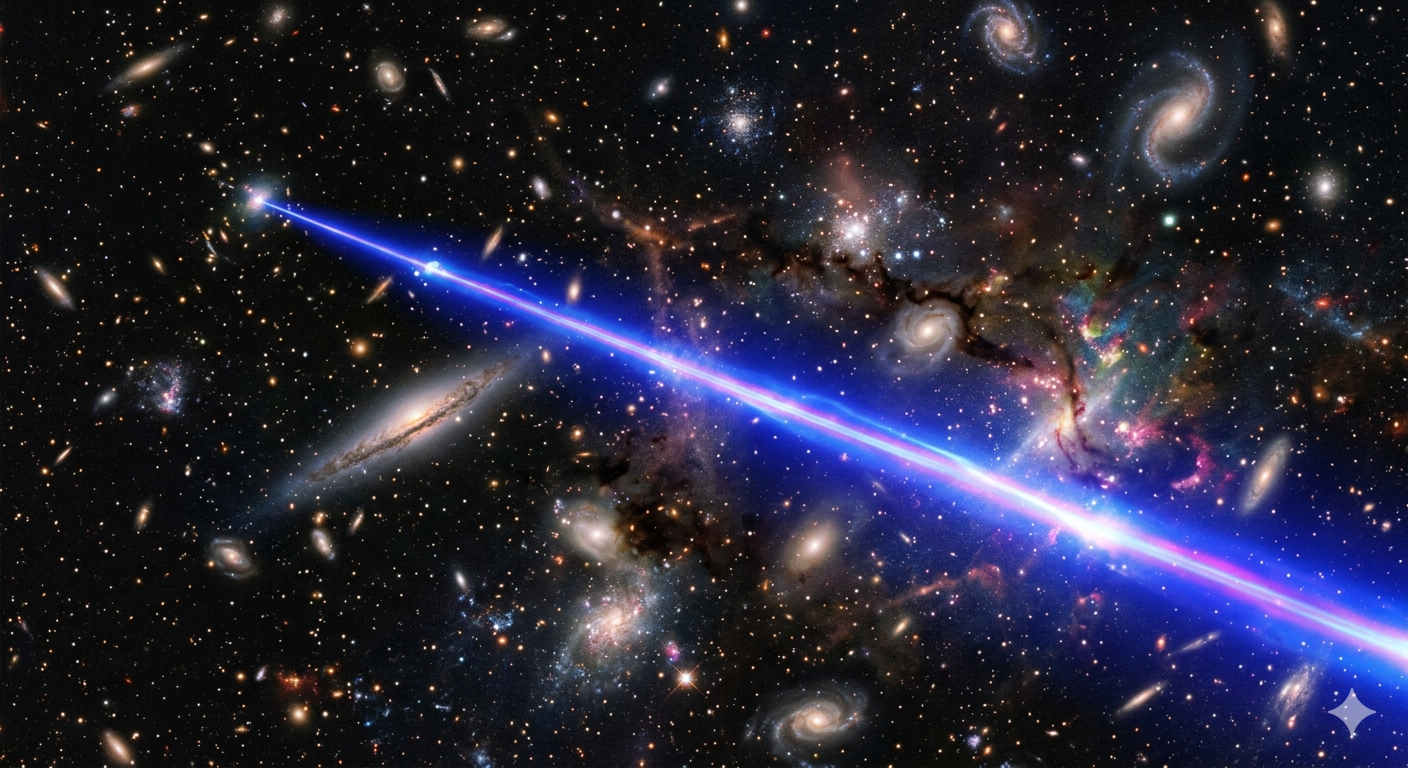
It was a burst of energy so intense and so focused that it defied the usual messy physics of exploding stars. We call it a Fast Radio Burst (FRB). But this wasn't a standard flare. This was a mega-laser signal, a concentrated beam of electromagnetic radiation that had been traveling through the void for eight billion years.
Think about that number. Eight billion.
When this signal first began its journey, the Earth did not exist. The Sun was not yet a glimmer in a collapsing cloud of gas. Entire galactic civilizations could have risen, mastered fire, built cathedrals, split the atom, and faded into dust while this single beam of light was still in transit. It is a ghost from a time when the universe was less than half its current age.
The Weight of a Speck of Light
To understand the scale of what we are dealing with, we have to talk about power. If you were to take every radio wave generated by every human being on Earth—every cell phone call, every television broadcast, every radar ping—and bundle them together, it would be a flickering candle compared to this.
This signal, cataloged as FRB 20220610A, released as much energy in a fraction of a millisecond as our Sun emits in thirty years.
Imagine standing on a dark beach at night. You see a flash on the horizon. It’s gone before you can even blink, but the afterimage lingers on your retina. You realize that for you to see that flash from so far away, the source must have been a bonfire the size of a continent. That is the sheer, terrifying scale of a mega-laser signal.
We aren't talking about a literal laser pointer held by a giant. In the vernacular of astrophysics, this is a "maser" or "laser" effect occurring on a galactic scale—likely fueled by a magnetar. A magnetar is the corpse of a star that has collapsed into a sphere the size of a city, spinning hundreds of times per second, wrapped in a magnetic field so powerful it would dissolve the atoms in your body from thousands of miles away.
When these celestial monsters twitch, they crack. And when they crack, they howl in radio waves.
Searching for the Invisible Bridge
The real question isn't just what made the sound, but where it came from. The signal didn't come from a quiet neighborhood. By using the Very Large Telescope in Chile, researchers traced the echo back to a small, chaotic cluster of merging galaxies.
This is where the story shifts from "cool space fact" to "fundamental crisis of reality."
For decades, cosmologists have been haunted by a math problem. When we count all the stars, planets, and dust clouds in the universe, the numbers don't add up. About half of the "normal" matter that should be there—the protons and neutrons that make up you, your coffee cup, and the moon—is missing. It’s not dark matter. It’s just... gone.
We suspected it was hiding in the vast, lonely stretches of "nothing" between galaxies. The Intergalactic Medium. But how do you measure something that you can't see, in a place you can't go?
You use the ghost.
As the mega-laser signal traveled those eight billion light-years, it didn't move through a perfect vacuum. It bumped into a few lonely atoms here and there. Each collision slowed the signal down just a tiny bit, specifically the lower-frequency parts of the beam. By the time the signal hit the Australian desert, it was smeared out.
By measuring that smear, we can weigh the emptiness of space. This single burst of light acted like a cosmic dipstick, telling us exactly how much "stuff" is floating in the dark between the stars. We found it. The missing matter is there, thin as a whisper, stretching across the abyss.
The Human at the End of the Wire
There is a specific kind of vertigo that comes with this discovery.
Scientists like Stuart Ryder and Ryan Shannon, the minds behind the detection, spend their lives looking at graphs. They deal in megahertz and gigaparsecs. But beneath the data is a profound human vulnerability. We are a species that has been on this planet for a heartbeat, staring at a signal that has been traveling since the dawn of time.
It makes our daily anxieties feel both trivial and sacred. The signal was traveling while the first multicellular life crawled out of the oceans. It was halfway here when the dinosaurs were wiped out. It was entering the final leg of its journey when you were born.
We often think of space as a silent, static map. We see photos from Hubble or Webb and think of them as still lifes. But the detection of this mega-laser reminds us that the universe is screaming. It is a violent, energetic, and deeply connected web of events.
The fact that we can sit on a spinning rock, build a mesh of wire and steel, and catch a millisecond-long whisper from eight billion years ago is the ultimate testament to human curiosity. We are the universe trying to understand itself.
The Silence That Follows
What happens now? We keep listening.
Each new burst is a flashlight. Every time one of these signals hits our sensors, it illuminates a different corner of the dark. We are building a map of the invisible. We are learning that the "void" isn't a void at all, but a reservoir of the very atoms that built us.
There is a certain discomfort in realizing how little we still know. We still don't know exactly why magnetars behave this way, or if there are other, even more exotic objects responsible for these beams. We are like people hearing a distant thunderclap and trying to describe the shape of the lightning.
But there is beauty in the pursuit.
Tonight, somewhere in the outback, a telescope is tilted toward a patch of black sky that looks empty to the naked eye. It is waiting. It is listening for the next ghost, the next eight-billion-year-old secret to come crashing into the present.
The universe is talking. We are finally starting to hear the words.
A single pulse of light, older than our world, just told us where we came from. It reminds us that we are not just observers of the cosmos. We are the destination of its longest-running messages.
The cursor continues to blink. The desert remains cold. The stars keep screaming into the dark, and for the first time, we aren't just hearing the noise—we are beginning to understand the song.