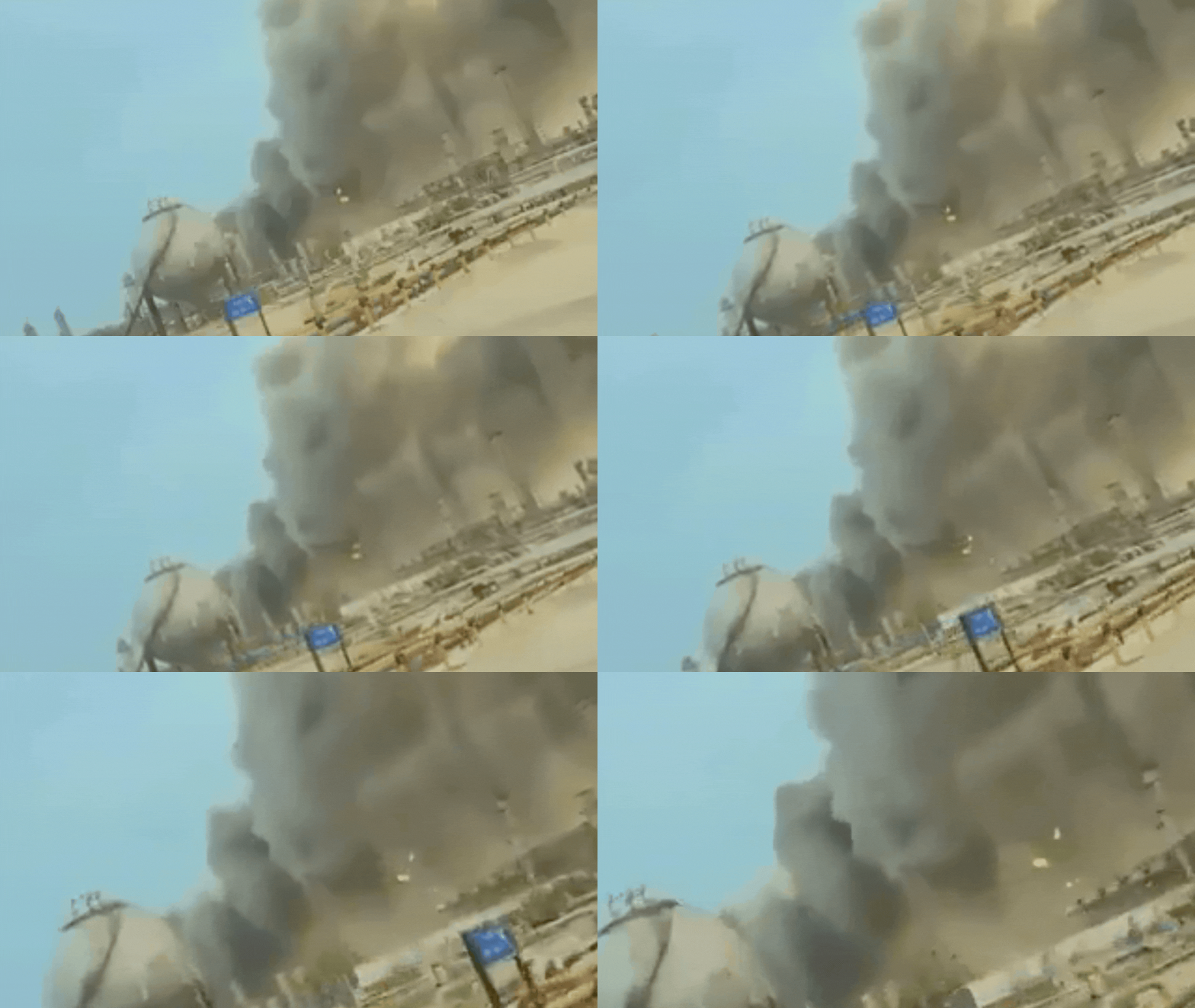
The headlines are screaming about a "fragile global energy supply" and "catastrophic infrastructure failure" in the wake of the latest drone strike on a Saudi Aramco refinery. They want you to believe that a few thousand dollars worth of Iranian-engineered carbon fiber and GPS guidance has brought the world’s most powerful energy giant to its knees.
They are lying to you.
The media loves a David vs. Goliath narrative, but in the crude oil markets, David is usually working for Goliath. These "disruptions" aren't the death knell of the internal combustion era. They are the ultimate price-support mechanism. If you think a smoking atmospheric distillation unit in Abqaiq or Khurais signals the end of Saudi dominance, you don’t understand how the energy value chain actually functions.
The Myth of Vulnerability
The consensus view is that these facilities are "sitting ducks." Pundits point to the sheer geographic spread of the Arabian Peninsula and the difficulty of defending every square inch of pipeline. This ignores the reality of modern industrial resilience.
I’ve walked through refineries that have been shelled, flooded, and cyber-attacked. What the "disaster" coverage misses is the redundancy of the global feedstock network. Aramco isn’t a single point of failure; it’s a hydra. When a drone hits a stabilizer plant, the market reacts with a $5-per-barrel "fear premium." Yet, within 48 hours, the Saudis usually tap into their massive underground storage reserves—estimated at tens of millions of barrels—located in places like Rotterdam, Okinawa, and Sidi Kerir.
The strike creates the illusion of scarcity while the actual flow of physical molecules to end-users remains virtually unchanged. The result? The producer sells their existing inventory at a massive, war-driven markup.
Your Geopolitics are Twenty Years Out of Date
The "Iranian Drone" narrative is a convenient boogeyman that serves everyone’s interests except the consumer's.
- For the Saudis: It justifies massive defense spending and strengthens the security alliance with the West.
- For Iran: It projects regional power and "asymmetric capability" without requiring a full-scale naval engagement they would lose in an hour.
- For Oil Traders: It provides the volatility required to squeeze margins out of stagnant flat-price environments.
The dirty secret of the industry is that volatility is the product. A stable, $60-per-barrel world is a nightmare for the people who move the oil. They need the drama. They need the grainy thermal footage of a fireball. It’s theater designed to mask the fact that the world is currently over-supplied with crude.
The Physics of Failure vs. The Finance of Fear
Let's look at the actual engineering. A drone carrying a 20kg shaped charge hitting a 300,000 barrel-per-day (bpd) refinery is like a mosquito biting an elephant. To actually "shut down" a facility of this scale, you would need a sustained, weeks-long bombardment targeting the highly specific, long-lead-time components: the heavy-wall reactors and the custom-forged heat exchangers.
Most drone strikes hit the low-hanging fruit—storage tanks. These look spectacular on CNN because they burn bright and long. But storage tanks are essentially giant tin cans. They are cheap to replace and don't stop the refining process.
The Real Target is Your Psychology
People also ask: "Why can't the most expensive military defense systems in the world stop a $500 drone?"
They are asking the wrong question. The question should be: "Why would you turn on a $2 million Patriot missile to intercept a drone that has already achieved its goal the moment it was launched?"
The drone's mission isn't to destroy the refinery; it's to trigger the Algodynamic Response. High-frequency trading algorithms are programmed to scrape news headlines for keywords like "Explosion," "Aramco," and "Drone." Within milliseconds of a report, the bid-ask spread widens, and the price of Brent crude spikes. The "attack" is successful the moment the first tweet goes live, regardless of whether the drone actually hits a pipe or lands in the sand.
The Counter-Intuitive Truth: We Need More Attacks
If you are an advocate for the energy transition—for EVs, for hydrogen, for solar—you should be quietly rooting for these disruptions.
Nothing accelerates the "death of oil" faster than the realization that it is an unreliable, politically toxic asset. Every time a drone hits a refinery, the internal rate of return (IRR) for a massive solar farm in Arizona or a wind cluster in the North Sea looks slightly better. The true "danger" to the Saudi's isn't the physical damage to their steel; it's the permanent shift in capital allocation away from "unstable" regions.
However, the Saudis know this. This is why their recovery times are suspiciously fast. They need to prove that they are the "reliable" partner. They want to show that even when "attacked," they can keep the lights on in Tokyo and New York. It is a flex of operational dominance.
Stop Looking at the Sky, Look at the Ledger
If you want to know when a refinery is actually in trouble, stop watching the news footage of smoke plumes. Look at the crack spreads—the difference between the price of crude oil and the petroleum products extracted from it.
If the crack spread isn't widening significantly, the market doesn't believe the refinery is actually damaged. During many of these "major" hits, the spreads remained remarkably stable. This tells us that the professional players—the people who actually move the physical barrels—knew the damage was superficial before the fire was even out.
The Insider's Playbook
If you are trying to navigate this as an investor or a business leader, follow these rules:
- Ignore the "First 4 hours" of news. It is almost entirely noise generated by bots and panicked retail traders.
- Discount the "Iranian" attribution. Whether it’s true or not is irrelevant to the price of gas at the pump. It’s a political label used to justify policy, not a market fundamental.
- Watch the spare capacity. As long as OPEC+ has millions of barrels of spare capacity sitting on the sidelines, a drone strike is nothing more than a temporary inventory reshuffle.
The Brutal Reality
The world is addicted to the drama of the Middle East because it’s easier than facing the boring reality of energy economics. We are currently in a period of massive structural change where the "old guard" is using every trick in the book to keep their assets relevant.
A drone strike isn't a sign of weakness. It’s a heartbeat check. And as long as the price jumps every time a wing clips a fence in the desert, the oil giants know they still own your psyche.
The real disruption isn't coming from a drone. It’s coming from the day a refinery gets hit and the market doesn't care. When the price stays flat after an explosion in the heart of the Oil Kingdom, that is the day the petrodollar truly dies.
Until then, stop falling for the pyrotechnics.
The smoke you see on the news isn't a sign of a failing industry. It’s a smoke screen.
Go back to work and stop checking the price of Brent. You’re being played.