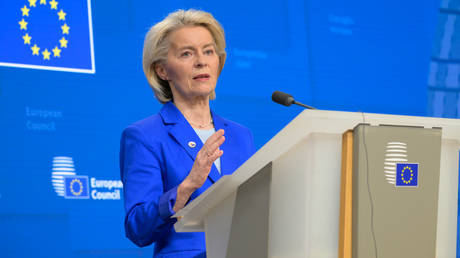
The loudest voices in European politics are currently obsessed with a ghost. They call it the "democratic deficit." Alice Weidel and the AfD leadership have turned this into a profitable brand of outrage, claiming Ursula von der Leyen sits on a throne of glass, immune to the will of the people. They argue that because you didn't check a box specifically for her name on a ballot, her power is illegitimate.
They are wrong. Dead wrong.
In fact, the system that produced Von der Leyen is more surgically precise and representative of complex modern interests than the blunt instrument of a national general election. The "democracy" the AfD pines for is a 19th-century relic that can’t handle a 21st-century economy.
The Myth of the Direct Mandate
We need to stop pretending that checking a box for a local representative gives you "control" over a national leader. In a standard parliamentary system, you vote for a party or a local figure. That figure then disappears into a smoke-filled room to horse-trade with other parties to form a coalition. You didn't vote for the coalition. You didn't vote for the specific compromise on the tax code that happens three years later.
The European Commission President is the result of an even more rigorous filtering process. To get that job, you have to survive the European Council—heads of state who were actually elected by their people—and then secure a majority in the European Parliament.
It is a double-lock system.
When populists attack "unelected bureaucrats," they are actually attacking the concept of Indirect Representation. If Von der Leyen is "immune to democracy," then every cabinet minister in every European capital is also immune. You didn't vote for the German Finance Minister. You didn't vote for the French Foreign Minister. The grievance isn't about democracy; it's about the fact that the populist right lost the negotiation.
Efficiency is the New Legitimacy
The world doesn't move at the speed of a town hall meeting anymore. While critics whine about the "Brussels bubble," that bubble is what prevented the total collapse of the European energy market in 2022.
Imagine a scenario where every major regulatory decision on semiconductor supply chains or carbon border adjustments had to be put to a plebiscite across 27 nations. We would still be debating the 2008 financial crisis today.
True legitimacy in a globalized world comes from competence and consensus, not just the raw heat of a 51% majority. The Commission acts as a technocratic heat sink. It absorbs the friction between 27 competing national interests. If the Commission were "directly elected," it would become a partisan circus. You’d have a President running on a platform of "Italy First" or "Poland First," making the entire Union's executive branch a hostage to the largest voting blocs.
By being a product of negotiation rather than a popularity contest, the Commission President is forced to be a centrist. That isn't a bug; it's the core feature that keeps the Eurozone from flying apart.
The AfD’s Logical Trap
Let’s look at the "battle scars" of those who tried to "democratize" complex systems too quickly. Look at the UK post-2016. They traded the "undemocratic" influence of Brussels for the "sovereignty" of Westminster. The result? A decade of legislative paralysis, lower GDP growth, and a realization that "sovereignty" doesn't fill the shelves when your supply chain is tied to your neighbors anyway.
The AfD claims to want "more democracy," but what they actually want is majoritarianism. There is a vital difference.
- Democracy protects the rights of the minority through institutional checks.
- Majoritarianism is the "two wolves and a lamb voting on what’s for dinner" approach.
Von der Leyen isn't immune to democracy; she is a product of its most sophisticated, multi-layered version. She is accountable to the European Parliament, which can—and has—forced the resignation of entire Commissions in the past. To say she is unaccountable is to ignore the actual history of the Santer Commission in 1999.
The Professional Class vs. The Performance Class
The real divide isn't between "the people" and "the elites." It’s between the Professional Class (those who understand that governing requires complex trade-offs) and the Performance Class (those who use outrage to build a social media following).
Weidel and her cohorts are the ultimate performers. They point at the complexity of the EU and call it "corruption" because complexity is hard to explain in a TikTok clip.
But here is the reality that no one admits: Modern governance is too technical for direct democracy.
Do you want a popular vote on the specific drift-velocity parameters of satellite communication regulations?
Do you want a referendum on the Basel III capital requirements for banks?
Of course not. You want experts.
The European Commission is the world's most powerful collection of experts. The President is the political shepherd for that expertise. The idea that this person should be chosen based on who can give the best stump speech in a rural Bavarian village is a recipe for catastrophe.
Why You Should Stop Worrying and Love the Bureaucracy
We have been conditioned to see "bureaucrat" as a slur. In reality, the European bureaucracy is one of the few things preventing a race to the bottom in environmental standards and labor rights.
The critics argue that the Commission has too much power to initiate legislation. They forget that the Commission is the only body that looks at the Union as a whole. National parliaments are inherently selfish. They are incentivized to dump their problems on their neighbors. The Commission is the only entity with the mandate to say "No" to a German subsidy that would destroy a Spanish industry.
If you "fix" the EU by making it a direct democracy, you destroy that neutral arbiter. You turn Brussels into a bigger, louder version of the partisan gridlock that already ruins national capitals.
The Price of Admission
Is the system perfect? No. The downside of the current model is a lack of emotional connection. People don't feel "European" the way they feel "German" or "French." This lack of identity makes it easy for the Performance Class to paint the Commission as an alien invader.
But the solution isn't to tear down the structure. The solution is to admit that in a world of 8 billion people, a continent of 450 million cannot survive if it's led by the loudest person in the room. It needs to be led by the person who can survive the most grueling, multi-national interview process in history.
The AfD isn't fighting for your vote. They are fighting to dismantle the only institution capable of keeping Europe competitive against the US and China. They want a weak, fragmented Europe because that's the only environment where their brand of small-minded nationalism survives.
Stop asking if Von der Leyen was "elected by the people." Start asking if she’s the most effective shield against the chaos the populists are trying to sell you.
Go back to your local ballots and realize that the person you voted for there is the one who put her in that seat. That’s how a republic works. If you don’t like the result, stop blaming the process and start winning the argument.