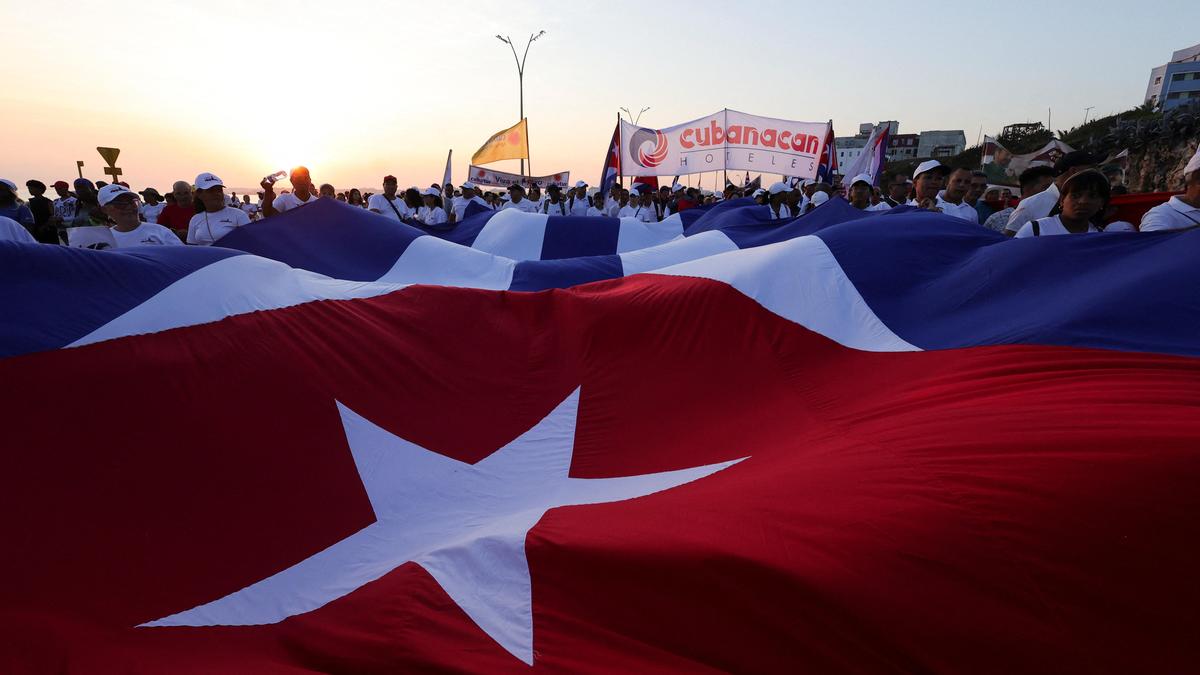
The Chinese Foreign Ministry recently lashed out at the United States for expanding sanctions against Cuba, labeling the measures "illegal" and a violation of international norms. While this rhetoric follows a predictable script of diplomatic condemnation, the underlying reality is far more complex than a simple defense of a Caribbean ally. Beijing is not just protecting a small island nation; it is signaling to the rest of the world that it intends to dismantle the efficacy of the U.S. dollar as a tool of geopolitical coercion.
The United States recently tightened the screws on Havana by targeting entities with links to the Cuban military and intelligence services. Washington argues these measures are necessary to curb human rights abuses and prevent the Cuban government from propping up authoritarian regimes elsewhere in the region. Beijing, however, views these moves as a direct assault on the principle of sovereign trade. By calling these sanctions illegal, China is setting the stage for a broader push to insulate its own economic interests—and those of its partners—from the reach of the U.S. Treasury.
The Geopolitical Chessboard in the Caribbean
Cuba occupies a unique position in the Chinese imagination. For decades, it has served as a symbolic outpost of resistance against American hegemony. But in the 2020s, the relationship has shifted from revolutionary solidarity to cold, hard infrastructure and intelligence cooperation. China sees Cuba as a strategic node. It is a listening post within earshot of Florida and a potential logistics hub for Chinese maritime interests in the Western Hemisphere.
When the U.S. restricts a Cuban entity’s ability to use the global financial system, it creates a ripple effect that hits Chinese companies operating on the island. Chinese telecommunications firms and construction giants have significant footprints in Cuba. These companies often rely on complex supply chains that can be disrupted by even a slight expansion of American blacklists. By framing the sanctions as a violation of international law, Beijing is providing a legal and moral shield for its enterprises to continue doing business with Havana, regardless of Washington’s decrees.
The tension highlights a fundamental disagreement over the "rules-based order." To the United States, the rules include the right to restrict trade with actors that undermine global stability or democratic values. To China, the only rules that matter are those that protect the sanctity of borders and the right of any nation to trade with whoever it chooses. This is a clash of philosophies that will define the next decade of international relations.
Weaponizing the Dollar and the Rise of Alternatives
The core of the dispute lies in the dominance of the U.S. dollar. Most international trade is settled in greenbacks, which gives the U.S. government the power to track and block transactions involving sanctioned parties. This "exorbitant privilege" has long been a thorn in Beijing's side. Every time a new sanction is leveled against Cuba, it serves as a reminder to the Chinese leadership that their own economy remains vulnerable to the same mechanisms.
The CIPS Factor
China has been quietly building the Cross-Border Interbank Payment System (CIPS) as a direct competitor to SWIFT. While CIPS is still small compared to its Western counterpart, every round of U.S. sanctions gives other nations an incentive to join the Chinese network. Cuba, under the weight of the embargo, is the perfect testing ground for these alternative financial rails.
We are seeing a shift where trade between China and Cuba—and other sanctioned nations like Iran or Russia—is increasingly conducted in yuan. This bypasses the American banking system entirely. It is a slow, methodical decoupling. It is not about a sudden collapse of the dollar, but rather a gradual erosion of its monopoly. Beijing’s defense of Cuba is a public relations campaign for a world where the U.S. Treasury no longer holds the master key to global commerce.
The Risk of Overreach
There is a danger for Washington in this approach. If sanctions are applied too broadly or too frequently, they lose their potency. Sanctions work best when they are targeted and supported by a broad coalition. When the U.S. acts unilaterally against a country like Cuba, it alienates allies and pushes non-aligned nations closer to China’s orbit.
Many countries in the Global South watch these developments with a mix of anxiety and pragmatism. They do not necessarily support the Cuban government’s internal policies, but they fear a world where their own economic lifeblood can be cut off at the whim of a politician in D.C. Beijing plays on these fears. Their diplomats use the word "illegal" specifically to resonate with leaders in Africa, Southeast Asia, and Latin America who feel similarly squeezed by American financial power.
Economic Survival in Havana
For the people on the ground in Havana, the war of words between superpowers feels distant but the economic impact is visceral. The Cuban economy is in its worst state in thirty years. Fuel shortages, rolling blackouts, and a lack of basic medicines have pushed the country to the brink. While the Cuban government blames the "blockade" for every failure, the reality is a mix of American pressure and internal mismanagement.
China’s support is a lifeline, but it is not a blank check. Beijing is a pragmatic lender. They have seen what happens when they pour money into unstable regimes—look at the debt crises in Venezuela or Sri Lanka. Consequently, Chinese investment in Cuba is increasingly focused on projects that offer clear strategic returns or long-term resource security. They are helping Cuba modernize its power grid and telecommunications, but they are doing so with an eye on the contracts that favor Chinese state-owned enterprises.
The U.S. sanctions are designed to make it as difficult as possible for the Cuban military to profit from the island’s economy. Since the military controls large swaths of the tourism and retail sectors, this hits the heart of the government’s revenue streams. By stepping in, China is effectively underwriting the survival of the current Cuban administration. This isn't just about trade; it's about ensuring that a key ideological ally doesn't collapse under the weight of American pressure.
Sovereignty as a Shield
The word "sovereignty" is the most powerful weapon in China’s diplomatic arsenal. By framing the U.S. sanctions as an attack on Cuban sovereignty, Beijing is setting a precedent. If the world accepts that the U.S. can dictate who Cuba trades with, then the world must accept that the U.S. can dictate who China trades with.
This is the "why" that the competitor's article missed. This isn't just a news bite about a diplomatic spat. It is a fundamental disagreement over who gets to define the boundaries of global power. The U.S. sees itself as the world’s policeman, using financial tools to enforce a moral and political standard. China sees itself as the champion of a multipolar world where no single power can tell another how to run its internal affairs or its trade ledger.
The Fragmented Future of Trade
We are moving toward a bifurcated global economy. On one side, a Western-led bloc using the dollar and values-based trade restrictions. On the other, a Chinese-led bloc emphasizing non-interference and alternative currencies. Cuba is a microcosm of this split.
The American strategy of "maximum pressure" assumes that enough economic pain will eventually force a change in behavior or a change in government. But this strategy fails to account for a powerful third party willing to mitigate that pain. Every Chinese ship that docks in Mariel harbor and every yuan-denominated credit line extended to Havana makes the U.S. sanctions less effective.
Beyond the Rhetoric
When the Chinese spokesperson stands at the podium and denounces the "illegal" actions of the United States, they are speaking to several audiences at once. They are reassuring the Cuban leadership of their continued support. They are warning the U.S. that its financial dominance is being challenged. And most importantly, they are auditioning for the role of the new leader of the Global South—a leader that promises trade without lectures and commerce without conditions.
The U.S. expansion of sanctions may achieve its short-term goal of punishing the Cuban government, but the long-term cost is a world that is rapidly learning how to live without the American financial system. This isn't a theory; it is a visible shift in the flow of capital and the language of diplomacy. The Caribbean is no longer an American lake, and the dollar is no longer the only game in town.
The conflict over Cuba is a preview of the coming decades. It is a world where "legal" and "illegal" are defined not by international consensus, but by which superpower’s bank you happen to be using. Washington must decide if the price of isolating a small island is worth the cost of accelerating the rise of a parallel global economy that it cannot control.