The air above the Potomac didn't just vibrate; it screamed. It is a specific kind of sound, the rhythmic, bone-deep thrum of a military-grade rotor cutting through the humid haze of a Washington afternoon. Inside the cabin of the Black Hawk, the world looks different. The monuments of power—the white marble, the sprawling Pentagon, the geometric precision of the capital—shrink into a miniature playboard.
For most, a ride in a vertical-lift bird of the United States military is a somber affair. It is a taxi to a theater of war, a medical evacuation platform, or a strictly regulated transport for the architects of national security. But on this particular day, the passenger list read like a collision between the high-stakes world of defense and the grit of a Detroit dive bar.
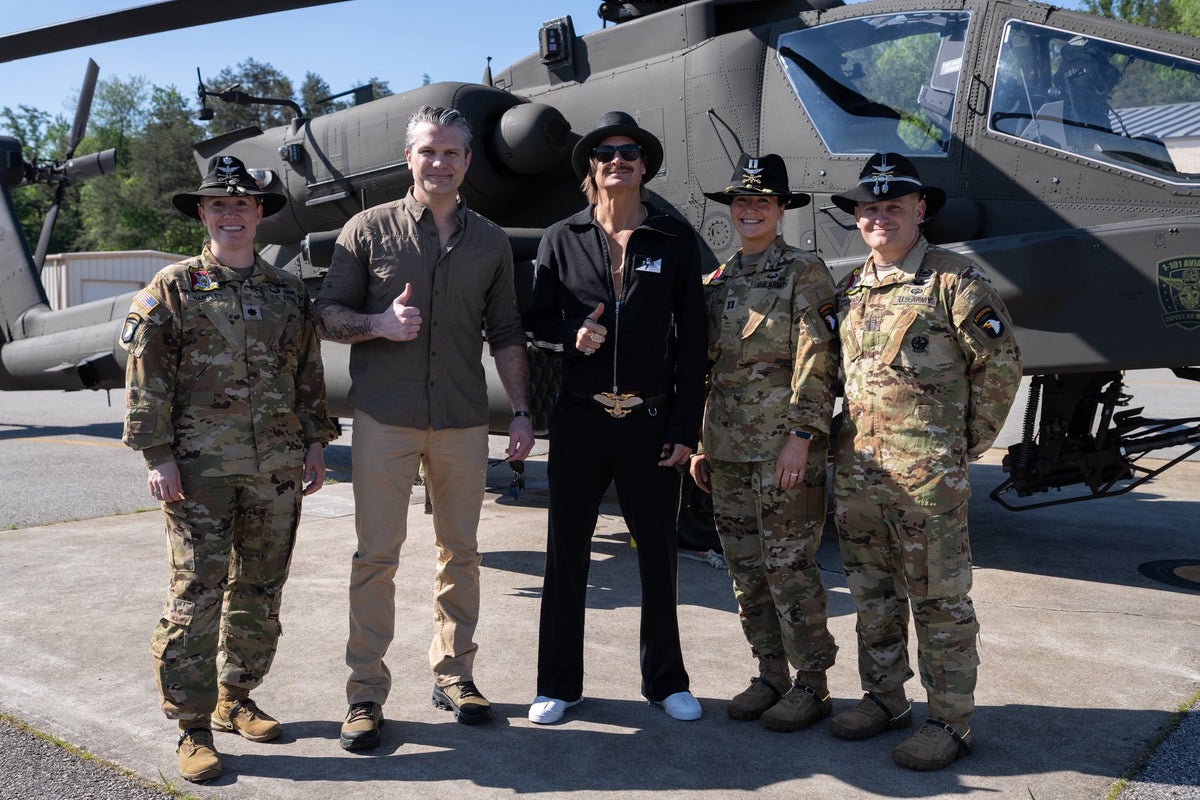
Pete Hegseth, the man currently holding the keys to the world’s most formidable military machine, sat alongside Robert Ritchie. You know him as Kid Rock.
The Sound of Two Worlds Colliding
The optics were loud. Loud as a guitar solo in an empty cathedral.
Here was the Secretary of Defense, a man responsible for millions of uniformed lives and a budget that dwarfs the GDP of entire nations, hosting a rock star on what many critics quickly labeled a "joyride." The optics weren't just about a flight; they were about the brand of a new American era. Hegseth, a combat veteran himself, didn't see a PR nightmare or a breach of protocol. He saw a peer. He saw, in his own words, a "patriot."
To understand why this matters, you have to look past the aviator sunglasses and the camouflage. This wasn't just a celebrity getting a perk. It was a signal fire. For decades, the Pentagon has operated on a diet of buttoned-up professionalism and sterile briefings. There was a wall—thick, grey, and reinforced—between the grit of popular culture and the machinery of the State.
That wall just took a direct hit from a Detroit cowboy.
The Cost of the Flight Path
Critics immediately began tallying the receipts. Every hour a Black Hawk stays in the sky costs the American taxpayer thousands of dollars in fuel, maintenance, and crew hours. When that flight is used to ferry a multi-platinum recording artist over the skyline, the math starts to feel personal to the person working a double shift to pay their heating bill.
Consider the hypothetical mechanic. Let’s call him Miller. Miller spends his nights under the belly of these machines, torque-wrenching bolts until his knuckles bleed, ensuring that when a soldier needs a lift out of a hot zone, the engines don’t fail. To Miller, the helicopter is a tool of survival. When it becomes a stage for a high-altitude hang-out, the tool changes shape. It becomes a symbol of access.
It raises a question that has haunted the halls of the Pentagon for a century: Who owns the prestige of the uniform?
Is it the public that funds it? Is it the soldiers who wear it? Or is it the leadership who uses it to define the culture of the country? Hegseth’s decision to bring Kid Rock into that inner sanctum suggests he believes the military’s soul is tied more closely to the "American Badass" ethos than to the dry regulations of the past.
A Patriotism Defined by Proximity
The word "patriot" is a heavy one. It’s been used to justify revolutions and to silence dissent. When Hegseth applied it to Kid Rock, he wasn't just giving a compliment. He was drawing a line in the sand.
Kid Rock has built a career on a specific brand of American rebellion—a mix of blue-collar pride, rock-and-roll excess, and an unfiltered political stance that has made him a hero to some and a pariah to others. By putting him in that seat, Hegseth was validating that specific brand of identity as the "correct" version of American loyalty.
Imagine the young lieutenant watching this play out on social media. This officer has been trained to keep their politics out of the cockpit. They have been told that the military is a neutral instrument of national will. Then, they see the highest levels of leadership using military assets to bridge the gap with partisan cultural icons. The neutrality doesn't just flicker; it fades.
The tension here isn't just about the flight. It’s about the shift from a military that serves the state to a military that mirrors a movement.
The Invisible Stakes of the Joyride
There is a psychological weight to military hardware. When a B-52 flies over a football stadium, the roar is meant to inspire awe and a sense of shared protection. But that awe relies on a certain level of sacredness. If the hardware becomes a backdrop for celebrity content, the "sacred" starts to look like "scenery."
Hegseth’s defenders argue that this is exactly what the military needs—a shot of adrenaline and a connection to the people who actually fight the wars. They see a Secretary who isn't afraid to break the mold and a celebrity who genuinely loves his country. They see a bridge being built where there used to be a chasm.
But bridges work both ways.
While the flight was happening, the world didn't stop turning. Somewhere, a drone was being monitored. Somewhere, a carrier group was navigating the South China Sea. The Pentagon is a place of infinite gravity. When you introduce the levity of a "joyride," you risk changing the gravitational pull of the entire institution.
The View from the Ground
As the helicopter eventually touched down and the rotors slowed to a whine, the images were already hitting the internet. The smile on Kid Rock’s face was genuine. The pride in Hegseth’s stance was unmistakable. They had shared an experience that few humans will ever know—the feeling of being suspended above the center of the world by sheer mechanical might.
But as the dust settled on the landing pad, the reality of the ground remained.
The military remains an organization facing recruitment crises, aging infrastructure, and a world that feels increasingly like a tinderbox. A single flight with a rock star won't fix those problems. It won't buy a single spare part or settle a single geopolitical dispute.
What it does is change the conversation. It forces us to look at the Pentagon not as a faceless building of stone and secrets, but as a place where personal loyalties and cultural wars are now being fought in the open.
The flight is over. The fuel is burned. The photos are liked and shared a million times over. But the vibration in the air remains—a low, humming reminder that the line between commander and campaigner has never been thinner.
The Black Hawk is back in the hangar. The silence that follows is louder than the engines ever were. It is the silence of a transition, the quiet space where an old way of doing things dies, and something much louder, much rowdier, and much more uncertain takes its place.
Washington watched the sky that day, but the real story was written in the shadows cast on the ground. When the powerful and the famous take to the air together, the rest of us are left looking up, wondering if we’re still on the same map.
The rotors stop. The door opens. The world waits to see who steps out next.