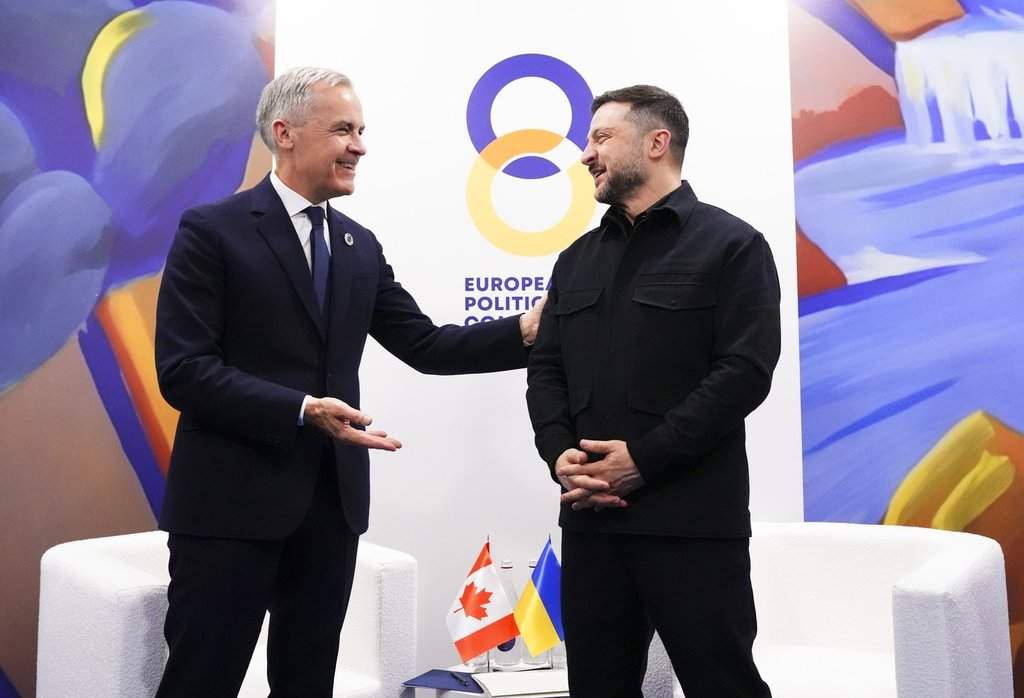
The headlines are predictable. They read like a press release from a mid-tier defense contractor. Zelenskyy announces a "drone deal" with Canada. The public nods. The pundits talk about solidarity. The stock prices of specialized aerospace firms tick upward by a fraction of a percent.
Everyone is missing the point. Meanwhile, you can find similar events here: The Balkan Buffer Structural Decay and the Marginalization of the High Representative.
While the media focuses on the optics of bilateral cooperation, they are ignoring the cold, hard physics of modern attrition. Buying drones from a G7 country at boutique prices is not how you win a high-intensity conflict in 2026. It is how you balance a budget and keep diplomats happy.
If we want to discuss the reality of the front line, we need to stop pretending that high-cost, slow-moving procurement cycles from the West can compete with the hyper-iterative, garage-built reality of the Donbas. To see the bigger picture, check out the excellent report by NPR.
The Boutique Drone Fallacy
Western defense procurement is built on a "Gold-Plated" philosophy. We want drones that are hardened against every possible interference, capable of flying in a hurricane, and built to last ten years. That is a death sentence in a theater where the average lifespan of a small UAV (Unmanned Aerial Vehicle) is measured in hours, not months.
The "drone deal" with Canada likely focuses on sophisticated platforms. Think Teledyne FLIR or similar high-end manufacturers. These are incredible pieces of engineering. They also cost $50,000 to $100,000 per unit.
When a $500 hobbyist drone carrying a 3D-printed drop mechanism can disable a multi-million dollar tank, the math of the "official deal" falls apart. Ukraine doesn't need 500 perfect drones. It needs 50,000 "good enough" drones. Canada’s manufacturing base, hampered by high labor costs and rigid regulatory frameworks, is fundamentally incapable of providing the volume required for a war of this scale.
The Logistics of Failure
Let’s look at the supply chain. A drone deal signed in Ottawa has to go through:
- Export permit reviews.
- Treasury Board approvals.
- Environmental impact assessments of the manufacturing plant.
- Shipping logistics across the Atlantic.
By the time a Canadian-made drone reaches a pilot in a trench near Bakhmut, the electronic warfare (EW) frequencies it was programmed to bypass have already changed six times. The Russian military adapts its jamming signatures weekly. Western defense contractors, with their three-year development cycles and rigid hardware configurations, are bringing a metaphorical knife to a laser fight.
I have seen military industrial complexes burn through billions trying to "standardize" tech that is inherently ephemeral. You cannot standardize a revolution.
Ukraine Is the Teacher Not the Student
The most insulting part of these high-level "deals" is the underlying assumption that the West is providing the expertise. The reality is the exact opposite.
Ukraine currently operates the most advanced drone ecosystem on the planet. It is decentralized. It is rapid. It is brutal. They are using AI-driven terminal guidance to bypass EW jamming—tech developed in basements in Kyiv, not in labs in Toronto.
When Canada "partners" with Ukraine on drones, they aren't helping Ukraine catch up. They are trying to buy a front-row seat to the only real-world testing ground that matters. The deal isn't about saving Ukraine; it's about saving the Canadian defense industry from obsolescence.
The Cost of Compliance
We need to talk about the "Compliance Tax." Every time a Western government gets involved in a military tech deal, the price doubles and the speed halves.
Imagine a scenario where a Ukrainian startup needs a specific chip for a thermal sensor. In the current "black market" or "gray market" of rapid procurement, they buy it from a distributor in Shenzhen or through a front company in Poland and have it on a workbench in 48 hours.
Under an official "drone deal," that same chip must be sourced from a "trusted supplier." It needs a certificate of origin. It needs to be audited. The paperwork alone costs more than the drone. This is the friction that kills soldiers.
The False Promise of Sovereign Tech
The "lazy consensus" among journalists is that sovereign production in Canada is a security win for Ukraine. It isn't. It's a bottleneck.
Real innovation in this space is happening in the "unregulated" zones. The most effective drones in the world right now are FPV (First Person View) racing drones modified with RPG-7 warheads. They are cheap. They are disposable. They are terrifyingly effective.
Does the Canada deal include these? No. It includes "surveillance platforms" and "tactical reconnaissance" units. These are the tools of a 20th-century army trying to look busy in a 21st-century war.
What a Real Deal Would Look Like
If Canada actually wanted to change the trajectory of the war, they wouldn't be building drones in Ontario. They would be:
- Abolishing Export Controls: Allowing direct, unregulated transfer of dual-use components (motors, ESCs, flight controllers) to Ukrainian NGOs.
- Funding Component Factories in Poland: Moving the assembly as close to the border as possible to eliminate the 8,000-mile supply chain.
- Legalizing "Grey Zone" Hacking: Providing sovereign immunity for Canadian developers to contribute to Ukraine's open-source battle management software.
But they won't do that. It’s too messy. It doesn’t look good in a photo op. A "drone deal" involving shipping crates and ribbons is much easier to sell to a domestic audience that wants to feel helpful without actually understanding the carnage.
The Efficiency Trap
Economists love to talk about comparative advantage. Canada’s advantage is not mass-producing cheap electronics. China owns that. Ukraine’s advantage is rapid battlefield integration.
By forcing Ukraine to integrate Canadian hardware into their existing workflows, we are essentially asking them to slow down to our level. We are imposing our bureaucracy on their survival instinct.
I’ve seen this before in the corporate world. A lean, hungry startup gets "acquired" by a giant conglomerate. The giant promises "resources" and "scale." Instead, the startup gets buried in HR meetings and legal reviews. Within a year, the product is dead.
Ukraine is the startup. The Western defense establishment is the conglomerate.
Stop Applauding the Press Releases
We have to stop treating these bilateral agreements as "turning points." They are maintenance. They are the bare minimum required to keep the status quo.
The real war is being won by the kid in a hoodie who just figured out how to hop a frequency range using a $10 software-defined radio. He doesn't care about the drone deal with Canada. He doesn't even know it exists. He’s too busy making sure his drone doesn't fall out of the sky because of a Russian jammer that was deployed two hours ago.
Every dollar spent on a high-end Canadian drone is a dollar not spent on 100 FPV kits that could actually hold a treeline. We are trading volume for vanity.
If we don't fix the procurement model, we aren't sending help. We’re sending scrap metal.
Don't look at the handshake. Look at the unit cost. If the unit cost is higher than a used car, the deal is a failure. Warfare is now a commodity business, and the West is still trying to sell luxury goods.